Wellness with osteoporosis: what is safe, what to avoid, and what helps bone
The industry's reflex is that gentle is safe. For a spine with low bone density the real hazard is a loaded forward fold in a gentle-looking class, and the thing that actually helps bone looks anything but gentle.
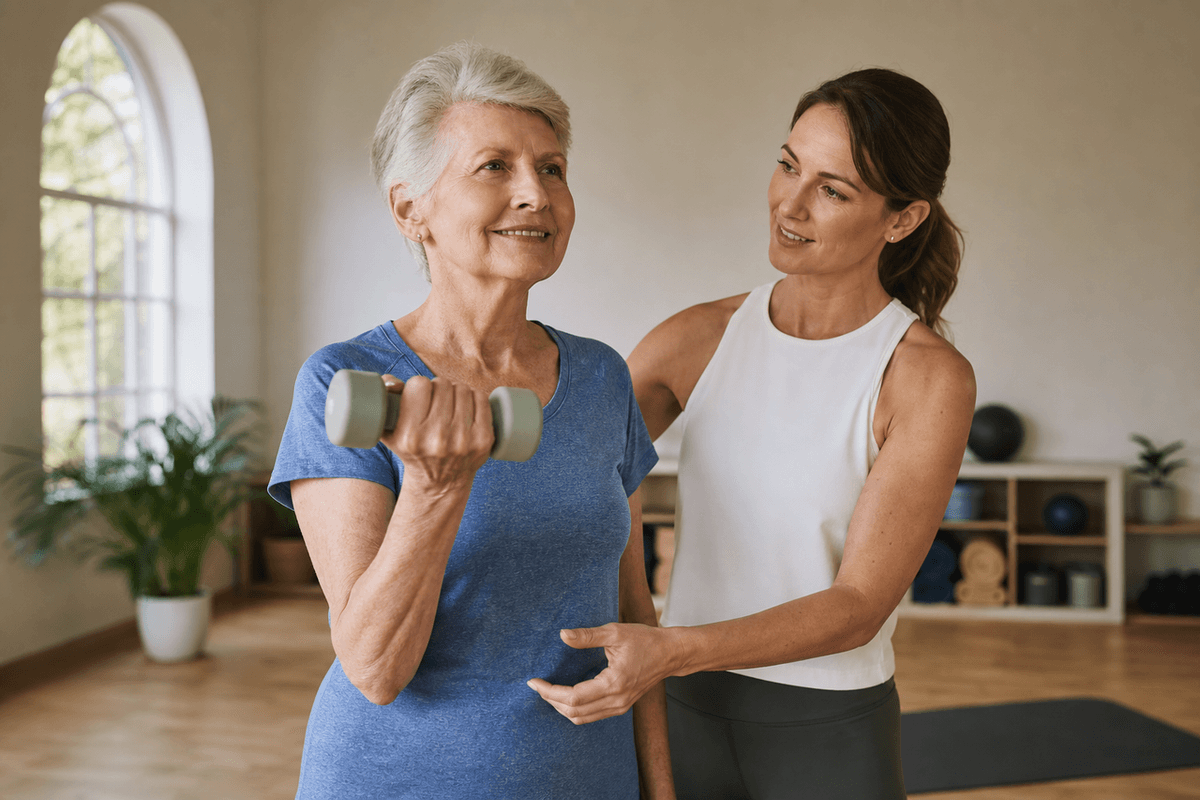
The honest verdict first: osteoporosis is not a reason to stop moving. It is a reason to be specific about how. The line that matters is not gentle versus vigorous, it is whether a movement bends the spine forward under load or at speed, because that is what can fracture a vertebra with low bone density, and it happens in gentle-looking classes.
The thing that actually helps bone is the opposite of gentle: progressive resistance and impact training, done under supervision. Balance work matters as much, because the injury that changes lives is usually a fall. Deep pressure massage and assisted stretching need adjusting, heat is fine, and the medical side belongs to your care team.
This is general information, not medical advice. What your scan showed, how high your fracture risk is and what to do about it are questions for the people who ordered the scan.
What osteoporosis and osteopenia are
Numbers on a scan, and what they mean for a fall.
Bone is living tissue that is constantly broken down and rebuilt, and osteoporosis is the state where the rebuilding has fallen behind for long enough that bone is less dense and breaks more easily. It is measured on a bone density scan, most often of the hip and spine.
Osteopenia is the band between normal and osteoporosis: lower density than expected, not yet at the threshold. It is not a disease so much as a flag. What matters for both is fracture risk, which depends on the scan, your age, past fractures, medication and other factors your clinician weighs together.
Many people find out after a fracture from a fall that should not have broken anything, or through screening after menopause. Our guide to menopause and wellness covers why bone density falls faster in those years.
The spinal flexion problem
The movement that breaks vertebrae, and it hides in gentle classes.
The vertebrae are stacked blocks of the type of bone that thins first in osteoporosis. Bending forward, especially with weight in the hands, a rounded back or momentum, compresses the front of those blocks, and in a spine with low density that can crush the front edge of a vertebra. That is a compression fracture, and it can happen without a fall.
The evidence that yoga can do this is a case series from the Mayo Clinic, Sinaki in Pain Practice in 2013, describing people with osteopenia or osteoporosis who developed vertebral compression fractures after yoga poses involving spinal flexion. A case series shows the hazard is real, not how common it is, and that is the right way to hold it: not a reason to avoid yoga, a reason to change which shapes you make in it.
In class terms, the moves to be careful with are deep seated and standing forward folds, sit-ups and crunches, toe-touches, deep twists under load, and any position a teacher or therapist pushes you further into. The safer version of most of them is to hinge at the hips with a long spine rather than round through the back, and a good teacher knows how to give you that shape. Tell them before class, every time, and ask specifically about forward bends and twists. Our guide to yoga styles and our reformer versus mat comparison both flag the same point, and Pilates has its own crunch-shaped exercises that need the same treatment.
What actually helps bone, and why gentle is not it
Load, done properly, is the medicine.
Bone responds to force. It thickens where it is loaded and thins where it is not, which is why the useful exercise for osteoporosis is resistance training that gets progressively heavier and impact that sends a jolt through the skeleton. That sounds like the last thing a fragile skeleton should do, and the trial evidence says otherwise when it is supervised.
Watson and colleagues in the Journal of Bone and Mineral Research in 2018 ran the LIFTMOR randomized trial, in which supervised high-intensity resistance and impact training improved bone density and physical function in postmenopausal women with low bone mass, with no injuries under supervision. The wider picture is more modest: Howe and colleagues in the Cochrane Database of Systematic Reviews in 2011 found that exercise has a small but real effect on bone density in postmenopausal women, with combined programs doing best.
The expert consensus, Giangregorio and colleagues in Osteoporosis International in 2014, the Too Fit To Fracture recommendations, puts it together: a multicomponent program of resistance, balance and posture training, and avoiding rapid, repetitive or loaded spinal flexion. The word supervised is doing real work in all of this. What the program looks like for your bones is a physiotherapist’s or exercise physiologist’s job, and we are not handing out a lifting plan for a skeleton nobody here has scanned.
Balance, falls and the injury that matters
Most osteoporotic fractures start with a fall, so not falling is the goal.
A hip fracture is the outcome everyone is trying to prevent, and it almost always follows a fall. That makes balance training a bone treatment in effect, even though it does nothing to density. Sherrington and colleagues in the Cochrane Database of Systematic Reviews in 2019 found that exercise reduces the rate of falls in older people living at home, with balance and functional training, and tai chi, doing the most.
Tai chi is the class that fits this best: slow, upright, weight-shifting, no forward folds under load, and a well-evidenced effect on balance. Our tai chi and qigong explainer covers what to expect, and our guide for older adults starting safely covers the standing-up-slowly and wet-floor points that apply to everyone later in life and more to you.
Massage, Thai stretching and massage chairs
Pressure and leverage are the two words to think about.
Massage is fine with osteoporosis, and the adjustment is pressure. Deep, sustained pressure directly over the spine, ribs or a hip with low bone density carries a fracture risk that the same pressure on healthy bone does not, which is why our guide to deep tissue and sports massage lists it as a reason to speak up. Moderate pressure on muscle, off the bone, is the ask.
Leverage is the second word. Thai massage and other assisted-stretching styles use the therapist’s body weight to move you into positions, including forward folds and twists, and that is exactly the loaded flexion above with someone else applying the load. Tell them, and expect a much gentler session, or choose a style that does not rely on it. Our types of massage guide covers which styles use which techniques.
Massage chairs apply firm mechanical pressure along the spine that you cannot fine-tune the way a therapist can, which is why our read on whether a massage chair is worth it puts osteoporosis on the ask-first list. Ribs are the usual worry.
Saunas, hot yoga and pools
Heat is fine. Dizziness and wet floors are the risk.
Heat does nothing to bone either way, and a sauna, a hot spring or a warm pool is a reasonable thing to enjoy. The hazard around them is a fall: standing up quickly from heat, a wet tiled floor, a plunge tub with a high step, a hot yoga room where dizziness arrives before you expect it. Move slowly, use the rails, and treat the changing room floor as the most dangerous part of the visit.
Moving in a warm pool takes load off joints, which makes it a comfortable place to work on range and fitness. It does not load bone, so it complements the resistance work rather than replacing it.
Osteoporosis and wellness at a glance
| Practice | Fine as is | Needs adjusting | Avoid |
|---|---|---|---|
| Yoga | Standing, balance and hip-hinge shapes | Forward folds, twists, any pose you are pushed into | Loaded or fast spinal flexion |
| Pilates | Control and posture work with an informed instructor | Crunch-shaped exercises | Loaded flexion on the reformer |
| Tai chi | Almost all of it | Nothing specific | Nothing specific |
| Resistance and impact training | The treatment, under supervision | Progression, which is the supervisor’s job | Going it alone with a heavy bar |
| Massage | Moderate pressure on muscle | Pressure over spine, ribs and hips | Deep sustained pressure on bone |
| Thai and assisted stretching | A gentle session with an informed therapist | Every stretch that folds or twists you | Being levered into a fold |
| Massage chairs | Ask first | Intensity, if you use one | Firm spinal programs |
| Sauna, hot springs, pools | The heat and the water | Getting in and out, standing up | Rushing on wet floors |
What is oversold
Bone “regeneration” from a bottle or a device, and the myth that gentle is always safe.
Supplements and devices sold as rebuilding bone are the obvious pitch, and none of them has anything like the trial evidence that supervised loading has. Whole-body vibration is the gadget marketed hardest for bone, and our read on whether vibration plates actually work does not settle it, so ask your clinician before standing on one. Whether you need calcium, vitamin D or medication is a question for your care team, not a shelf. Our guide to spotting a nonsense wellness claim is the filter.
The subtler one is “gentle yoga is safe for everyone”. The Mayo case series describes people doing yoga, not a contact sport. Gentle describes effort. The hazard is direction and load, and a class can be both gentle and wrong for your spine.
What belongs to your care team
The scan, the risk, the medication and the program.
The scan and how often to repeat it, your overall fracture risk, and whether medication is warranted are decisions for your doctor, and we take no position on any of them. The exercise program itself, the loads, the progression and the technique that keeps your spine long under them, belongs with a physiotherapist or exercise physiologist who works with osteoporosis. The trials that showed benefit were supervised, and that is the version to copy.
See a doctor promptly for sudden back pain, especially after bending or lifting something ordinary, for a loss of height or a new stoop, and for pain after a minor fall. Any of those can be a fracture you did not feel happen. Our guide to which bodywork suits which complaint covers getting assessed before booking, and our credential-checking guide covers vetting whoever you see. We only recommend what we would send a friend to, and here that means someone who asks about your scan before they touch your back.
FAQ
Is yoga safe with osteoporosis? Yes, with the forward folds, crunches and loaded twists modified and a teacher who has been told. The Mayo Clinic case series linked spinal flexion poses to vertebral fractures, so direction and load are what to watch, not how gentle the class looks.
Can I have a deep tissue massage with osteoporosis? Moderate pressure on muscle is fine. Deep sustained pressure over the spine, ribs or hips carries a fracture risk on low-density bone, so say what your scan showed and ask for the pressure to stay off the bone.
Does walking help osteoporosis? It helps fitness and balance, and it loads bone only lightly. The trial evidence for improving density comes from supervised resistance and impact training, which is a different thing from a daily walk.
Is a sauna or hot tub safe with osteoporosis? The heat is fine. The risk is falling on a wet floor or standing up dizzy, so take the getting in and out slowly and use the rails.
What is the difference between osteopenia and osteoporosis? Both describe bone density below what is expected on a scan. Osteopenia is the milder band, osteoporosis the threshold beyond it, and what matters for either is your overall fracture risk, which your clinician calculates from more than the scan.
The bottom line on osteoporosis
Osteoporosis changes how you move, not whether. The hazard in a studio is loaded or fast forward bending of the spine, which can fracture a vertebra in a gentle-looking class, and the fix is hinging at the hips, modifying folds, crunches and twists, and telling every teacher and therapist before they start.
What helps bone is progressive resistance and impact training under supervision, with balance work to prevent the fall that does the real damage. Massage is fine at moderate pressure off the bone, assisted stretching needs a gentler hand, heat is fine, and wet floors are the thing to respect.
The scan, the risk, any medication and the program itself belong to your care team, and sudden back pain, a loss of height or pain after a small fall is a reason to see them rather than book.