Do vibration plates actually work? The honest answer
A machine you stand on for ten minutes, sold as a shortcut to fat loss and a workout replacement. There is real research underneath it, and it is about a different population using a different class of machine.
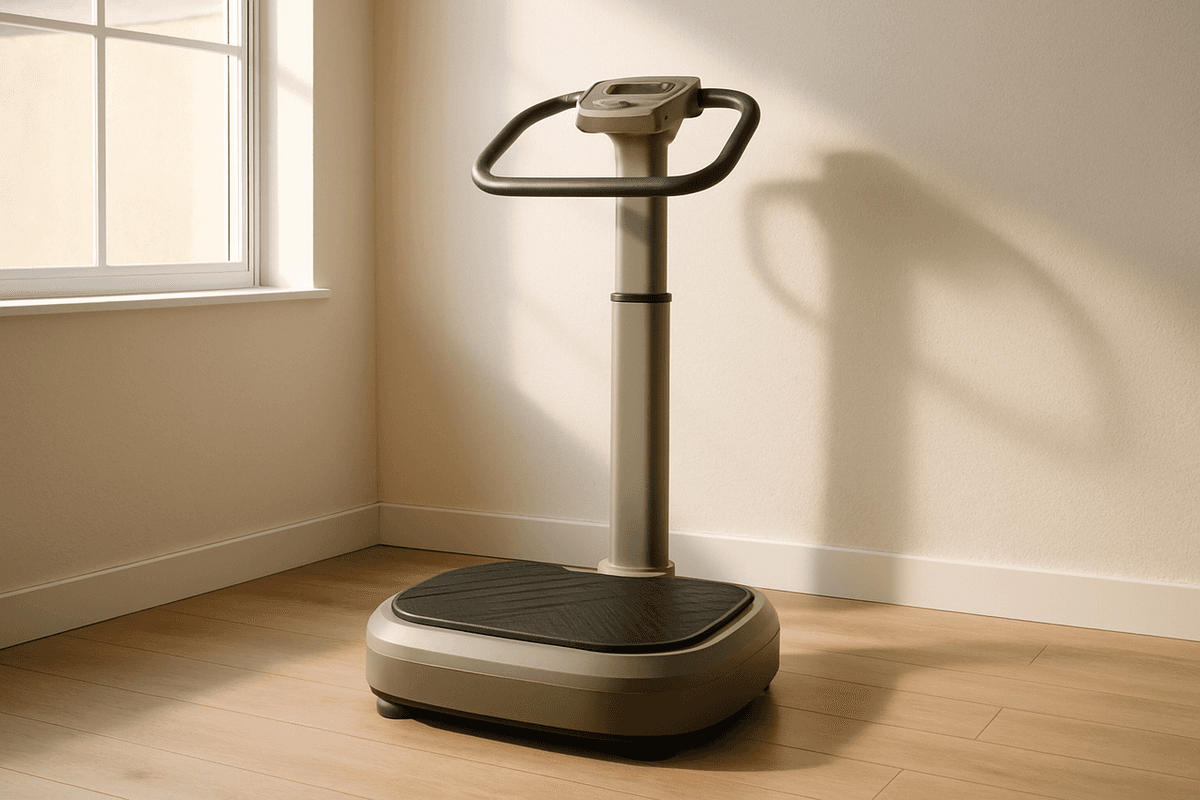
Mostly no, not for the reasons they are sold. A vibration plate will not burn fat, will not replace a workout, and will not deliver the “ten minutes equals an hour at the gym” claim printed on the box. What whole body vibration does have is narrower and more credible: several small trials support improvements in balance, mobility, and lower body function in older adults, and there is mixed but genuine research on bone density in postmenopausal women.
So this is not a scam category. It is a real modality with a modest evidence base stretched to cover claims it cannot carry. The studies were largely done on older or deconditioned people, using supervised protocols, on commercial machines. The marketing is aimed at everyone else, on a $150 plate.
Our own recovery lounge guide grades the vibration station as weak and tells you to skip it. Nothing here changes that verdict for a general fitness audience. It only explains where the narrow exception sits.
What a vibration plate actually does to your body
It shifts the surface under you fast enough that your muscles keep correcting.
A vibration platform oscillates, either up and down or side to side around a central pivot, at tens of cycles per second. Your body is then constantly, involuntarily adjusting to a moving base.
That produces reflexive muscle activity: small, fast contractions you do not consciously initiate. It also produces an acute increase in local circulation, one of the better supported short-term effects in this category.
Both are real. Neither is training. Reflexive low-load contractions are not equivalent to lifting something heavy, and a circulation bump lasts about as long as the session.
Vibration plate claims at a glance
| Claim | What the evidence supports | Verdict |
|---|---|---|
| Balance and mobility in older adults | Several small trials and reviews point this way | Reasonable support, mixed |
| Bone density in postmenopausal women | Studied, results inconsistent across trials | Promising, not settled |
| Increases circulation during a session | Consistent acute effect | Supported, short-lived |
| Short-term flexibility or range of motion | Commonly reported acute effect | Plausible, temporary |
| Reduces muscle soreness | Small and inconsistent findings | Weak |
| Burns fat or causes weight loss | No meaningful support | Not supported |
| ”10 minutes equals an hour at the gym” | Nothing supports the equivalence | Marketing |
| Replaces resistance training | Loads are not comparable | Not supported |
| Reduces cellulite, detoxifies, drains lymph | No credible evidence | Not supported |
Who vibration plates genuinely help
Older adults working on balance, and possibly bone health.
The most defensible use is in older or deconditioned people. Supervised protocols appear to help with balance, lower body strength, and functional mobility. For someone whose main health risk is a fall, that is not a small outcome, and it is why physical therapy clinics own these machines.
Bone density in postmenopausal women is the other interesting thread. Some trials find benefit, others do not, and protocols vary enough that comparing them is difficult. Calling it established oversells it, and dismissing it undersells the research.
If that is you, our guide on starting wellness safely as an older adult is the better first read: supervision and progression matter more here than the machine.
What a vibration plate will not do
Anything involving fat, detox, or replacing your training.
Fat loss is the most marketed claim and the least supported. Standing on a plate does not create an energy deficit worth measuring, and studies pairing vibration with diet or exercise cannot separate the plate from the intervention obviously doing the work.
Cellulite and detox claims are not partially true. They are the standard markers of a product sold past its evidence, and our guide on spotting a nonsense wellness claim covers the pattern.
The equivalence claims have no basis. If you want strength, you need progressive load. If you want cardiovascular fitness, you need sustained effort. A plate delivers neither.
Budget plates versus commercial platforms
Not the same class of machine, and most research used the expensive one.
Commercial platforms in clinics, universities, and some gyms are heavy, motor driven units with verified frequency and amplitude, often costing several thousand dollars. They are the devices behind most of the credible studies.
The consumer plates sold online in the $100 to $400 range are a different product. Frequency and amplitude are often unverified or misstated, and the numbered “levels” on the remote may not correspond to anything measurable.
This is the same gap we described in our PEMF mats guide: real clinical research on one device, consumer hardware several steps removed, and marketing that quotes the research anyway. A budget plate is not a cheap version of the studied intervention. It may not be the intervention.
We have not tested any of these machines, and we only recommend what we would send a friend to. Here that means no product recommendation.
Who should check with a doctor first
More people than you would expect for a machine you just stand on.
Commonly listed reasons to speak with a clinician before using whole body vibration include pregnancy, recent fractures, acute injuries, implanted devices such as pacemakers or joint replacements, retinal problems, severe cardiovascular disease, advanced osteoporosis, a history of blood clots, and epilepsy.
This is not medical advice, and the list is not exhaustive. The point is that vibration transmits through your whole skeleton, including your spine and head, so it is worth a conversation if any of it applies to you. A studio that puts you on a plate without asking a single screening question is worth questioning.
What to do instead, depending on your goal
Match the tool to the outcome you actually want.
If your goal is fat loss, this is the wrong purchase entirely. If your goal is strength or bone health and you are able to train, loaded resistance work has a far stronger evidence base than vibration.
If your goal is soreness or range of motion, cheaper tools do more. Our foam roller versus massage gun comparison covers what those deliver, and do compression boots actually work covers the other big recovery purchase.
If your goal is feeling less inflamed or generally better, our guide on what actually reduces inflammation is more useful than any machine, and building a weekly recovery routine is where the real leverage sits.
FAQ: vibration plates
Do vibration plates help you lose belly fat? No. There is no credible evidence that a vibration plate causes fat loss, in the abdomen or anywhere else. Results in studies combining vibration with diet or exercise are attributable to the diet and exercise.
Is a cheap vibration plate as good as a commercial one? Probably not, and possibly not comparable at all. Most research used commercial platforms with verified frequency and amplitude, while budget units often cannot document either.
How long should a session be? Research protocols typically use short bouts, on the order of several minutes, repeated across a week rather than in long single sessions. Longer is not better.
Is it safe for everyone? No. Pregnancy, recent fractures, implants, retinal conditions, and serious cardiovascular disease are all commonly listed reasons to check with a doctor before starting.
The bottom line on vibration plates
Whole body vibration is a real modality with a narrow evidence base: reasonable support for balance and mobility in older adults, mixed research on bone density in postmenopausal women, and a genuine but short-lived circulation effect. That is the honest ceiling.
Everything past that (fat loss, gym equivalence, detox, cellulite) is marketing running well ahead of the research, and most of that research was not done on the plate you would buy. If you are an older adult working on balance, raise it with a clinician. For everyone else, it stays the station to skip.
To find recovery studios and wellness venues near you, start with our city wellness maps.