What is ear seeding? Auricular acupressure, explained
Tiny gold-coloured beads taped to points on your ear, left for a few days, pressed when you want an effect. It has spread from acupuncture clinics to nail salons and TikTok, and the evidence sits in an unusual place.
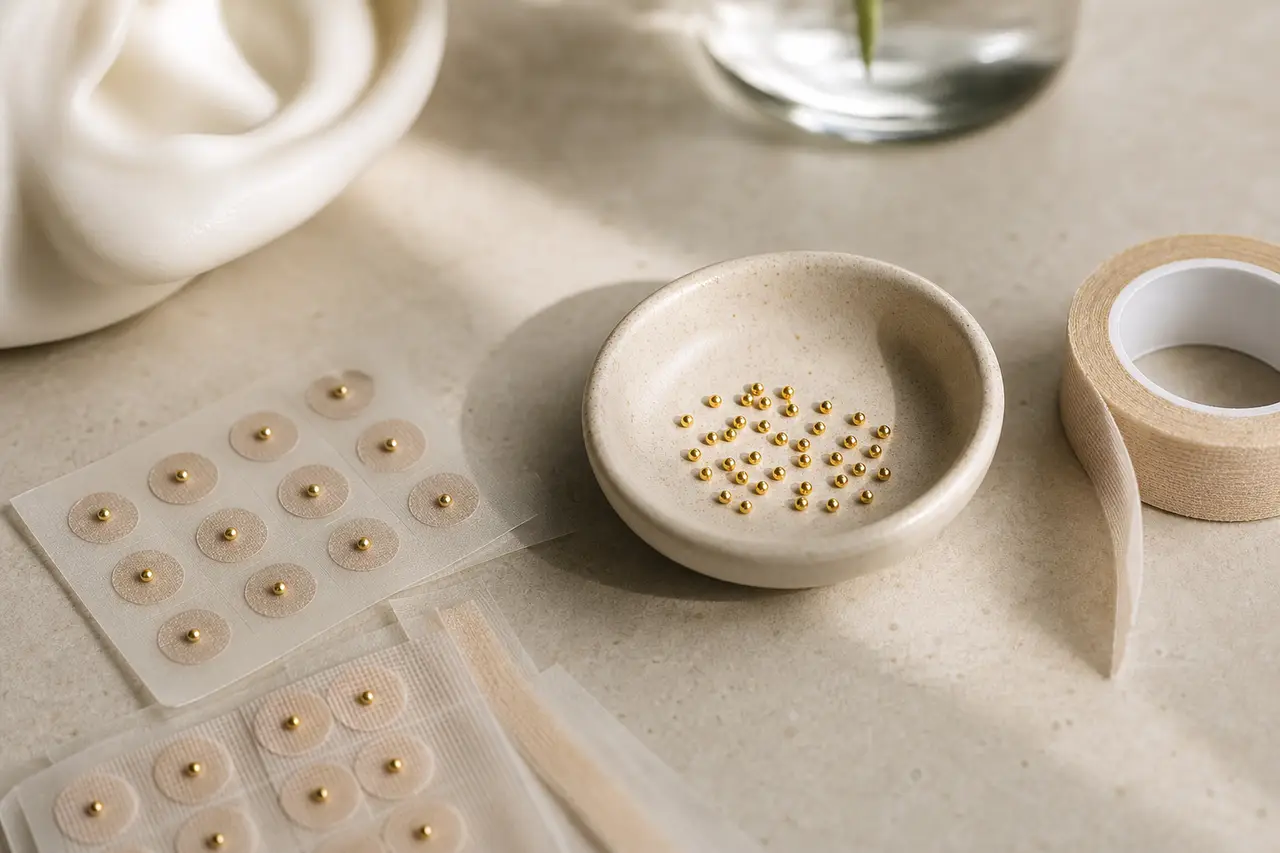
Short answer: Ear seeding is small beads taped to points on the outer ear and pressed for a few seconds several times a day, left on three to five days. No needles, $20 to $60. Meta-analyses in specific conditions like period pain report real benefits; the trials are small and blinding is near-impossible.
Ear seeding is the practice of taping small beads, traditionally vaccaria seeds and now often gold-coloured metal, onto specific points on the outer ear. They stay on for several days, and you press them periodically.
It comes from auricular acupuncture, which maps the ear as a microsystem of the body, and it has escaped that clinical context spectacularly. You can now get ear seeds at nail salons, at wellness pop-ups, and in kits sold online with a diagram.
The evidence sits somewhere more interesting than either the enthusiasts or the sceptics suggest, and the practical risks are small but not zero.
What actually happens with ear seeds?
Beads, tape, and a few days.
A practitioner identifies points on the auricle, cleans the area, and applies each seed on a small adhesive patch. The seeds stay for three to five days, sometimes up to a week, and you press them for a few seconds several times a day or when you want the effect.
There are no needles and it is not painful; the sensation is mild pressure and a slight awareness of something on your ear. Sessions are short, usually 10 to 20 minutes, and cheap compared with acupuncture.
The underlying model, auriculotherapy, maps regions of the ear to organs and body areas. That map is a traditional framework rather than an anatomically demonstrated one, which is worth holding in mind separately from whether the practice produces effects. Our guides on acupuncture and reflexology cover the same tension between a traditional map and measurable outcomes.
What does the evidence show on ear seeding?
Specific conditions, decent signal, hard-to-blind trials.
The research base is unusual because it is not broad wellness studies; it is clustered in fairly specific clinical questions, often in nursing and integrative-oncology literature.
One representative synthesis is Kong and colleagues in Frontiers in Endocrinology in 2023, a systematic review and meta-analysis of auricular acupressure for dysmenorrhea, which reported benefits for pain across the pooled randomised trials. Similar reviews exist for insomnia, chemotherapy-induced nausea, and post-operative pain.
The methodological caveats are substantial and consistent. Blinding is nearly impossible, since you can feel a bead on your ear; sham controls usually place seeds at non-points, which may not be inert; trial sizes are modest; and much of the literature comes from a small number of research groups.
So the honest summary: a real signal in specific conditions, from a literature with structural weaknesses, and nothing like the general “balances your nervous system” claim it is marketed with.
Ear seeding at a glance
| Ear seeding | |
|---|---|
| What it is | Beads taped to auricular points, pressed periodically |
| Needles | None |
| Wear time | 3 to 5 days typically |
| Session length | 10 to 20 minutes |
| Typical cost | $20 to $60, often an add-on |
| Best-studied uses | Dysmenorrhea, insomnia, nausea, post-op pain |
| Evidence quality | Positive signal; blinding near-impossible, small trials |
| Main risks | Skin irritation, adhesive allergy, infection if left too long |
| Hard rule | Never in the ear canal; not for children who may swallow them |
What are the actual risks?
Small, and worth respecting.
Skin irritation and adhesive reactions are the most common issue, particularly if the seeds are left beyond a week or if you have sensitive skin or a nickel allergy. Metal seeds are more likely to cause a reaction than plant seeds.
Infection is uncommon and does happen when seeds are left too long, when the ear is not cleaned first, or when the site is repeatedly pressed with unwashed hands. Auricular cartilage infections are unpleasant and hard to treat, which is the one reason to take hygiene here seriously rather than casually.
Two firm rules. Nothing goes in the ear canal, ever. And they are not appropriate for young children, who may pull them off and swallow them. If you have had ear surgery, have a skin condition on the ear, or have an ear piercing that is still healing, skip it.
Who is applying them, and does it matter?
It matters more for the claims than for the safety.
In a clinical setting this is done by a licensed acupuncturist as an adjunct, often between sessions, and their scope of practice and training is verifiable. Our guide on checking a wellness practitioner’s credentials covers how.
At a nail salon or a pop-up, the person applying them may have done a short course or watched a video. The physical act is simple enough that this is not especially dangerous, and what changes is the quality of the advice attached: hygiene instructions, wear time, and whether anyone tells you to stop if the skin reacts.
The bigger issue with the informal end is claim inflation. Seeds marketed for weight loss, anxiety cures, fertility, or “detox” are running far past anything the literature supports. Our guide on whether sweating detoxes your body covers that pattern of borrowed language.
Is it worth trying?
Low cost, low risk, modest expectations.
If you have one of the better-studied complaints, period pain in particular, and you want a cheap low-risk adjunct to whatever else you are doing, this is a reasonable thing to try. It is inexpensive, non-invasive, and easy to stop.
Judge it the way you would judge anything with a strong expectation effect: try it for a couple of cycles, notice whether anything changes, and be willing to conclude it did nothing. That is a legitimate outcome.
What it should not be is a replacement for treatment of a diagnosed condition, or the thing you spend meaningfully on. Our guides on acupuncture vs massage and which bodywork for which complaint cover the alternatives with more evidence behind them.
How do you look after them?
Clean, dry-ish, and time-limited.
Have your ear cleaned before application, and wash your hands before pressing the seeds. Press for a few seconds at a time rather than grinding at them, which is how skin gets broken.
Take them off at the agreed time, usually within five days and no more than a week, and give the skin a break before the next set. Do not simply leave them until they fall off.
Remove them early and see a doctor if you get redness spreading beyond the seed, swelling, warmth, discharge, or pain in the cartilage rather than the skin.
FAQ: ear seeds
Does ear seeding hurt? No. Mild pressure at most, and application is painless.
Can I get ear seeds wet? They tolerate showering, though they come off faster. Swimming and saunas will loosen them quickly, so time them around a heat session rather than the reverse.
Can I apply ear seeds myself? Kits exist, and the risk is mostly hygiene and leaving them on too long. Clean the ear, wash your hands, and respect the wear time.
Is ear seeding the same as acupuncture? No. Same traditional framework, no needles, and a much smaller intervention. Our acupuncture guide covers the fuller practice.
The bottom line on ear seeding
Ear seeding is beads taped to points on the outer ear and pressed periodically, derived from auricular acupuncture and now sold well outside clinical settings. Meta-analyses in specific conditions such as period pain report real benefits, from a literature where blinding is close to impossible and the trials are small.
Treat it as a cheap, low-risk adjunct with modest expectations rather than a treatment. Keep it hygienic, take them off within about five days, never put anything in the ear canal, and discount any marketing that promises weight loss, detox, or a cure.