Do PEMF mats work? What the evidence actually shows
A mat you lie on that pulses a magnetic field through you, sold for anywhere from a few hundred to fifteen thousand dollars. There is real clinical research here, and it is mostly about a different device treating a different problem.
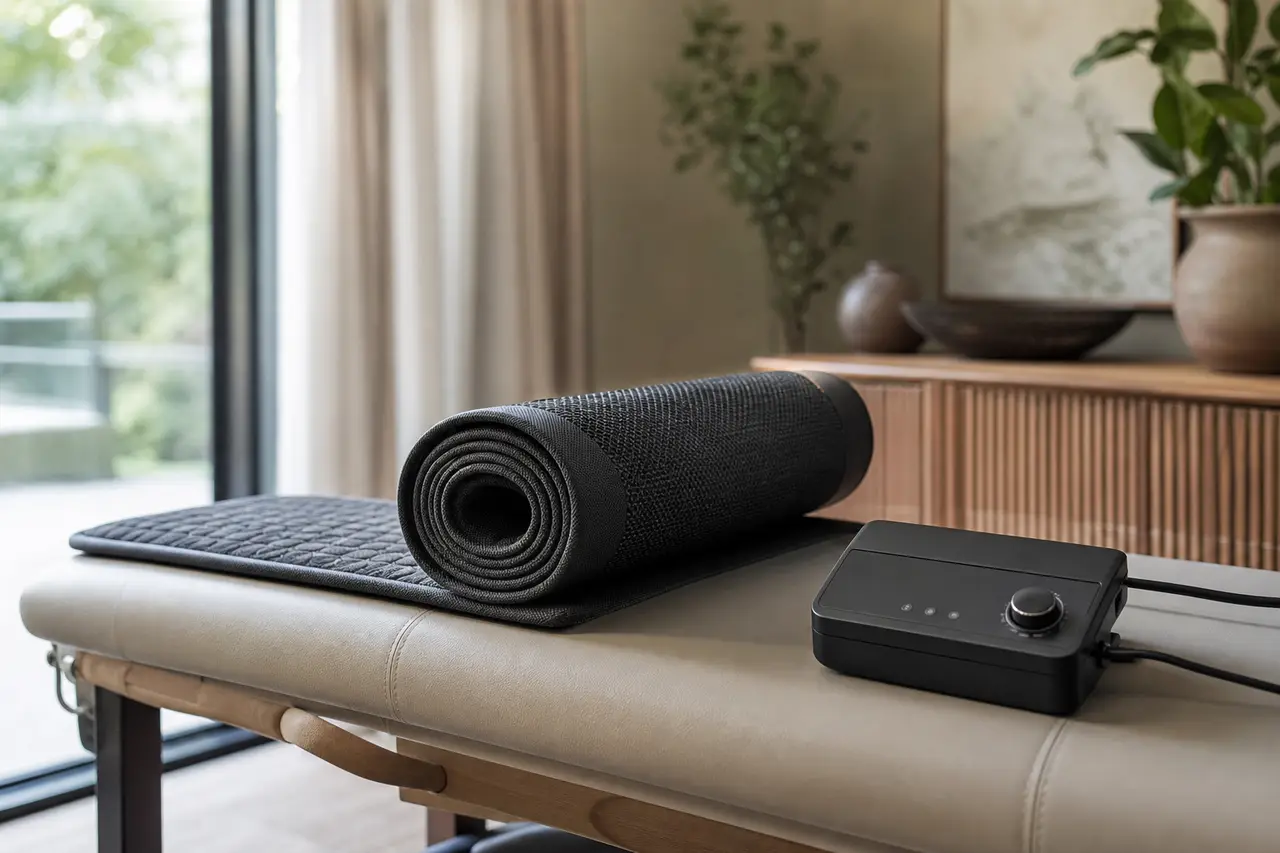
Short answer: A 2020 Physical Therapy meta-analysis supports PEMF for osteoarthritis pain, stiffness and function, and specific devices are FDA-approved for non-union fractures and spinal fusion. That research used particular field strengths, frequencies and waveforms on clinical devices. Consumer mats rarely match them, and the energy and recovery claims are unsupported.
PEMF stands for pulsed electromagnetic field therapy: a device generating a low-frequency magnetic field that passes through the body. In clinical use it has been around for decades. In wellness it now appears as a mat you lie on at a recovery studio, or buy for your spare room at prices from a few hundred to well over ten thousand dollars.
The unusual thing about this category is that the underlying research is real and reasonably substantial. That is rarer than it sounds in wellness.
The gap is between what was studied and what is being sold. The research used specific devices at specific parameters for specific conditions, and a consumer mat marketed for energy and recovery is several steps removed from any of it.
What does the evidence actually support?
Osteoarthritis, most clearly.
The most useful synthesis is Yang and colleagues in Physical Therapy in 2020, a systematic review and meta-analysis of randomised placebo-controlled trials examining PEMF for pain, stiffness, physical function, and quality of life in osteoarthritis. It found benefits, with the usual caveats about heterogeneity between trials.
There is also a genuine, long-standing clinical use in bone healing: PEMF devices are FDA-approved for non-union fractures and as an adjunct to spinal fusion, through the agency’s strictest premarket approval pathway. That is a specific, regulated, prescribed application.
Beyond that the picture thins quickly. Low back pain research is mixed, and the broader claims, energy, sleep, recovery, circulation, inflammation, cellular regeneration, are not supported by anything comparable.
Why does the device matter so much?
Because the parameters are the treatment.
PEMF is not one thing. Field strength, frequency, waveform, and session duration all vary, and the clinical trials used specific combinations delivered by specific devices, often targeted at a joint rather than the whole body.
A consumer full-body mat may operate at a fraction of the intensity, at different frequencies, with a manufacturer’s own protocol that has never been tested. Saying “PEMF is evidence-based” and pointing at a mat is like citing a prescription drug trial to sell a supplement that shares one ingredient.
This is the same gap that exists in red light therapy, where research-grade devices deliver considerably more than most consumer panels. Our guide on red light and infrared therapy covers that parallel, including the honest note that consumer devices frequently underdeliver relative to the studies.
PEMF claims at a glance
| Claim | Status |
|---|---|
| Helps osteoarthritis pain and function | Supported by meta-analysis, with clinical devices |
| Aids non-union fracture healing | FDA-approved, prescribed, specific devices |
| Adjunct in spinal fusion | FDA-approved for that use |
| Low back pain | Mixed |
| Improves sleep | Not established |
| Speeds athletic recovery | Not established |
| Boosts energy or “cellular function” | Not established |
| Reduces inflammation systemically | Not established |
| Consumer mats match trial devices | Usually not; parameters differ |
| Detoxes or realigns anything | No |
What about the FDA clearance you see quoted?
Read what it was approved or cleared for.
Retailers frequently cite FDA status in a way that implies broad endorsement. That status is specific: certain PEMF devices are FDA-approved for bone growth stimulation in non-union fractures and as spinal fusion adjuncts, and some are merely cleared under a general wellness or muscle-stimulation pathway that carries a much lower evidentiary bar.
A device approved or cleared for one indication tells you nothing about a different indication, and general wellness clearance is close to meaningless as a quality signal.
The practical question to ask a retailer: approved or cleared for what, specifically, and can you show the indication. A vague answer is the answer. Our guide on checking a wellness practitioner’s credentials covers verifying claims generally.
Is it safe?
Broadly yes, with clear exclusions.
PEMF is non-invasive, produces no heat sensation, and adverse effects in trials are minimal. Sessions are typically 10 to 30 minutes lying on a mat.
The exclusions are firm and centre on implanted electronics. Do not use PEMF with a pacemaker, an implanted defibrillator, a cochlear implant, an insulin pump, or a deep brain stimulator. Pregnancy and active seizure disorders are also standard contraindications, and anyone with a metal implant should ask their doctor first.
Those are not soft cautions; they are the reason a reputable venue screens you before a session. A studio that does not ask is a studio worth questioning.
What is it worth paying?
Very little, until you know it does something for you.
At a recovery studio, a PEMF mat session is usually $25 to $60, often bundled with other modalities. That is a reasonable amount to spend finding out whether you notice anything.
Consumer mats run from a few hundred dollars for low-power units to $10,000 or more for the high-end systems marketed with clinical language. At the top of that range you are making a significant bet on a category whose consumer evidence is thin.
If you have osteoarthritis and want to try PEMF on the basis of the research that exists, that is a conversation with your doctor about an appropriate device, not a wellness purchase. Our guide to what actually helps osteoarthritis covers where a device like this sits next to exercise and heat. Our guides on which recovery tool for which problem and do compression boots actually work cover how the recovery-gadget category compares on evidence per dollar.
How does it compare to the other recovery gadgets?
Better research base, weaker consumer translation.
Compared with most of the recovery lounge menu, PEMF has an unusually solid clinical literature behind the concept. Compared with the same menu, it has an unusually large gap between that literature and the product on offer.
Massage, by contrast, has the strongest head-to-head evidence for soreness and perceived fatigue, and costs nothing to test. Our guide on which recovery tool for which problem covers the ranking, and does anything actually reduce inflammation covers the claim that most of these devices lean on.
The honest position: interesting technology, real clinical niche, and a consumer market running well ahead of it.
FAQ: PEMF mats
Will I feel anything? Usually a faint pulsing or nothing at all. Absence of sensation is not evidence either way, and it is one reason the category attracts strong marketing.
How long before I would know if a PEMF mat helps? Trials typically run several weeks of repeated sessions. A single session is not a test.
Is a cheap mat better than nothing? Possibly no different from nothing, since low-power consumer units may not reach the parameters used in research. Cheap is not automatically a safe bet here.
Can I use a PEMF mat with a pacemaker? No. Implanted electronic devices are a firm contraindication.
The bottom line on PEMF mats
PEMF has a genuine clinical evidence base: meta-analysis supports it for osteoarthritis pain and function, and specific devices are FDA-approved for bone healing. That is more than most of the recovery-gadget category can say.
The problem is translation. Consumer mats rarely match the devices or parameters that were studied, and the claims attached to them, energy, sleep, recovery, inflammation, are not supported. Try one at a studio for the price of a session before considering a purchase, and never use one with an implanted electronic device.