What is Kneipp therapy? Cold water treading, explained
A nineteenth-century Bavarian priest built a water-cure system that Germany still prescribes and insures. Its signature practice is walking through knee-deep cold water like a stork, and it is the cheapest thing in this entire field.
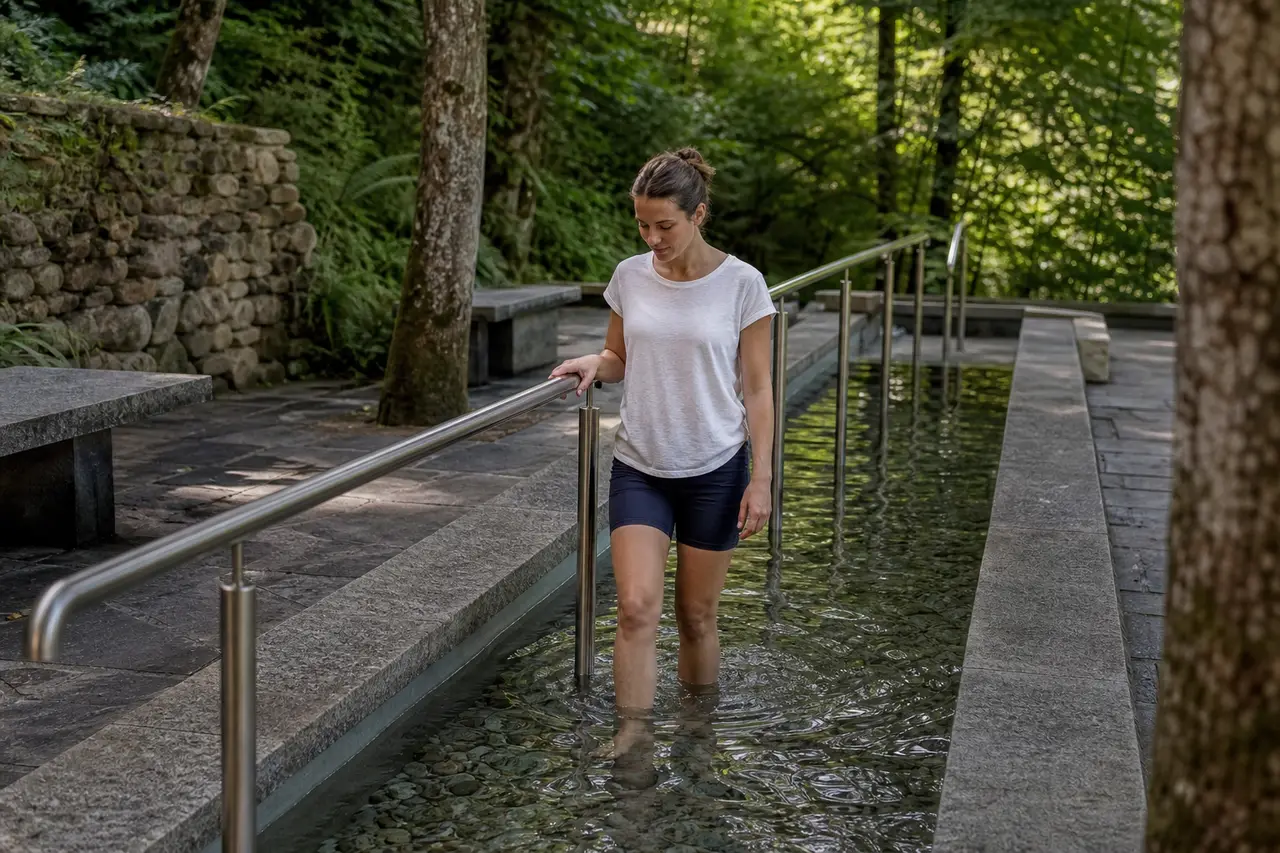
Short answer: Kneipp therapy is a nineteenth-century Bavarian system of brief, partial cold-water applications, most famously treading stork-style through knee-deep cold water for 30 seconds to a few minutes. Because your chest is never submerged there is no cold-shock gasp, which makes it far lower-risk than a plunge. A 2023 BMJ Open review found positive effects.
If you have walked through a German or Austrian spa town and seen people lifting their knees exaggeratedly through a shallow stone trough of cold water, you have seen Kneipp therapy. It looks eccentric. It is also one of the oldest formalised cold-exposure systems in Europe and it remains part of mainstream German medicine.
Sebastian Kneipp was a Bavarian priest who developed the system in the 1800s after treating his own tuberculosis with cold water immersion in the Danube. What he built was not a single trick but a structured method of brief, targeted cold applications.
It is worth knowing about for a practical reason: it is the cheapest and lowest-barrier form of cold exposure available, and it long predates the current plunge-tub boom.
What does the practice actually involve?
Brief, targeted, repeated cold applications.
Water treading is the signature. You walk slowly through knee-deep cold water lifting each foot fully clear of the surface, stork-style, for 30 seconds to a few minutes, then step out and warm up by moving rather than towelling dry.
Cold arm baths involve submerging your forearms in cold water for around 20 to 30 seconds. It is often used for alertness, and it is genuinely effective as an afternoon reset.
Cold affusions are streams of cold water poured over specific parts of the body in a set sequence, usually starting away from the heart and working inward.
The system also includes four other pillars beyond water: movement, nutrition, herbal medicine, and what Kneipp called order or balance. In practice the water applications are what most people encounter.
What does the evidence show on Kneipp?
Positive effects across several conditions, from a modest base.
The best synthesis is Ortiz and colleagues in BMJ Open in 2023, a systematic review of randomised controlled trials of the clinical effects of Kneipp hydrotherapy.
The review identified trials across a range of conditions including quality of life, sleep, and vascular and immune-related outcomes, and reported positive effects in a number of them.
The caveats are the ones that apply to almost all hydrotherapy research: modest study sizes, variable protocols, difficulty blinding participants who can obviously tell whether they are standing in cold water, and heterogeneity that makes pooling hard. It is a real evidence base rather than a strong one, which is a fair description of most of this field. Our guide on what the cold plunge evidence shows covers the adjacent literature.
Kneipp therapy at a glance
| Kneipp therapy | |
|---|---|
| Origin | Bavaria, 1800s, Sebastian Kneipp |
| Signature practice | Water treading, knee-deep cold water |
| Typical duration | 30 seconds to a few minutes |
| Water temperature | Cold tap water, roughly 12 to 18°C |
| Equipment needed | A bath, a stream, or a basin |
| Cost | Effectively zero |
| Status in Germany | Part of mainstream care; some treatments insured |
| Evidence | Systematic review of RCTs found positive effects; modest quality |
| Intensity vs a plunge | Much lower; partial rather than full immersion |
How does it differ from a cold plunge?
Partial, brief, and repeated rather than whole-body.
A cold plunge is full immersion at low temperature, which triggers the cold shock response: an involuntary gasp, rapid breathing, and a sharp cardiovascular spike. That response is the main risk in cold plunging and the reason for the safety rules.
Kneipp applications are partial. Knees down, or forearms only, at cold-tap rather than ice-bath temperature. There is no gasp reflex because your chest is never submerged, which makes it dramatically lower-risk and accessible to people for whom a plunge is out of the question.
The trade-off is that the stimulus is milder, so if you are chasing the large adrenaline response that plunging produces, this is not that. Our guides on cold plunge vs cold shower and how to breathe during a cold plunge cover the full-immersion version.
How do you try it at home?
A bathtub and a tap is the whole setup.
Run 15 to 20 centimetres of cold water in a bath, hold the wall or a rail, and walk slowly through it lifting each foot completely clear of the water. Start with 30 seconds and build toward a couple of minutes.
Then, and this is the part people skip, do not towel your legs dry. Wipe off the excess water with your hands and put socks on, then walk around or do something active until you are warm. Rewarming through movement rather than external heat is central to the method.
For the arm bath, fill a basin, submerge your forearms up to just above the elbow for 20 to 30 seconds, then shake off and warm up the same way. Evening treading is traditionally used for sleep; the arm bath is better suited to the afternoon.
Stop if you get pain rather than cold sensation, and skip it entirely if you have Raynaud’s, peripheral vascular disease, or reduced sensation in your feet. Our guide on sauna, cold and massage with diabetes covers why foot sensation matters, and cold plunge safety covers the wider exclusions.
Where does it fit alongside heat?
It pairs naturally, and traditionally does.
Kneipp facilities usually sit alongside saunas, and the sequence of heat followed by a brief cold application is essentially a gentler version of contrast bathing. The affusion after a sauna round is a classic German spa pattern.
If a full plunge tub is too much, or the studio does not have one, treading or an affusion is a legitimate cold half of a contrast cycle rather than a consolation prize. Our guides on the right order for contrast therapy and contrast therapy benefits cover the sequencing.
You will find dedicated treading basins in German-speaking spa towns, in some US Nordic-style spas, and increasingly in parks in Europe as public installations. Our guide on finding a good sauna in a new city covers vetting a venue, and you can browse day experiences by city to see what hydrotherapy formats exist near you.
Why is it worth knowing about?
Because the barrier to cold exposure is usually the tub.
Most people who never try cold exposure are stopped by cost, access, or the intimidation of full immersion. Kneipp removes all three: a bathtub, cold tap water, and a practice you can stop at any second by stepping out.
It is also a useful corrective to how new the current cold trend presents itself. Structured cold-water protocols with clinical use and research behind them have existed for well over a century, which is worth remembering when a plunge studio explains that cold exposure has just been discovered.
Whether it does more than a cold shower is not established. It is more targeted, more structured, and considerably more pleasant than standing under cold water, which for a free intervention is enough.
FAQ: Kneipp therapy
How cold should the water be? Cold tap water is the traditional standard, roughly 12 to 18°C. Ice is not part of the method.
How often? Daily is traditional and fine. It is brief and mild enough that frequency is not the constraint.
Can I tread in a cold stream or the sea? Yes, and that is the original version. Watch footing and water quality.
Is Kneipp just a cold shower with extra steps? Partly, though the targeting, the brevity, and the rewarming-by-movement rule are distinct. Our cold plunge vs cold shower comparison covers the simpler alternative.
The bottom line on Kneipp therapy
Kneipp therapy is a structured nineteenth-century system of brief, partial cold-water applications, most recognisably walking through knee-deep cold water, and it remains part of mainstream German care. A systematic review of randomised trials found positive effects across several conditions from a modest evidence base.
Its real appeal is accessibility: no tub, no cost, no cold shock response, and you can stop by stepping out. Do not towel dry afterwards; warm up by moving, which is the part of the method most people miss.