What is Watsu? Aquatic bodywork, explained honestly
You float in chest-deep warm water while a practitioner cradles, stretches and moves you through slow arcs. People describe it in unusually emotional terms, which makes the modest state of the evidence worth stating clearly.
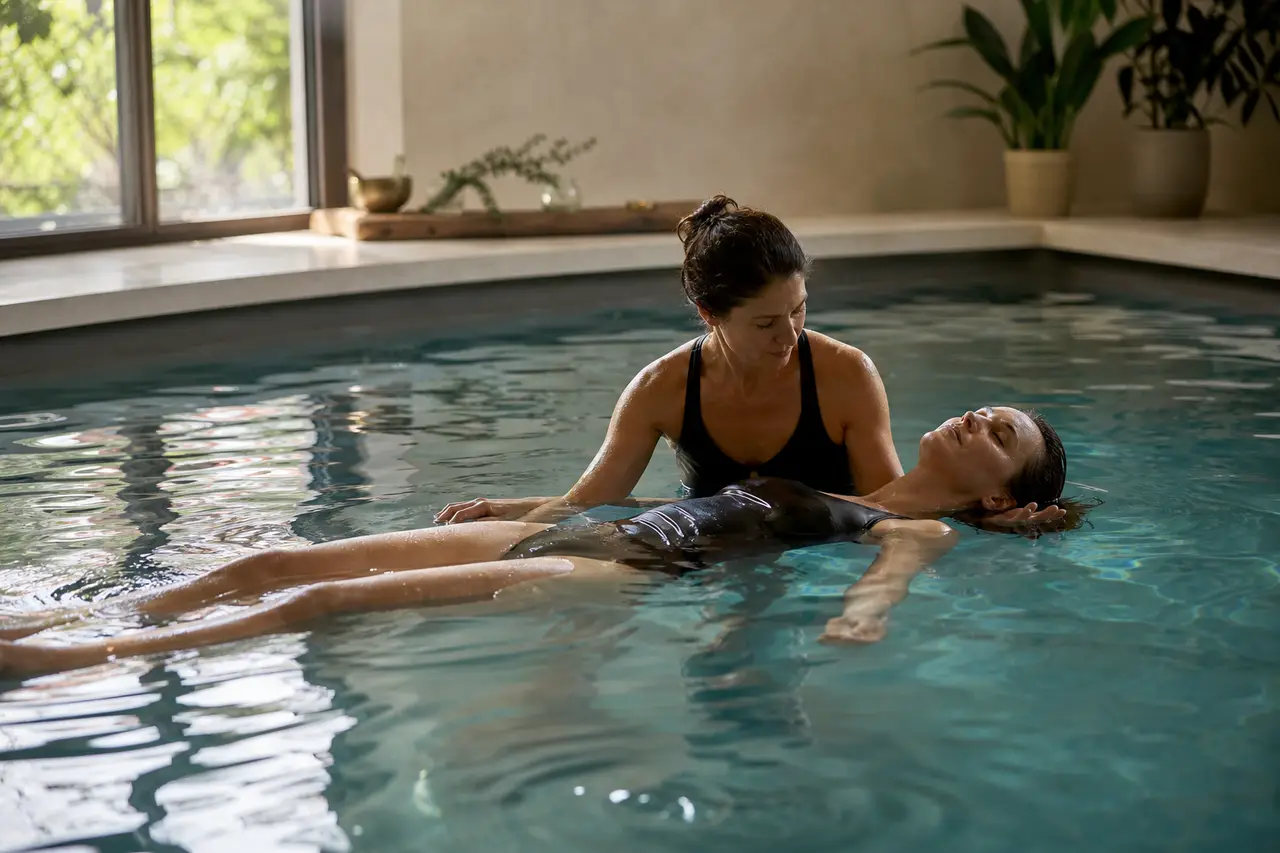
Short answer: Watsu is bodywork done while you float on your back in water kept near body temperature, around 35°C, with a practitioner supporting your head and body through slow stretches, rotations and gliding arcs for 45 to 60 minutes. A 2020 systematic review found real effects on pain, mobility and wellbeing from a thin literature.
Watsu is bodywork done in water. You float on your back in a warm pool, roughly chest-deep for the practitioner, who supports your head and body and moves you through slow stretches, rotations, and gliding arcs while you do nothing at all.
The name is a compression of water and shiatsu, and it grew out of Zen shiatsu adapted to a pool in California in the early 1980s. Sessions run 45 to 60 minutes and the water is kept close to body temperature, around 35°C.
People come out of it describing something closer to a profound experience than a treatment, which is exactly why it is worth being precise about what the research does and does not show.
What actually happens in a Watsu session?
You float, and someone else does everything.
You enter a warm pool and the practitioner supports you at the head and lower back so you float supine, usually with flotation aids on the legs. Your ears are underwater for much of it, which mutes sound considerably.
From there the practitioner moves you: slow rotations, gentle spinal undulations, limb stretches, and long gliding arcs through the water. Some points are held with shiatsu-style pressure. There is no effort required from you and no instruction to follow.
It is deeply passive in a way almost nothing else is. Even a massage involves lying on a firm surface with gravity acting on you; here there is neither. That is the mechanism people point to for why it feels so unlike other bodywork.
What does the evidence show on Watsu?
Real effects, from a small and imperfect literature.
The best synthesis is Schitter and colleagues in PLOS ONE in 2020, a systematic review and meta-analysis of the applications, indications, and effects of passive hydrotherapy WATSU.
It found reported benefits including reductions in pain and improvements in mobility and wellbeing across the studies it could include, and identified use across a range of populations including musculoskeletal pain, pregnancy, and neurological conditions.
The honest caveats are substantial: the included studies are few, mostly small, frequently uncontrolled, and blinding is impossible. A review can only be as strong as what it pools. Read it as “there is a real signal and a thin literature”, which is a more useful summary than either dismissal or enthusiasm.
Watsu at a glance
| Watsu | |
|---|---|
| Setting | Warm pool, around body temperature |
| Your role | Entirely passive; you float and are supported |
| Session length | 45 to 60 minutes |
| Ears underwater | Usually, for much of the session |
| Evidence base | Small, mostly low-quality; a systematic review found modest positive effects |
| Commonly used for | Chronic pain, limited mobility, stress, pregnancy |
| Main practical barrier | Very few facilities have a warm enough pool |
| Not suitable if | Fear of water, open wounds, incontinence, uncontrolled seizures, some infections |
Why does the water change things?
Buoyancy removes load, warmth reduces guarding.
Two mechanisms are plausible and neither requires anything exotic. Buoyancy unloads the spine and joints, which allows ranges of movement that would be uncomfortable or impossible on a table, particularly for people with pain or restricted mobility.
Warm water at close to body temperature reduces muscular guarding and the sensation of a boundary between you and the environment. Combined with muted hearing and being supported entirely by someone else, it produces a state most people find unusually deep.
There is a third element worth naming plainly: being held. Sustained, non-clinical physical support from another person is rare in adult life, and it likely contributes to the emotional responses people report. That is not a criticism of the modality; it is probably part of how it works.
What do people mean by an emotional response?
It is common enough that practitioners plan for it.
A significant number of people cry, feel unexpectedly moved, or surface memories during or after a session. Practitioners treat this as normal and will usually mention it beforehand.
Plausible contributors: deep relaxation lowering the usual guard, the sensation of being held and carried, and the specific quality of floating supported with your ears underwater. Whether anything more than that is happening is not something evidence can currently settle.
What matters practically is that it is common, it is not a sign anything went wrong, and a good practitioner gives you quiet time afterwards rather than moving straight to the next thing. If you would find that unwelcome, this is worth knowing in advance. Our guide on somatic work and TRE covers a related set of body-based approaches and the same caution about emotional release framing.
Who should avoid it, and who is it good for?
Water-specific exclusions, and mobility as the strongest case.
Avoid it if you have a fear of water or being unable to control your position, since the whole premise is surrendering both. Open wounds, skin infections, and incontinence are exclusions on hygiene grounds. Uncontrolled seizure disorders, severe cardiac or respiratory conditions, and anything affecting airway control need medical clearance first.
Pregnancy is a common indication rather than an exclusion, and warm-water work is often well tolerated, but clear it with your care team. Our guide on pregnancy safety covers the wider heat question, and note that Watsu pools are far cooler than a hot tub.
The strongest practical case is for people with limited mobility or chronic pain, where buoyancy allows movement that a table does not. Our guides on accessible wellness and wellness with an autoimmune condition cover the access and infection questions that apply.
How do you find it?
The pool is the constraint, not the practitioner.
Watsu requires a pool heated to around body temperature and deep enough for the practitioner to stand comfortably while you float. Ordinary lap pools are far too cool and hot tubs are far too hot and too small. That single requirement is why it is scarce.
Look for dedicated aquatic bodywork centres, some rehabilitation and hydrotherapy facilities, destination spas with a warm therapy pool, and occasionally physical therapy clinics with aquatic programmes.
Ask about training specifically, since the modality has a formal certification pathway through Worldwide Aquatic Bodywork Association programmes, and ask about the water temperature, because a pool at 30°C produces a different and much less comfortable session. Our guides on checking a practitioner’s credentials and finding a good studio in a new city cover vetting, and you can browse day experiences by city to see what water-based options exist near you.
FAQ: Watsu sessions
Will my head go underwater? Your ears usually will; your face stays above the surface throughout. Some practitioners offer nose clips, and you can ask to keep your ears out if the sensation is unpleasant.
Do I need to be able to swim? No. You are supported the entire time and never asked to move yourself. Comfort in water matters more than swimming ability.
What do I wear? Swimwear, and something you can relax in rather than anything that needs adjusting.
How does Watsu compare to a float tank? Both use buoyancy and sensory reduction, but a float tank is solitary and still, while Watsu is guided movement by another person. Our guides to float tanks and float tank vs sound bath cover the solo version.
The bottom line on Watsu
Watsu is passive bodywork performed while you float in body-temperature water, supported entirely by a practitioner who moves you through slow stretches and arcs. Buoyancy and warmth allow movement that a table does not, which makes it a genuinely interesting option for limited mobility and chronic pain.
The systematic review found positive effects on pain, mobility, and wellbeing from a small and mostly low-quality evidence base, which is worth stating plainly given how powerfully people describe the experience. Check the pool temperature and the practitioner’s certification before booking, and skip it if being unable to control your position in water would distress you.