Your first hammam: what to expect
A hammam is not a sauna with tiles. It is a wet, warm room where somebody scrubs you fairly vigorously with a coarse mitt, and the amount of skin that comes off is the detail nobody warns first-timers about.
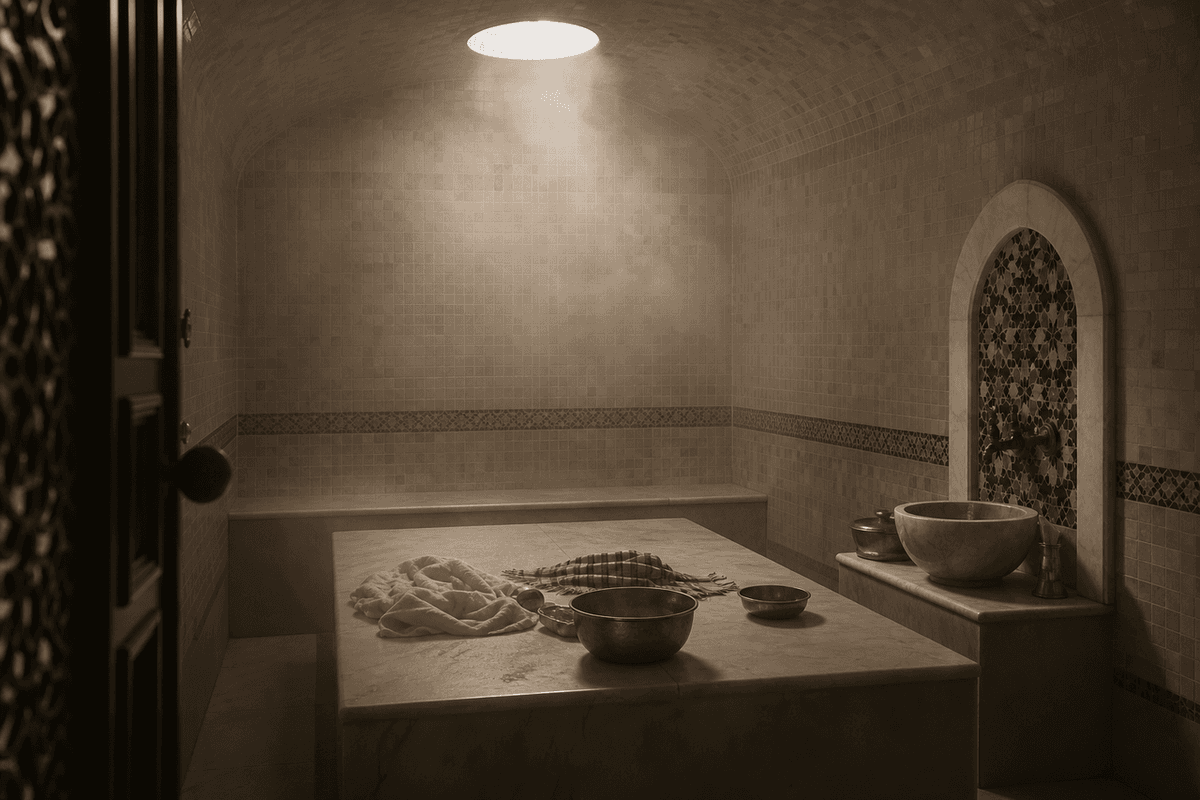
Short answer: A hammam is a guided sequence in a humid room around 40°C, not a room you sit in alone: 15 to 20 minutes softening your skin, then an attendant scrubs you with a coarse kese mitt, then a foam wash and rinse. Expect 45 to 90 minutes and milder heat than a sauna.
A hammam is a wet, warm bathing tradition from the Ottoman and North African world, and it works differently from every other heat room you may have tried. The heat is milder than a sauna, the humidity is high, and the centrepiece is not sitting still but being washed and scrubbed by an attendant.
That last part is what surprises people. This is a service performed on you, at close quarters, with more vigour than a spa treatment. Knowing that in advance turns it from alarming into enjoyable.
It is also one of the more welcoming introductions to bathhouse culture, because someone tells you what to do at every step. We don’t take placement fees, so nothing here points you anywhere.
What actually happens in a hammam?
Warm, soften, scrub, foam, rinse, rest.
You start in a warm humid room, often around 40°C, sometimes lying on a heated marble slab called a göbektaşı in the Turkish tradition. You stay there long enough to sweat properly and soften the outer layer of skin, usually 15 to 20 minutes.
Then an attendant, a tellak or natır in Turkish usage, scrubs you with a coarse mitt called a kese. This is the part first-timers remember. It is firm, methodical, and it removes visible grey rolls of dead skin, which is startling the first time and completely normal.
After that comes a foam wash, traditionally worked up with a cloth bag and poured over you in a cloud of soapy lather, then a hair wash, then rinsing with bowls of water. You finish resting in a cooler room with tea or water. The whole thing usually runs 45 to 90 minutes.
How does it differ from a sauna?
Milder heat, higher humidity, and someone else does the work.
A sauna is dry, very hot, and self-directed: you sit, you sweat, you leave when you decide. A hammam is much cooler but saturated with moisture, and it is structured as a sequence someone guides you through.
Because the humidity is near maximum, your sweat cannot evaporate efficiently, so the perceived heat is higher than the thermometer suggests. It is still substantially gentler than a sauna, which makes it a good option for people who find dry heat harsh.
It also differs from a Russian banya, where the heat is high and the signature treatment is being struck with leafy branches, and from a Korean jjimjilbang, which is a whole complex of rooms. Our comparison of sauna vs banya vs hammam vs Korean spa covers all four traditions.
Hammam at a glance
| Hammam | |
|---|---|
| Temperature | Around 40°C, humid |
| Duration | 45 to 90 minutes |
| Structure | Guided sequence, not self-paced |
| Signature element | Kese scrub by an attendant |
| Nudity | Usually underwear or a wrap; varies by venue |
| Gender separation | Common, either separate rooms or separate hours |
| Good for beginners | Yes, someone tells you what to do throughout |
| Skip if | Sunburn, fresh tattoo, eczema flare, recent waxing or shaving |
What do you wear, and how modest is it?
Usually a wrap or underwear, and it varies.
Most hammams provide a cotton wrap called a peştemal, and you typically keep underwear on underneath. Full nudity is less common than at a Finnish sauna or a Korean spa, though some traditional venues differ and Western hotel hammams are usually the most covered.
Gender separation is standard, either through separate facilities or separate hours, and attendants are normally the same gender as the guests. Ask when booking if that matters to you.
Bring flip-flops if they are not provided, and a change of underwear, because what you wear in will be soaked. Do not bring anything you would mind getting wet, and expect to leave jewellery in a locker. Our guide on what to wear and bring covers the general kit.
What is hammam etiquette?
Quiet, unhurried, and led by the attendant.
Rinse before you get on the marble, follow the attendant’s directions about turning over and where to sit, and keep your voice low. Hammams are traditionally social spaces, but they run at a calm pace and are not the place for a loud conversation.
Tell the attendant if the scrub is too firm. The kese is meant to be vigorous and it should not hurt; a good attendant will adjust immediately and would much rather you say so.
Tipping is customary in most traditional hammams and often expected, so ask at the desk what is normal there. Our guide on tipping at a wellness studio or spa covers the wider etiquette, which varies more by venue format than people assume.
Who should skip it, and when?
Anything that makes vigorous exfoliation a bad idea.
Skip the scrub, or the whole visit, if you have sunburn, an eczema or psoriasis flare, open cuts, a fresh tattoo, or a skin infection. Do not book one for the day after waxing, shaving, or a chemical peel, because a kese on freshly stripped skin is genuinely unpleasant and can damage it. Our guide to wellness with eczema or psoriasis explains why a scrub during a flare is the worst of these.
If you have sensitive skin, rosacea, or a skin condition, ask for a gentler scrub or skip that step and keep the steam and wash. Our guide on whether a sauna helps your skin covers how heat interacts with skin conditions.
The general heat cautions also apply, though less sharply than for a sauna because the temperature is lower. Our guides on pregnancy safety, sauna and the heart, and what to do if you feel faint cover the cases worth checking.
How do you find a good one?
Traditional venues first, and ask what is included.
In the US you will find hammams in Turkish and Moroccan-run bathhouses, in some large Korean and Russian spa complexes, and as a treatment on the menu at hotel spas. Those are quite different products: the last is often a scrub in a steam room rather than a full traditional sequence.
Ask exactly what the service includes, whether the scrub and foam wash are both part of it, how long it runs, and whether the wrap and towels are provided. Price varies widely and the cheapest option is often the shortest.
Our guides to your first bathhouse or Korean spa, finding a good studio in a new city, and reading studio reviews cover vetting, and you can browse day experiences by city to see which venues are bathhouse-format.
FAQ: hammam and kese scrub
Will the scrub hurt? It should feel firm and slightly abrasive, not painful. Say so if it crosses that line; attendants adjust routinely.
Is the grey stuff from the kese scrub really dead skin? Yes, softened stratum corneum coming away. It is normal and it is more than you expect. It is not toxins, despite what you may be told. Our guide on whether sweating detoxes your body covers that claim.
How often can you go? Once a month is plenty for most skin. Weekly aggressive exfoliation is more than most people’s skin barrier wants.
Turkish or Moroccan, what is the difference? Broadly, the Turkish style centres on the heated marble slab and a foam wash; the Moroccan style typically uses black soap and rhassoul clay before the scrub. Both share the warm-soften-scrub-rinse structure.
The bottom line on your first hammam
A hammam is a guided sequence in a warm humid room, built around a firm scrub with a coarse mitt and a foam wash performed by an attendant. It is milder in heat than a sauna and more hands-on than anything else in bathhouse culture.
Go with underwear you do not mind soaking, expect the scrub to be vigorous and to produce startling results, say something if it is too firm, and skip it entirely if your skin is sunburnt, freshly waxed, or flaring.
If the humid heat is what you liked and you are wondering whether to seek out steam rooms or saunas from here, our sauna vs steam room comparison covers the two formats and how long to stay in each.