Finnish sauna vs banya vs hammam vs Korean spa: what's the difference?
Four cultures looked at heat and water and drew four different conclusions. One is dry and hot, one is humid and involves being hit with branches, one is warm marble and lather, and one is a whole day out. All are wonderful; they are not interchangeable.
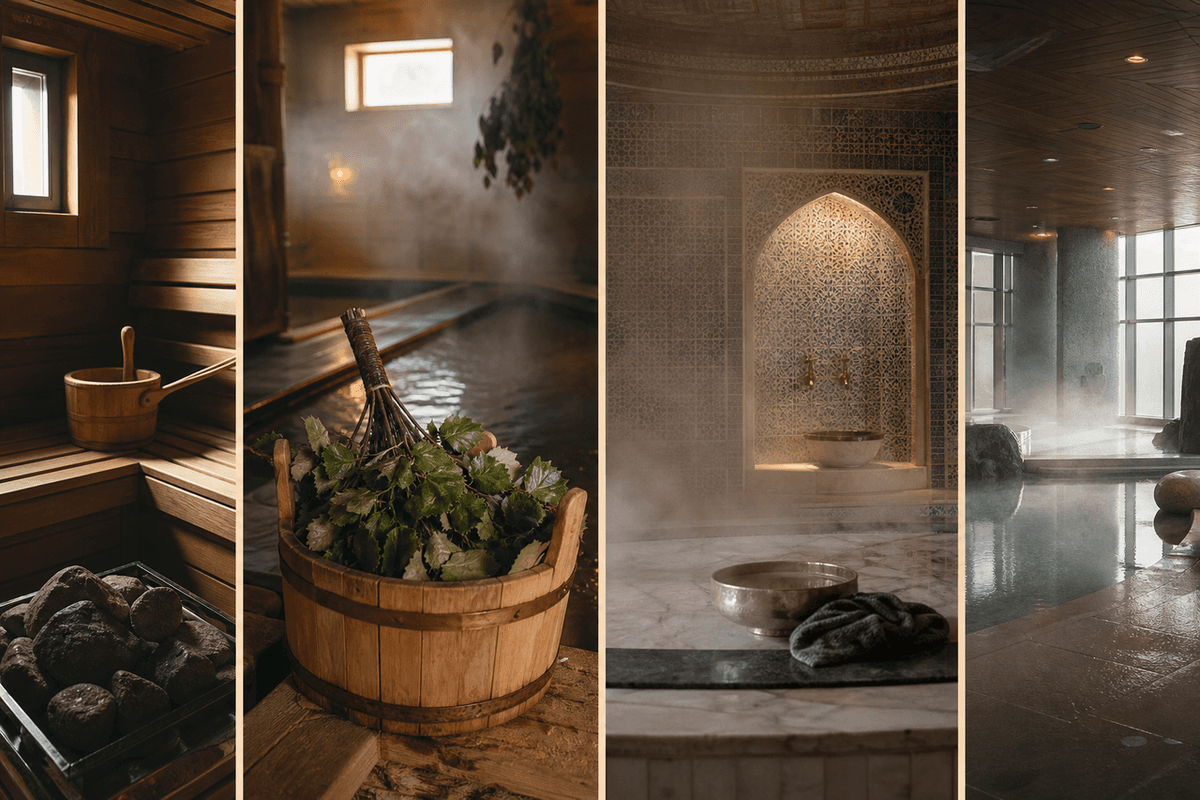
Short answer: A Finnish sauna is dry and hot, roughly 160 to 195 F. A Russian banya is humid and involves a gentle thrashing with leafy birch branches. A Turkish hammam is warm marble with a coarse-mitt scrub and soap lather. A Korean jjimjilbang is an all-day complex of pools, saunas and heated rooms.
They all use heat and water to relax you, but each tradition does it differently. A Finnish sauna is hot and dry. A Russian banya is humid and famously involves being gently thrashed with leafy branches. A Turkish hammam is a warm marble room with a vigorous scrub and a cloud of soap lather. A Korean jjimjilbang is a whole-day social complex of baths, saunas, and heated rooms.
None is better than the others, and they are not interchangeable. If you loved a dry Finnish sauna, a humid banya will feel like a different animal, and a hammam is barely a sauna at all.
Here is what actually distinguishes them, so you can pick the experience you want rather than being surprised.
What defines a Finnish sauna?
Dry, high heat, and simple ritual.
The Finnish sauna is the archetype most people picture: a wood-lined room heated to roughly 160 to 195 F, with low humidity, where you sit and sweat. You can throw water on hot stones to produce a burst of steam, called loyly, which briefly raises the humidity and the intensity.
The ritual is straightforward: heat until you have had enough, cool down with a cold shower, plunge, or cold air, rest, and repeat. It is often followed by exactly that cold contrast. Our sauna and heart guide covers the well-studied benefits, and our right order guide covers the hot-cold cycle.
It is the most familiar and the driest of the four, and the one whose health evidence is strongest.
What is a Russian banya like?
Humid, hot, and involving branches.
A Russian banya is hotter-feeling than it sounds because it combines high heat with much more humidity than a Finnish sauna, created by throwing water on the stones. That moisture makes the heat feel more intense and enveloping.
Its signature ritual is the venik: a bundle of leafy birch or oak branches used to gently swat and massage your body, which sounds alarming and feels wonderful, stimulating circulation and releasing the scent of the leaves. There is usually a plunge into very cold water afterward.
A banya is a robust, social, hearty experience, more theatrical and hands-on than the quiet Finnish sauna. Our first bathhouse guide covers the etiquette that carries across these wet, communal spaces.
What happens in a Turkish hammam?
Warm marble, a scrub, and a lot of lather.
A Turkish hammam is the odd one out, because it is not really about intense dry heat. It centres on a large heated marble slab in a warm, steamy room, where you lie and let the warmth and humidity open your pores. The heat is gentler than a Finnish sauna.
The heart of it is the treatment: an attendant scrubs you vigorously with a coarse mitt, a kese, sloughing off a startling amount of dead skin, then covers you in mountains of soap lather and gives you a wash and massage. You leave polished and softened rather than wrung out by heat.
It is more of a cleansing-and-scrub ritual than a sweat session, and the most hands-on and pampering of the four in the classic full-service version.
What is a Korean jjimjilbang?
A whole-day bathing and lounging complex.
A Korean spa, or jjimjilbang, is less a single room and more a large complex you spend hours or a whole day in. It has gender-separated wet bathing areas with a range of hot and cold pools and saunas, where you are nude, plus a large mixed-gender common area, worn in provided loose clothing, with themed heated rooms lined with materials like salt, clay, jade, or charcoal.
Crucially it adds places to nap, eat, and relax, so it is social and communal, often visited with friends or family for an unhurried day. Optional add-ons include the same kind of vigorous body scrub found in a hammam.
It is the most all-encompassing and social of the four, built for lingering rather than a quick sweat. Our first bathhouse guide walks through a first visit.
Which bathing tradition should you choose?
Match it to the experience you actually want.
Choose a Finnish sauna for a clean, simple, hot-and-dry sweat with a strong evidence base, and if you like the quiet, meditative version. Choose a banya for a hotter, humid, hearty, social experience with the invigorating branch massage. Choose a hammam if you want gentle warmth plus a deep-cleansing scrub and pampering rather than an endurance sweat. Choose a Korean spa if you want a long, social, do-a-bit-of-everything day out.
They share a common thread of heat, water, and cold contrast, and the etiquette is broadly the same: shower before soaking, keep it calm, and hydrate. Our sauna versus steam room guide covers a related distinction, and our contrast therapy guide the hot-cold cycle they all use.
The honest advice is to try more than one. They scratch different itches.
The bottom line on these four traditions
Finnish sauna is dry and hot, Russian banya is humid with a branch massage, Turkish hammam is warm marble with a scrub and lather, and a Korean jjimjilbang is an all-day social bathing complex. Same raw ingredients, four distinct rituals.
Pick by the experience you are in the mood for, and do not assume loving one means you will love them all in the same way. Half the fun is the difference.
To find saunas, bathhouses, and spas near you, start with our city wellness maps. If you want to try these traditions in person, our city guides to Seattle, San Francisco, and Chicago name real banyas and bathhouses to start with.