Accessible wellness: saunas and studios with a disability
Venue websites say 'accessible' and mean there is a ramp at the front door. The parts that decide whether a visit works are the wet-floor route, the plunge entry, the bench transfer and the changing room, and none of them appear on the booking page.
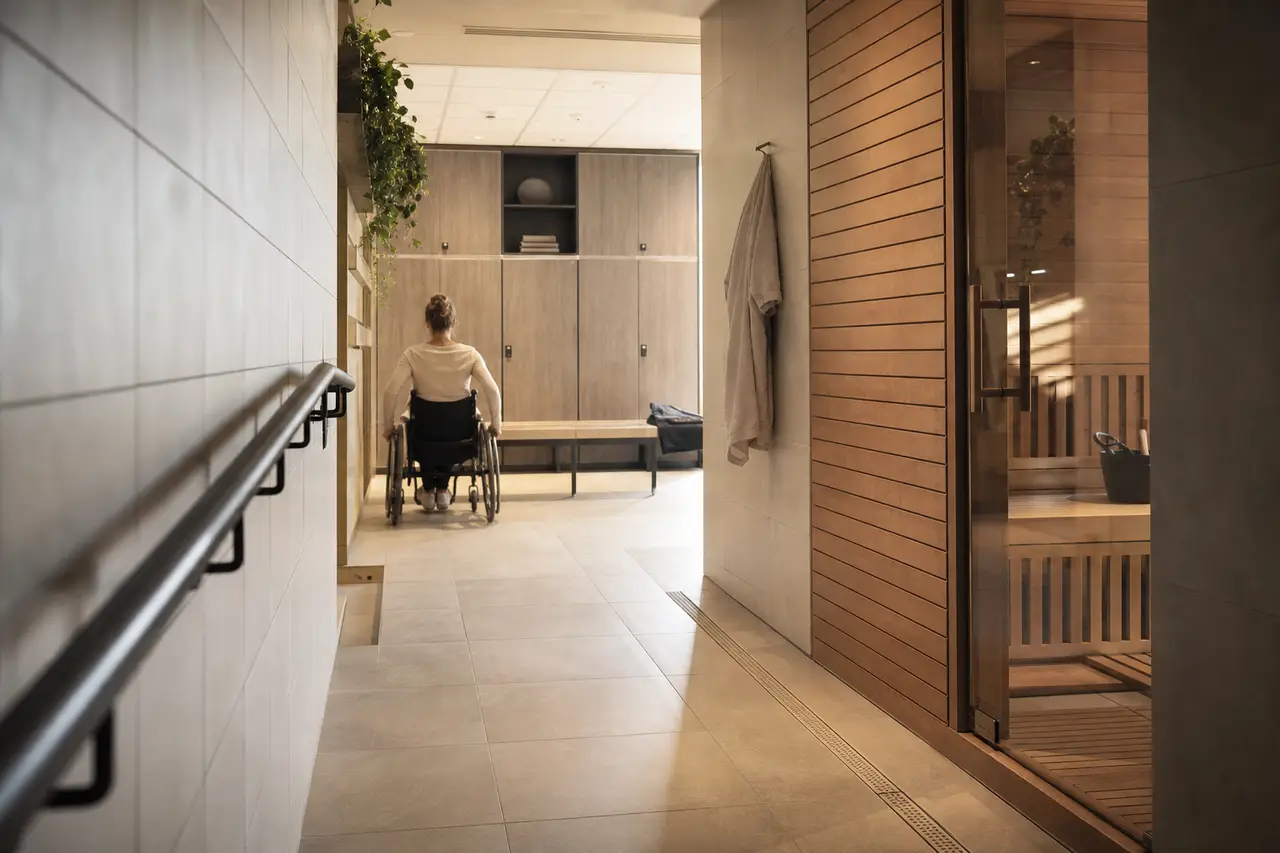
Short answer: Accessible on a booking page usually means the front door and the toilet. What decides whether a visit works is the route across wet floors, whether the plunge has steps and a rail, bench height for a transfer, the changing room, and whether staff have ever handled one. Ask about the route, not the label.
“Wheelchair accessible” on a booking page usually means the front door and the toilet. It rarely means the sauna bench, the plunge entry, the wet-floor route between them, or whether anyone on staff has ever thought about a transfer.
That gap is why people who could perfectly well use these places often stop trying after one wasted trip. The information exists; it is just not published anywhere.
This is a guide to what to ask, in enough detail that a phone call gives you a real answer rather than a reassurance. It covers mobility mostly, and touches on sensory and other access needs where the questions differ.
Why is “accessible” not a useful word here?
Because wellness venues have unusual layouts.
A standard accessibility check assumes a dry, level, predictable building. A bathhouse is wet, has level changes at pool and plunge edges, has heat that affects some conditions, and has benches at heights nobody designed for transfers.
So a venue can be genuinely ADA-compliant at the entrance and still be unusable for you at the point that matters. The reverse also happens: an older building with a step at the door may have staff who solve problems well and a layout that works fine once you are in.
The Americans with Disabilities Act sets requirements for public accommodations including accessible entrances, routes, and restrooms, and pool lift requirements apply to pools and spas at many venues. What it does not do is guarantee that a sauna bench, a cold plunge, or a treatment room works for your particular needs. Ask about the specific features rather than the compliance label.
What should you actually ask?
If the reason is a condition rather than a fixed disability, our guide to wellness with multiple sclerosis covers the heat, footing and fatigue questions that make a venue work or fail on the day.
Ask about the route, surface by surface.
The route. Is there a step-free path from the entrance to the changing room, and from the changing room to each facility? How far, and across what surface?
Wet floors. Are they tiled, textured, or slick? Are there handrails along the wet routes? This is the question that most often decides things and the one nobody volunteers.
The plunge. Steps or a ladder? A grab rail? A transfer bench or a lift? Depth?
The sauna. Bench heights, whether there is a lower bench at roughly transfer height, and whether the door is wide enough and easy to open.
Changing. Is there an accessible cubicle with a bench, and is there space to transfer? Is there a roll-in shower?
Staff. Will someone be nearby, and can they assist, or is their policy that they cannot touch guests?
Access questions at a glance
| Feature | What to ask, specifically |
|---|---|
| Entrance to changing room | Step-free? How long, what surface? |
| Wet-floor route | Textured or slick tile? Handrails? |
| Changing cubicle | Accessible one with a bench and transfer space? |
| Shower | Roll-in? Fold-down seat? Handheld head? |
| Sauna door and benches | Door width, lower bench height, is it a step up? |
| Cold plunge | Steps vs ladder, grab rail, transfer bench, lift? |
| Pool or hot tub | Is there a lift, and is it actually operational today? |
| Treatment room | Height-adjustable hydraulic table? Door width? |
| Staff assistance | Permitted, trained, and available at your time? |
| Quiet hours | Least crowded slot; easier for everything |
What about massage and treatments?
Often the most accessible thing on the menu.
A hydraulic or electric height-adjustable table transforms transfers, and many clinics have one. Ask specifically whether the table is height-adjustable rather than whether the room is accessible.
Say what you need at booking rather than on arrival: how you transfer, whether you need assistance, whether certain positions are uncomfortable or unsafe, and any areas to avoid. A good therapist will ask follow-up questions and plan the session around it.
Some conditions have specific cautions worth flagging: reduced or absent sensation in an area means pressure feedback is missing and the therapist should work more conservatively; spasticity, contractures, pressure sores, or a history of blood clots all change what is appropriate. Our guides on checking a practitioner’s credentials and types of massage cover finding the right person.
Chair massage and seated treatments exist and are underused. If a table transfer is the obstacle rather than the massage, ask.
Does heat or cold need extra care?
For some conditions, yes, and specifically.
Heat intolerance is well recognised in multiple sclerosis, where a rise in core temperature can temporarily worsen symptoms. That is a reason to be cautious with saunas and hot tubs and to test briefly rather than commit.
Impaired temperature regulation and impaired sensation are the other two to plan around. If you cannot reliably feel a hot bench or hot floor tiles, that is a burn risk in exactly the way it is for someone with diabetic neuropathy, and it means checking surfaces by hand and checking your skin afterwards. Our guide on sauna, cold and massage with diabetes covers that mechanism in more detail.
Autonomic dysreflexia is a specific concern for people with higher spinal cord injuries and is a reason to discuss heat and cold exposure with your doctor before trying it. Our guide on what to do if you feel faint in a sauna covers the general warning signs.
What about sensory and neurodivergent access?
Different questions, equally unpublished.
If noise, unpredictability, scent, or being touched unexpectedly are the barriers, the useful questions are about the environment rather than the route. Ask whether there is music and whether it can be turned down, whether the steam room uses eucalyptus or strong oils, how busy a given time slot is, and whether the therapist will narrate what they are about to do.
Many venues will happily run a session with no talking, no music, and a clear step-by-step explanation if you ask at booking. Almost none of them advertise it.
Private cabins and single-occupancy rooms solve most of this at the cost of the communal experience. Our comparison of private vs communal sauna covers the trade-off, and our guide to Aufguss ceremonies covers a format worth avoiding if strong scent or a fixed unbroken duration is a problem.
How do you plan the visit?
Call, go off-peak, and do a look-around first.
Call rather than email if you can, because the person who answers can often walk the route while talking to you. Ask for the least busy hours, which make everything easier: less queuing, more room to move, more staff attention.
Ask whether you can come and look around before booking anything. Most venues will say yes, and ten minutes on site answers more than any phone call.
If a lift or a piece of equipment matters, confirm it is working that day and not stored in a cupboard, which is an extremely common situation. Our guides on finding a good studio in a new city and reading studio reviews cover vetting generally, and you can browse day experiences by city to see the formats near you.
FAQ: accessible venues
Does the ADA require a sauna to be accessible? It sets requirements for entrances, routes, restrooms, and pool and spa access at covered facilities. It does not guarantee a usable sauna bench or plunge entry, which is why the specific questions matter more than the compliance claim.
Are pool lifts usually available? Many venues with pools have them. Whether it is installed, operational, and staff know how to use it varies enormously. Confirm on the day.
Should I bring my own equipment? A transfer board, non-slip footwear, and your own shower chair if you use one are all reasonable to bring and most venues will accommodate them.
What if staff say they cannot assist with a transfer? That is a common insurance-driven policy rather than hostility. Ask what they can do, and bring someone if assistance is essential.
The bottom line on venue access
“Accessible” on a booking page usually describes the front door. What decides a visit is the wet-floor route, the plunge entry, the bench height, the changing cubicle, and whether staff can help, and none of it is published.
Call and ask about each feature specifically, go at the quietest hours, ask to look around first, and confirm on the day that any lift or equipment is actually working. Flag heat intolerance and any impaired sensation to a doctor before you start.
For the specific questions a blind or low-vision guest should ask, our guide to wellness with a visual impairment goes deeper.