What is Aufguss? The sauna ceremony, explained
Somebody walks in with a bucket of scented ice, pours it on the stones, and then spends fifteen minutes waving a towel at you in choreographed rounds. It is a real European tradition, it is arriving in US bathhouses, and it is considerably hotter than a normal sit.
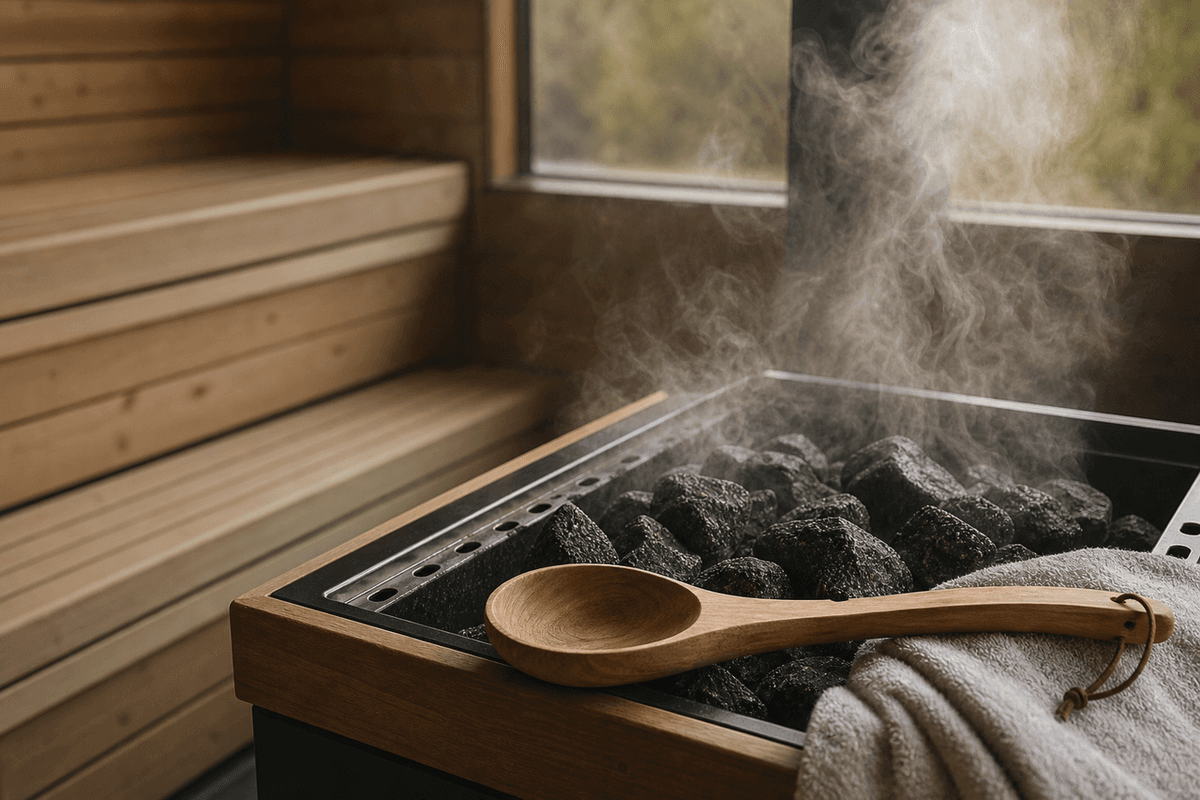
Short answer: Aufguss is a hosted sauna round, usually 10 to 15 minutes, in which a Saunameister pours scented water or ice onto the stones and circulates the steam with choreographed towel work. The air temperature barely changes; the moving air strips heat from your skin far faster, which is why it feels dramatically more intense.
Aufguss is a structured, hosted sauna round. A trained host, sometimes called a Saunameister, pours scented water or ice over the hot stones, then uses a towel to circulate the resulting steam around the room in deliberate rounds, usually with music and a set sequence.
It is a normal part of sauna culture across Germany, Austria, the Netherlands and much of central Europe, where it runs on a fixed timetable and people plan their visit around it. US bathhouses have started offering it, often under the name sauna ceremony or sauna ritual.
If you have only ever sat quietly in a hot room, it is a genuinely different experience. It is also meaningfully more intense than the thermometer suggests, which is the part worth understanding before you walk in.
What actually happens in one?
A fixed sequence of pours, waves, and rest.
A session usually runs 10 to 15 minutes and is divided into rounds. The host pours water, often with essential oils or scented ice balls, onto the stones, which produces a burst of steam. Then comes the towel work: broad, choreographed movements that push the hot air down and around the room.
Between rounds there is usually a pause, and often an invitation to leave if you have had enough. Many hosts hand out cold towels, ice, or citrus slices at the end.
The style varies enormously. Some are quiet and meditative with gentle music; others are theatrical performances with costumes, storytelling, and competitive-level towel choreography. There is an actual international championship for it, which tells you something about how seriously it is taken.
Why does it feel so much hotter?
Because moving air strips heat from your skin faster.
The air temperature barely changes when the water hits the stones. What changes is humidity and, crucially, air movement. Still air forms a thin insulating layer against your skin; the towel work destroys that layer and pushes hot, humid air directly at you.
The result is a large jump in how fast heat transfers into your body, without the wall thermometer moving much. That is why an Aufguss at the same nominal temperature feels dramatically more intense than a quiet sit, and why people who are perfectly comfortable at 90°C can find it overwhelming.
The humidity matters too, because your sweat evaporates less efficiently in moist air, which is your main cooling mechanism. Our comparison of sauna vs steam room covers that mechanism in more detail.
The Aufguss round at a glance
| Regular sauna round | Aufguss ceremony | |
|---|---|---|
| Length | You choose | Fixed, usually 10 to 15 minutes |
| Air temperature | Same | Roughly the same |
| Perceived heat | Baseline | Considerably higher |
| Humidity | Low | Spikes with each pour |
| Air movement | Still | Deliberately circulated |
| Can you leave mid-way | Any time | Yes, and you should if needed |
| Door policy | Open | Usually closed once it starts |
| Best bench for a first try | Wherever | The lowest one |
What is the Aufguss etiquette?
Arrive early, sit low, leave quietly if you need to.
Doors are normally closed once a ceremony begins, both to hold the heat and to avoid disrupting it, so arrive a few minutes early rather than trying to slip in. Some venues will not admit latecomers at all.
Sit on a towel, as in any sauna, and take the lowest bench for your first one. The heat difference between benches is large and it is larger during an Aufguss.
Leaving early is completely acceptable and hosts expect it. Do it quietly between rounds if you can, and do not feel you owe anyone an explanation. What is not acceptable is talking through it, arriving mid-round, or waving your own towel around. Our guide to first sauna etiquette covers the general rules.
Who should skip it or take it carefully?
Anyone for whom a normal sauna is already at the edge.
Because the effective heat load is higher and the duration is fixed rather than self-paced, an Aufguss removes the main safety mechanism people rely on: leaving when you feel like it. You can still leave, but the social pressure not to is real, and that is precisely the risk.
Skip it, or sit on the lowest bench for a very short first exposure, if you have a heart condition, high or unstable blood pressure, are pregnant, are new to sauna entirely, or take medication that affects heat tolerance or blood pressure. Our guides on sauna and the heart, pregnancy safety, and starting safely as an older adult cover each case.
Never go in having had alcohol, which our guide on alcohol and sauna covers, and know the warning signs in advance. Our guide on what to do if you feel faint is worth reading before your first ceremony rather than after.
Do the essential oils do anything?
They smell good. That is most of it.
Aufguss oils are usually citrus, mint, eucalyptus, pine, or seasonal blends, and the aroma is a real part of the experience. Menthol and eucalyptus in particular produce a strong cooling sensation on the skin and in the airways, which changes how the heat feels without changing the heat.
What they do not do is deliver therapeutic effects through steam. The aromatherapy claims attached to Aufguss are the same claims attached to aromatherapy generally, and the evidence for anything beyond mood and pleasantness is thin. Our aromatherapy explainer goes through it.
One practical note: if you have asthma or are sensitive to strong scents, a eucalyptus-heavy ceremony in high humidity can be genuinely uncomfortable. Ask what oil is being used.
How do you find one?
Traditional bathhouses first, then large recovery clubs.
Aufguss needs a big traditional sauna, a proper stove with stones, and a trained host, so you will find it at larger bathhouses and Nordic-style spas rather than at a studio with individual infrared cabins. It usually runs on a posted schedule, several times a day.
Because sessions are timed, this is one case where checking the schedule before you go genuinely matters. Our guides to your first bathhouse or Korean spa and finding a good sauna in a new city cover the practical side, and you can browse day experiences by city to see which venues are bathhouse-format.
Expect it to be included in a day pass at most venues rather than charged separately.
FAQ: Aufguss ceremonies
Is Aufguss the same as a banya venik treatment? No. Aufguss is a group ceremony using steam and a towel to move air. The Russian banya tradition uses leafy branches applied to the body, which is a different and more physical thing. Our guide to sauna vs banya vs hammam vs Korean spa covers the traditions.
Can I leave in the middle? Yes, always. Do it between rounds if you can, and quietly. No host will mind.
Do I need to book? Usually not, but sessions fill and doors close on time. Arrive early.
Should I plunge afterwards? Many people do, and it is the traditional follow-up. Ease into it rather than sprinting, especially after a hot ceremony. Our guides on the right order for contrast therapy and what to do after a cold plunge cover it.
The bottom line on Aufguss
Aufguss is a hosted sauna round where scented water goes on the stones and a host circulates the heat with a towel. The thermometer barely moves; the rate at which heat reaches your skin rises sharply, which is why it feels so much stronger.
Take the lowest bench your first time, arrive before the doors close, and treat leaving early as entirely normal. The fixed duration is the one thing that makes it riskier than a self-paced sit, so decide in advance that you will step out when you have had enough.