Barre vs reformer Pilates: which should you book?
Both promise long, strong muscles in a room full of mirrors, and the marketing is nearly identical. What actually differs is whether resistance comes from a spring-loaded machine or from your own bodyweight held at the edge of failure.
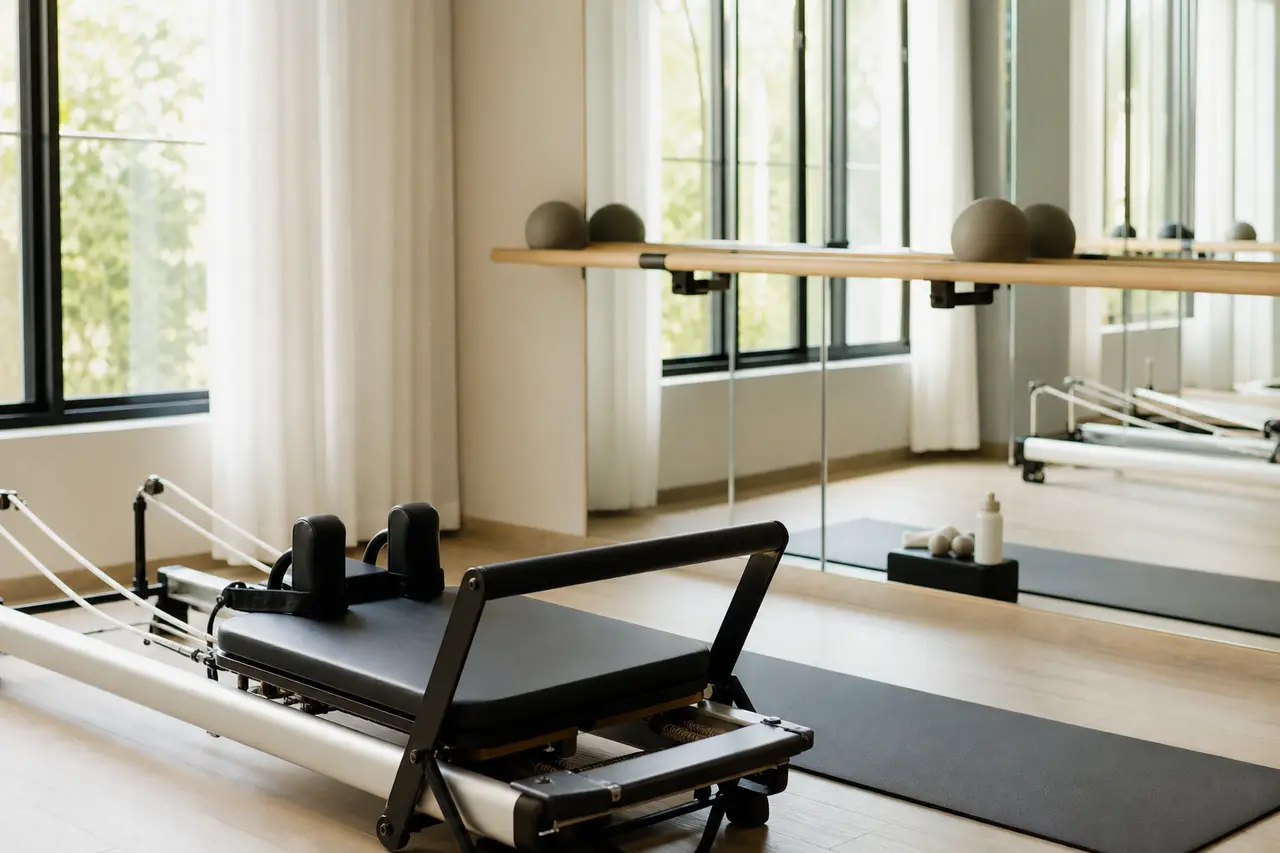
Short answer: Reformer Pilates loads you with calibrated springs on a machine that also supports your spine and joints, which makes it the better choice around injury or rehab; expect $30 to $60 a class. Barre uses bodyweight, high repetitions and small pulsing ranges, costs less, and is conditioning rather than rehabilitation.
These two get compared constantly because they occupy the same slot in people’s heads: a low-impact studio class, mostly women, mirrors, grippy socks, and a promise of long strong muscles.
The promise is roughly the same. The mechanism is not. Reformer Pilates loads you with calibrated springs on a machine that supports your body. Barre loads you with your own bodyweight, very high repetitions, and small pulsing ranges of motion held until the muscle gives out.
That single difference drives everything else: who each suits, what it costs, and which one you should pick.
What actually happens in each class?
One is a machine, the other is a ballet barre and a mat.
Reformer Pilates puts you on a carriage that slides along rails against adjustable spring resistance, with straps, a footbar, and a headrest. You work lying down, seated, kneeling, and standing, and the machine both resists and supports you. Class sizes are small because there is one machine per person. Our guide on Pilates reformer vs mat covers the equipment question in more detail.
Barre borrows from ballet conditioning: you hold a fixed barre for balance and work through small, high-repetition movements, often with light hand weights, a resistance band, or a small ball. There is no machine, class sizes are larger, and the format is closer to a group fitness class. Our guide on what a barre class is really like covers the experience.
Both are low-impact, both emphasise control over load, and both will make your legs shake.
Reformer and barre at a glance
| Reformer Pilates | Barre | |
|---|---|---|
| Resistance from | Calibrated springs on a machine | Your bodyweight, plus light weights |
| Class size | Small, one machine each | Larger group |
| Cost per class | $30 to $60 typical | $20 to $40 typical |
| Adaptable for injury | Strongly; springs assist as well as resist | Less so; mostly bodyweight |
| Learning curve | Steeper; the machine needs instruction | Gentle; follow along |
| Intensity style | Controlled load through full range | High reps, small range, burn to failure |
| Cardio element | Minimal | Moderate in faster formats |
| Best for | Rehab, control, technique, back issues | Conditioning, endurance, group energy |
| Builds real strength | Moderately, at higher spring loads | Limited; light loads |
Which adapts better to an injury?
Reformer, clearly.
This is the most important practical difference. The reformer’s springs can assist a movement as well as resist it, and the carriage supports your spine and joints while you work. That makes it genuinely useful for rehabilitation, for people returning from injury, and for anyone whose back does not tolerate loaded standing work.
It is also why clinical Pilates exists as a thing physical therapists offer, and why reformer work turns up in rehab settings. Our guide on whether yoga helps back pain covers a related evidence base, and massage vs physical therapy covers when you need assessment before any class.
Barre is harder to modify. It is bodyweight in standing positions with high repetitions, and while a good instructor will offer options, the format is less adjustable at the level of individual joints. If you are carrying an injury, start with reformer or with a private session.
Which is harder?
Different kinds of hard.
Barre usually feels harder in the moment. The high-repetition small-range work produces a specific burning fatigue quickly, and the classes are often continuous with little rest. People come out of a first barre class genuinely surprised.
Reformer is more controlled and technical, and the difficulty is in precision and in the springs rather than in accumulated burn. A well-loaded reformer session is demanding in a way that builds, and it is easier to make progressively harder by adding spring tension.
Neither is a substitute for resistance training if strength is your goal, because the loads in both are light by strength-training standards. Both are excellent at control, mobility, and muscular endurance. Our guide on which recovery tool for which problem covers where these sit alongside other training.
What about cost and access?
Barre is cheaper and easier to find.
Reformer classes cost more because the equipment is expensive and class sizes are capped by machine count. Expect $30 to $60 a class in most markets, more for semi-private, and considerably more for private instruction.
Barre runs $20 to $40 and takes more people per class, so there is more availability and cheaper intro offers.
For either, the intro-offer-then-membership pattern is standard, so check the terms before committing. Our guides on whether wellness studio memberships are worth it and how to cancel a wellness membership cover the traps.
What about Lagree, which claims to be both?
A separate, harder thing.
Lagree runs on a Megaformer, which is a reformer-derived machine, but the method is deliberately more intense: continuous time under tension, slow controlled movement, and no rest between exercises. It is closer to strength conditioning than either classic reformer Pilates or barre.
If you tried reformer and found it too gentle, Lagree is the natural next step. If you are coming back from an injury, it is the wrong first choice. Our guides on what a Megaformer class is really like and reformer Pilates vs Lagree cover the differences.
Which should you book first?
Match it to why you are going.
Book reformer if you are returning from injury, have back or joint issues, want to learn precise movement, or prefer small classes and individual attention.
Book barre if you want energy, music, a group, a cheaper entry point, and a workout that feels demanding immediately. It is also the easier one to walk into with no experience, since there is no equipment to learn. Our guides on your first Pilates class and group class vs private session cover getting started.
Doing both works well, since they complement rather than duplicate. And if the question is really Pilates versus something else entirely, our comparisons of barre vs Pilates and yoga vs Pilates cover the wider choice.
FAQ: barre and reformer
Will either give me long lean muscles? No exercise changes muscle shape; that is genetics and body composition. Both build endurance and control, which is a real and honest benefit.
Do I need grippy socks? Usually yes for both, and most studios sell them. Check before your first class.
Is barre good cardio? Faster formats raise your heart rate moderately. Neither is a substitute for proper cardiovascular training.
Which is better for beginners? Barre is easier to walk into cold. Reformer teaches better movement but needs instruction, so book an intro or private first session.
The bottom line on which to book
Reformer Pilates loads you with calibrated springs on a machine that also supports you, which makes it the better choice for injury, back problems, and learning precise movement. Barre loads you with bodyweight and high repetitions, costs less, takes more people, and feels harder immediately.
Neither builds significant strength, because the loads are light in both. Pick reformer if you are rehabbing or want technique, barre if you want group energy and a cheaper start, and consider Lagree if reformer turns out to be too gentle.