How cold, and for how long? Sauna and cold plunge temperature and time
The numbers everyone quotes come from convention and a handful of studies, not from a settled dose. Here are the ranges people actually use, where they came from, and how to find yours.
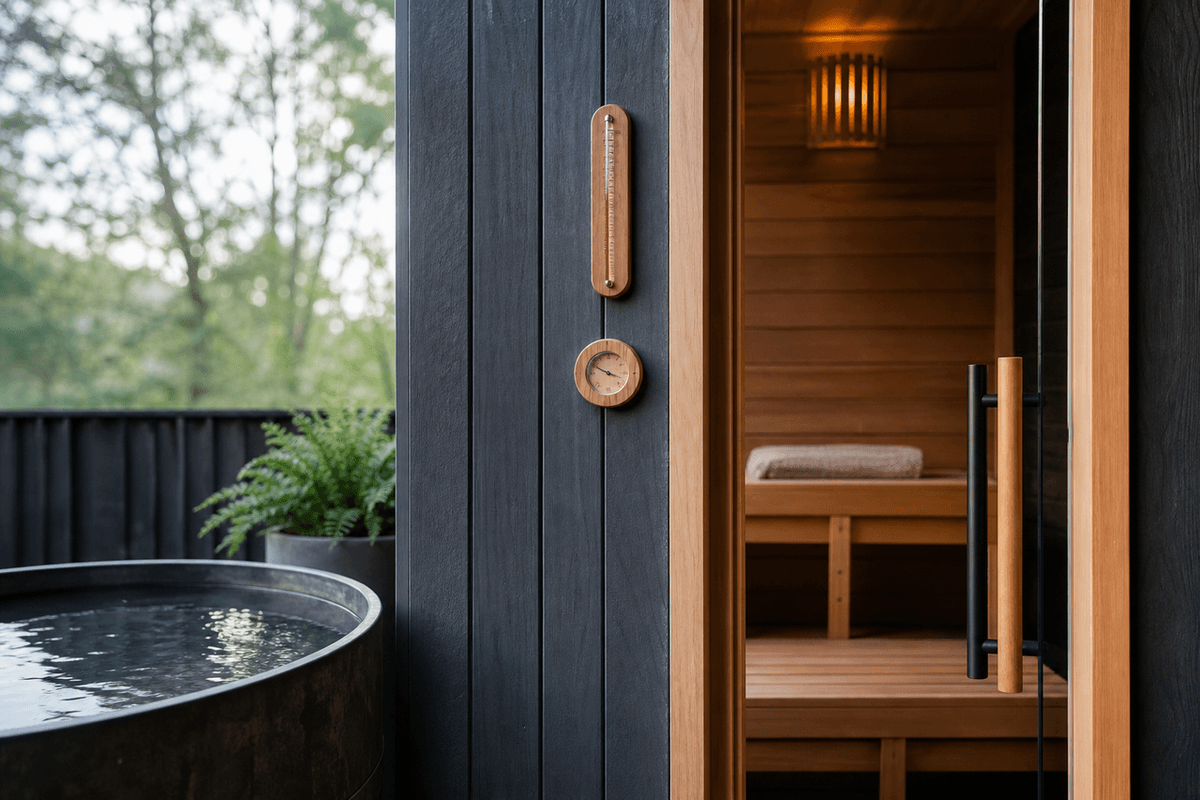
Short answer: In practice most cold plunges run 50 to 59F, about 10 to 15C, for two to five minutes, and most traditional saunas run 175 to 195F, about 80 to 90C, for ten to twenty. Those are conventions, not a proven dose. Beginners should start at 30 to 60 seconds, and colder always means shorter.
In practice, most cold plunges run 50 to 59F, about 10 to 15C, and most people stay 2 to 5 minutes.
Most traditional saunas run 175 to 195F, about 80 to 90C, and most sessions last 10 to 20 minutes.
Those are the ranges the world settled on, and they are reasonable. What they are not is a proven dose. There is no trial establishing that 53F for three minutes beats 57F for four.
Treat the numbers as a safe starting envelope, not a prescription, and let colder mean shorter.
Where do the cold plunge numbers come from?
Partly from research, partly from what a chiller can hold.
The often-cited dopamine and noradrenaline findings from Sramek and colleagues in the European Journal of Applied Physiology in 2000 used water at 14C, about 57F, for one hour, which nobody actually does.
The post-exercise immersion trials, including Roberts and colleagues in The Journal of Physiology in 2015, used around 10C for 10 minutes.
So the popular protocol sits between a study nobody replicates and a study whose effect you may not want. The honest read is that a range of cold temperatures works, and the specific number matters less than getting in regularly.
How long should a beginner stay in?
Thirty seconds. Genuinely.
The goal of your first sessions is not a dose. It is teaching your body to stop panicking in the cold, and that adaptation to the cold shock response is what changes over the first few weeks.
Start at 30 to 60 seconds in whatever cold your studio has, focus on slowing your breathing, and add time gradually. Two to three minutes is a good working target for most people, and past about five minutes you are collecting risk rather than benefit.
Our breathing guide covers the technique, and our beginner’s walkthrough covers a full first session.
Colder is not better, is it?
No, and this is the most common beginner mistake.
Below about 50F the cold shock response gets sharper and the time you can stay safely gets much shorter, so the extra cold buys you nothing except difficulty.
There is no evidence that 40F water produces better outcomes than 55F water, and considerable reason to think it produces worse ones, because it makes the practice unpleasant enough that people quit.
The rule of thumb: if the water is colder, cut the time. If you cannot control your breathing, it is too cold or too long. And read our safety guide before going near the very cold end.
What about sauna temperature and time?
A traditional Finnish sauna sits at 175 to 195F with low humidity, and 10 to 20 minutes is a normal session, often repeated in two or three rounds with cooling in between.
The large Finnish cohort study by Laukkanen and colleagues, published in JAMA Internal Medicine in 2015, that associated frequent sauna use with lower mortality was based on sessions averaging about 14 minutes at roughly 175F, four to seven times a week.
Infrared saunas run much cooler, around 110 to 140F, and sessions are longer, 20 to 40 minutes, because the heating mechanism differs. Our infrared vs traditional comparison explains why you cannot compare the two by temperature alone.
How do you build a contrast round?
Heat first, then cold, and repeat.
A common cycle is 10 to 15 minutes in the sauna, then 1 to 3 minutes in the plunge, then several minutes at room temperature to reset, done two or three times.
Whether you finish hot or cold depends on what you want afterwards, and our order guide covers that choice.
Do not use the sauna to rewarm immediately after a hard plunge, and do not stack more rounds than you can do while still breathing calmly.
The bottom line on temperature and time
Use 50 to 59F for 2 to 5 minutes in the cold and 175 to 195F for 10 to 20 minutes in the heat as a starting envelope, start well below your limit, and let colder mean shorter.
Consistency over weeks is doing more for you than any specific number on the thermometer. That is the whole argument in our how often guide, and the reason our habit guide matters more than your protocol.