Diastasis recti: what actually helps, and the crunch ban a trial overturned
Almost every pregnancy widens the gap between the abdominal muscles, and a whole industry sells closing it. The evidence points somewhere less dramatic: the gap matters less than how the wall works, and the movement everyone was told to fear turned out to be fine.
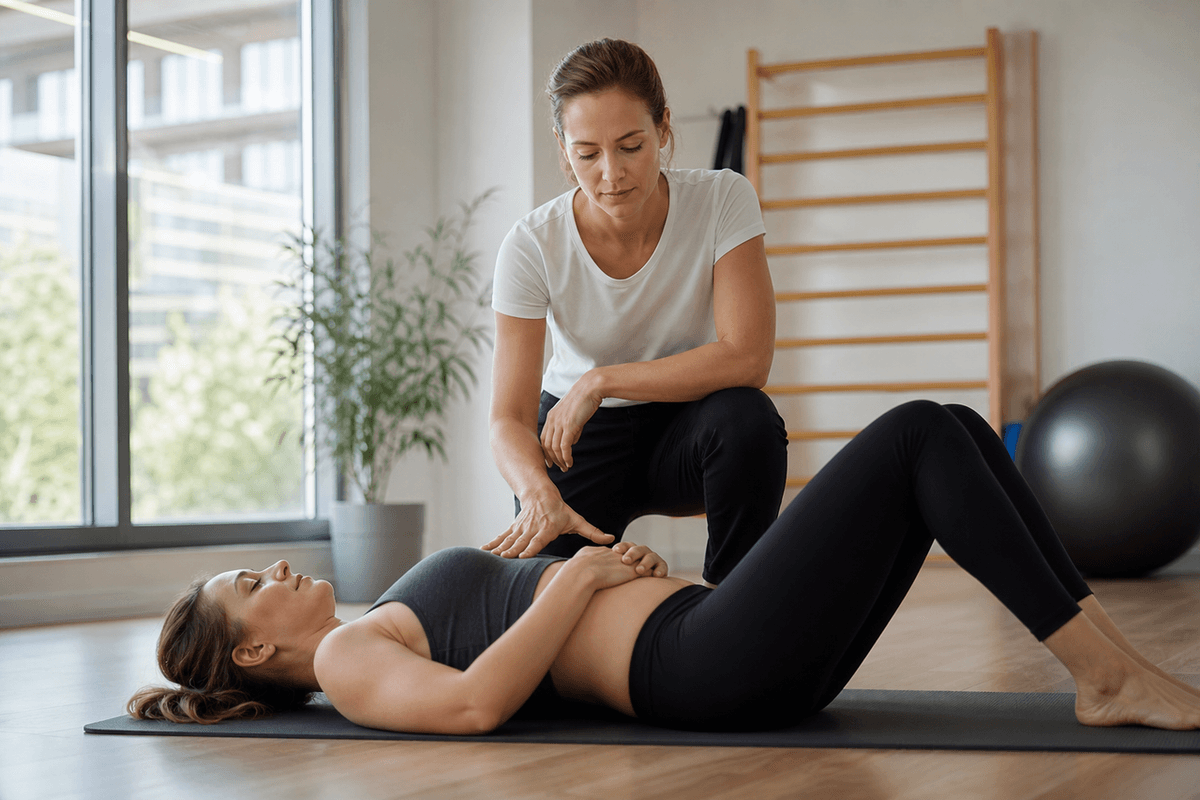
Short answer: The gap matters less than how the abdominal wall works. Diastasis recti is a stretched midline, near universal in late pregnancy, not a tear or a hernia, and one cohort found no link to back pain. Progressive trunk loading with a pelvic health physio helps; binders and massage close nothing.
Diastasis recti is a widening of the gap between the two long abdominal muscles along the midline, it is close to universal in late pregnancy and common a year after birth, and it is neither a tear nor a hernia. What changed is the evidence. The gap itself matters less than how the abdominal wall works, a large cohort found no link between the gap and back or pelvic pain, and a randomized trial found that curl-up training improved strength without widening it, which overturns the blanket “never crunch again” rule that studios, apps and binders were built on.
What actually helps is progressive loading of the whole trunk with someone who knows postpartum bodies, usually a pelvic health physiotherapist, and a class teacher who has been told. Massage cannot close it, binders do not fix it, and “close the gap” programs sell a number rather than function.
This is general information, not medical advice. A bulge that hurts or will not go back is a clinician’s question, and that section comes near the end.
What diastasis recti actually is
A stretched midline, not a torn one.
The two rectus abdominis muscles, the ones behind a six-pack, run down the front of the abdomen either side of a strip of connective tissue called the linea alba. Pregnancy stretches that strip to make room, and the muscles drift apart. After birth the strip often stays wider and softer than before, and that is diastasis recti. The tissue is thinner, not broken.
Sperstad and colleagues in the British Journal of Sports Medicine in 2016 followed women through pregnancy and the year after childbirth and found the separation very common, and found no association between the gap and low back or pelvic pain in that cohort. That single finding undercuts most of the fear sold around it: the gap is not, on its own, the reason a back hurts.
Men and people who have never been pregnant can have it too, from weight change, heavy lifting or simply how they are built. The finger-width check a clinician does above and below the navel is a rough screen, not a diagnosis to make from a video, and the number of fingers is a weak guide on its own. Our guide to which bodywork suits which complaint covers getting assessed before booking.
The crunch ban, and the trial that overturned it
One trial, supervised, and enough to stop the fear.
For years the standard advice was that any movement that curls the trunk, sit-ups, crunches, even lifting the head off the floor, would drive the two muscles apart and had to be avoided for good. Apps, classes and “diastasis-safe” programs were built on it.
Gluppe and colleagues in the Journal of Physiotherapy in 2023 tested it. In a randomized controlled trial in postpartum women, supervised curl-up training improved abdominal muscle strength without worsening the distance between the rectus muscles. Read it for what it is: one trial, with supervision, in one population. It is a reason to stop fearing the movement, not a licence for an unsupervised crunch program on the living room floor.
The wider exercise literature is thinner than the marketing suggests. Benjamin and colleagues in Physiotherapy in 2014 reviewed the trials of exercise before and after birth and found the evidence weak and inconsistent on whether exercise prevents or reduces the separation. Function improves with training. Whether the gap closes is a separate and less important question.
What actually helps
Load the whole trunk, gradually, with someone who knows.
The useful goal is an abdominal wall that manages pressure and load, which means the deep abdominal muscles, the pelvic floor and the breath working together under gradually increasing demand. That is described in words here on purpose: what it looks like for your body, and in what order, is the job of a pelvic health physiotherapist, who is also the person to assess the pelvic floor that often shares the same history. Our comparison of massage and physical therapy covers why only one of those changes what a trunk can carry.
Timelines after birth belong to our postpartum guide, including the caesarean specifics, and our guide to sauna, cold plunge and massage during pregnancy covers the months before. This piece is about the wall itself.
Pilates, yoga and studio classes
Tell the instructor, watch for doming, and adjust rather than panic.
Pilates and yoga classes are reasonable places to rebuild, with an instructor who knows what to look for. The signal to watch is doming: a ridge rising along the midline when you lift or brace, which means the wall is not managing the pressure of that particular movement yet. It is information, not a catastrophe, and the answer is a smaller version of the move or a different one, not the end of the class.
Early on, the shapes that tend to dome are the ones that load the front of the trunk hard: full planks, double leg lowers, heavy overhead work, and deep backbends that stretch the midline. An informed instructor scales those. The method matters less than the person teaching it, as our reformer versus mat comparison says of Pilates generally, and our guide to yoga styles helps pick a class that spends its time on control.
What massage can and cannot do
Comfort, honestly named, and nothing closed.
A postpartum back and abdomen are tired, and massage eases that. What it does not do is move two muscles closer together or tighten a stretched strip of connective tissue, and any therapist promising to close a gap by hand is describing something hands cannot do. Our piece on what massage does for recovery covers what that effect is and is not.
Abdominal binding and “closing” massage exist as cultural practices in many places, and people find them comforting and supportive in the early weeks. Comfort is a fair reason to want them. Evidence that they change the gap is not there, and a caesarean scar needs its own clearance before anyone works near it, as the postpartum guide covers.
Diastasis recti at a glance
| Approach | What it can honestly change | Best for |
|---|---|---|
| Pelvic health physiotherapy | Function, pressure management, the pelvic floor alongside | Anyone with symptoms, and the first stop |
| Progressive trunk loading | Strength and what the wall tolerates | Rebuilding, under guidance |
| Curl-ups and trunk flexion | Strength, without widening the gap in the trial | Supervised, not feared |
| Pilates or yoga with an informed instructor | Control, confidence, a place to practise | Once cleared, with doming watched |
| Massage | Comfort for a tired back and abdomen | Feeling better, not closing anything |
| Binders and wraps | Support and comfort early on | Comfort only, no closing |
| ”Close the gap” programs | A number on a ruler, at best | Nobody who wants function |
What is oversold
The fix that fits in a box.
Binders and wraps sold as repair are the obvious one, and the logic is the same as any external support: they hold you while they are on and change nothing underneath, as our read on whether posture correctors work explains for the back. “Close the gap in thirty days” programs sell the ruler measurement that the cohort study found does not track pain, and “diastasis-safe” is a marketing label rather than a standard.
Surgery exists, for some people with a wide separation, symptoms and a stable weight who have done the rehabilitation first. Pitched as a default, it is oversold. Our guide to spotting a nonsense wellness claim is the filter for the rest.
When this is a clinician’s question
Some bulges are not diastasis.
A bulge along the midline that is painful, hard, or cannot be gently pushed back can be a hernia, which is a different structure and a doctor’s question, promptly. So is persistent pain that does not fit the picture, and so are pelvic floor symptoms: leaking, heaviness, pain with sex, a sense that something is pressing down. Doming that hurts rather than simply appears is a reason to be assessed rather than to push on.
If you are not sure what you are feeling, that is itself a reason to see someone, and a pelvic health physiotherapist is the right first door for most of it. We only recommend what we would send a friend to, and here that means an assessment before a program. Our credential-checking guide covers vetting whoever you see.
FAQ
Can massage close diastasis recti? No. Massage eases a tired postpartum back and abdomen, which is worth having, and it does not move the muscles or tighten the midline. A therapist promising to close a gap by hand is describing something hands cannot do.
Are crunches bad for diastasis recti? Not according to the trial that tested it, where supervised curl-up training improved strength without widening the gap. That is a reason to stop fearing the movement, with guidance, not a licence for an unsupervised program.
Is Pilates safe with diastasis recti? Yes, with an instructor who has been told and who scales the moves that make the midline dome. The method matters less than the person teaching it.
Do binders fix diastasis recti? No. They offer support and comfort in the early weeks, and they change nothing underneath. Function comes from loading the trunk, not from wrapping it.
The bottom line on diastasis recti
Diastasis recti is a stretched midline, nearly universal in late pregnancy and common a year on, not a tear and not a hernia, and the gap on its own does not predict pain. The blanket ban on trunk flexion did not survive a randomized trial, and the exercise evidence overall is thinner than the marketing.
What helps is progressive loading of the whole trunk with a pelvic health physiotherapist, a class instructor who watches for doming and scales the move, and honest expectations of massage and binders, which comfort and close nothing.
A bulge that is painful, hard or will not go back, persistent pain, or pelvic floor symptoms are reasons to see a clinician rather than buy a program.