Do compression boots actually work? What the evidence says
The inflatable boots athletes wear on the sideline feel incredible and look scientific. The honest evidence says they are very good at one thing, decent at another, and oversold on the rest.
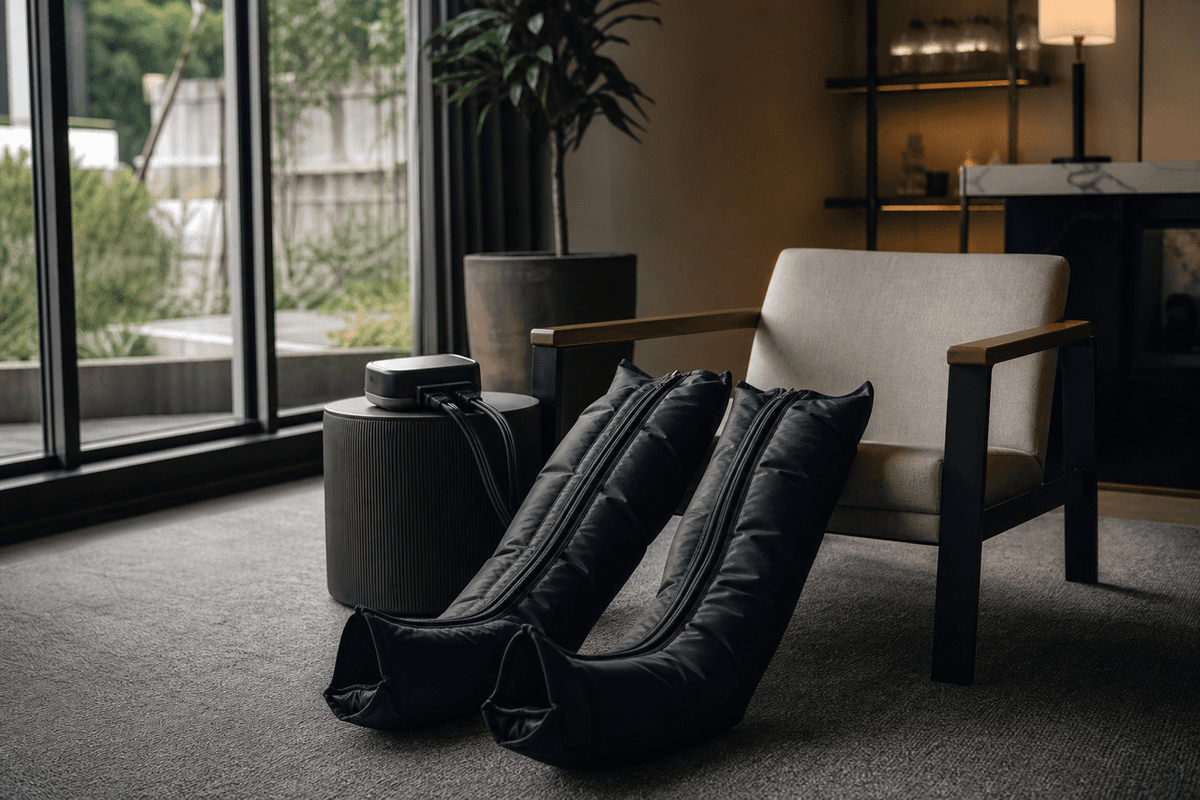
Short answer: They reliably make legs feel less sore and heavy, and that is worth something. What the evidence does not support is faster recovery: reviews find perceived soreness drops while evidence for objective recovery and next-session performance stays limited and inconsistent. Treat them as a comfort buy and twenty enforced minutes of rest, not a performance edge.
Compression boots reliably make your legs feel less sore and heavy, and they are genuinely pleasant. What the evidence does not clearly support is that they speed up your actual recovery in any way that shows up in your next performance. The strong, consistent finding is about how you feel, not about what you can do.
That is not a dismissal. Feeling less sore and more relaxed has real value, and the boots deliver it. It just is not the same claim as recovering faster.
So they are a good comfort and relaxation tool with modest evidence, and an oversold performance device. Worth using if you enjoy them, not worth believing the bigger marketing.
What are compression boots doing?
Squeezing your legs in waves to move fluid.
Pneumatic compression boots, the best known being Normatec, are inflatable sleeves that wrap your legs and squeeze in a rhythmic, often sequential pattern from the feet upward. The idea is to mimic and assist the body’s natural return of blood and lymph fluid from the limbs back toward the heart.
The intended effect is to reduce swelling and the pooling of fluid and metabolic byproducts after hard exercise, and to increase circulation through the limb during the session.
Mechanically this is plausible, and the sensation of it working is strong, which is a big part of why people love them. Whether that translates into meaningfully better recovery is the real question.
What does the evidence on compression boots show?
Good for perceived soreness, weak for measured recovery.
Reviews of the research land in a fairly consistent place: intermittent pneumatic compression reliably reduces perceived muscle soreness and the feeling of fatigue, but the evidence that it improves objective recovery markers, or your actual performance in a subsequent session, is limited and inconsistent.
In other words, studies find people feel better after using them, but struggle to show they perform measurably better than they would have anyway. This is a recurring pattern across recovery tools. Our massage recovery guide and ice versus heat guide describe the same feel-good-but-hard-to-measure story.
The honest summary: strong evidence for comfort, thin evidence for a real recovery edge.
Is feeling less sore worth anything?
Yes, genuinely, and it is worth being clear about that.
Feeling less sore and less heavy-legged is not nothing. It can make you more willing to train the next day, it aids relaxation, and the twenty minutes with your legs up doing nothing is itself restful. Perceived recovery influences behaviour, and behaviour influences results.
There is also a plausible benefit for reducing swelling and that heavy, puffy feeling after very long efforts or travel, where fluid pooling is real. Some people find them genuinely helpful after a marathon or a long flight.
So the value is real, it is just mostly in how you feel and how that affects what you do next, not in a measurable acceleration of tissue repair.
Who might actually benefit most?
High-volume athletes, and people who will genuinely use them.
If you train hard and often, and the limiting factor is how beaten-up your legs feel between sessions, boots can help you feel readier and more willing to go again. That subjective readiness has practical value for someone training daily.
For the average person exercising a few times a week, the benefit over simply resting, elevating your legs, walking, and sleeping is small. Sleep and easy movement remain the highest-value recovery tools by a wide margin. Our weekly recovery routine guide covers where the real leverage is.
They are also a nice, low-effort way to make yourself sit still and relax, which some people struggle to do otherwise.
Are they worth buying or paying for?
Depends on your budget and how much you value the feeling.
A personal set is a significant purchase, often many hundreds of dollars, and recovery lounges and studios increasingly offer sessions for a drop-in fee. Our session cost guide covers how that compares to other services.
Given the evidence, treat them as a comfort and relaxation buy, like a nice massage chair, not as a proven performance investment. If you will use them often and you value the feeling, they can be worth it. If you are buying them expecting a measurable training edge, the evidence does not back that.
Try a few sessions at a recovery lounge before spending on your own pair. Our foam roller versus massage gun guide covers cheaper home tools that occupy a similar space.
The bottom line on compression boots
Compression boots reliably reduce how sore and heavy your legs feel, which is pleasant and has real behavioural value, but the evidence that they speed genuine recovery or improve your next performance is weak.
Enjoy them for the comfort and the enforced twenty minutes of rest. Do not pay a premium expecting a proven performance boost, because that part is marketing ahead of the science.
To find a recovery lounge or wellness studio near you, start with our city wellness maps.
The same comfort-versus-treatment question applies to the other big recovery purchase: our guide on whether a massage chair is worth it runs that arithmetic.
The same evidence-first question applies to the other machine in most recovery lounges: our read on whether vibration plates actually work covers what the research does and does not support.