Cold plunge after a workout: good or bad? What the trials show for recovery and muscle growth
This is the one cold-exposure claim with real experimental evidence behind it, and it is mostly true. Here is what the studies found, how large the effect is, and how to keep both the plunge and the gains.
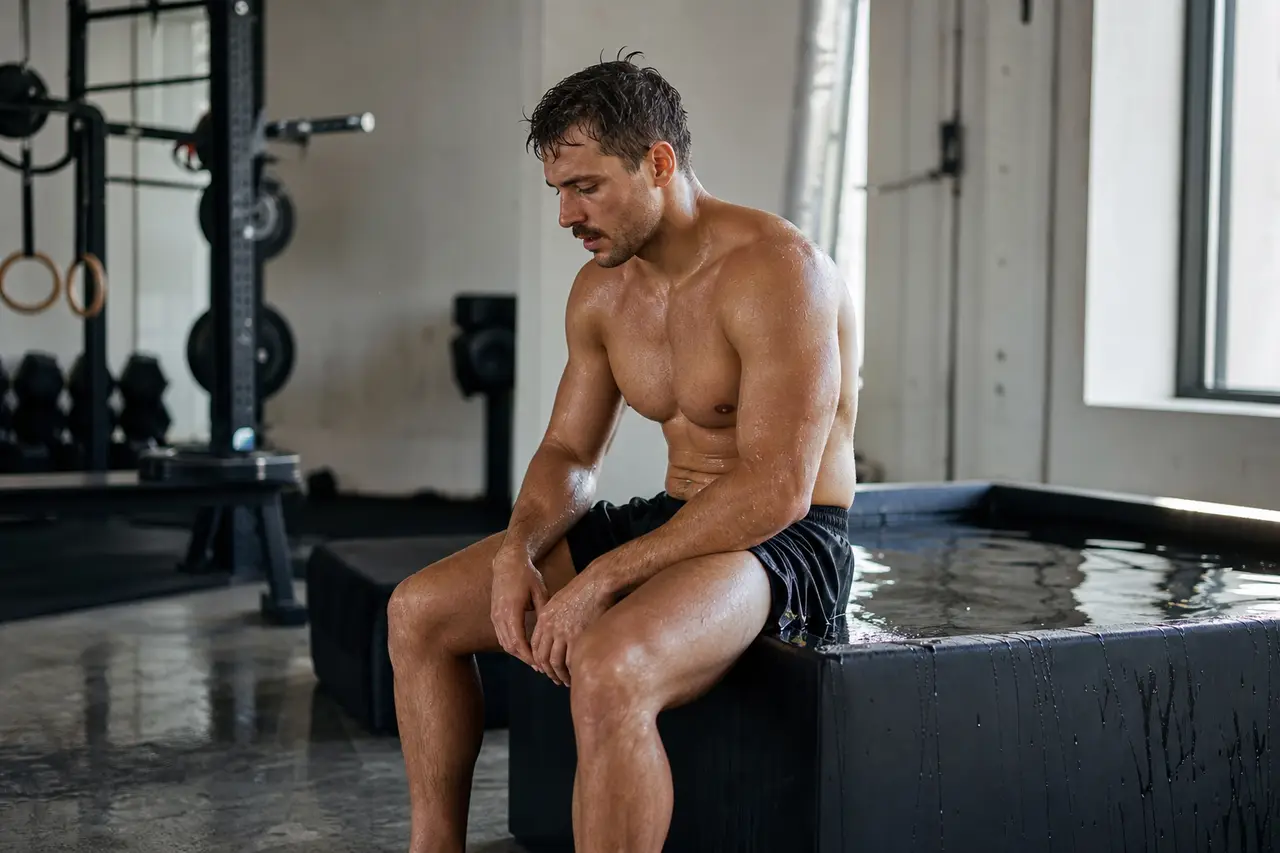
Short answer: It depends on your goal. For recovery, cold water works: a 2022 meta-analysis of 52 studies found it improved muscular power 24 hours after hard exercise, eased soreness and improved how recovered people felt. For muscle growth, it gets in the way: in two training trials, regular cold water right after lifting led to less muscle growth (one also found smaller strength gains, the other did not). If muscle is the goal, plunge on days you do not lift.
It depends on what you are training for.
Cold water immersion right after resistance training has been shown in controlled trials to reduce long-term gains in muscle size compared with resting or active recovery. For bouncing back from a hard session, though, the same cold water is one of the better-supported recovery tools.
The effect is real but narrow. It applies to cold immersion right after strength training, not to cold on rest days, not to cold before training, and not to endurance athletes chasing recovery between competition sessions.
If you want both, plunge on the days you do not lift, or before you train.
What does the evidence actually show?
The clearest result comes from Roberts and colleagues, published in The Journal of Physiology in 2015.
Twenty-one physically active men did 12 weeks of strength training, twice a week, and after each session either sat in cold water for 10 minutes or did light active recovery. Strength and muscle mass increased more in the active-recovery group; type II muscle fibre size grew by 17% with active recovery but not with cold water.
The same team found that cold immersion also blunted the acute signalling in muscle that drives growth, including satellite cell activity, in the hours after a session.
Fyfe and colleagues, in the Journal of Applied Physiology in 2019, had 16 men lift three times a week for 7 weeks, followed by 15 minutes in water at 10°C or a passive rest at 23°C. Growth of type II muscle fibres was smaller with cold water, but gains in one-rep maximum leg press were similar in both groups. Their conclusion: post-exercise cold water “should therefore be avoided if muscle hypertrophy is desired,” but blunted fibre growth “does not necessarily translate to impaired strength development.”
What cold water does for recovery
The recovery side is well supported. A 2022 meta-analysis in Sports Medicine by Moore and colleagues pooled 52 studies comparing cold water with passive recovery after a single hard session. Cold water improved the recovery of muscular power 24 hours after both eccentric and high-intensity exercise, reduced muscle soreness, improved how recovered people felt and lowered creatine kinase, a marker of muscle damage. It made no difference to the recovery of strength.
A 2023 follow-up compared cold water with other recovery methods across 28 studies: it was better than the alternatives for soreness and similar for muscular power and flexibility.
That is why the timing question matters: the same cold water that helps you feel ready for tomorrow’s session can, done after every lifting session for months, take some muscle growth with it.
Why would cold do that?
Because the inflammation you are dousing is part of the adaptation.
Resistance training causes local muscle damage and an inflammatory and signalling cascade, and that cascade is the message that tells the muscle to repair itself larger and stronger.
Cold immersion reduces blood flow, muscle temperature, and that inflammatory response. It genuinely makes you feel better sooner, which is exactly the problem: it suppresses the signal along with the soreness.
Cold is not damaging the muscle. It is quieting the conversation that follows the workout.
How big is the effect, honestly?
Meaningful for a serious lifter, probably irrelevant for most people.
The differences in these trials show up over months of consistent, hard training. They are not dramatic overnight losses. If you lift twice a week for general health and you love your post-gym plunge, the plunge is very unlikely to be what limits your results.
If you are training specifically for hypertrophy or strength, it is a real and avoidable cost.
Part of the recovery effect may also be expectation. In a 2014 trial in Medicine & Science in Sports & Exercise, Broatch and colleagues found that a placebo recovery treatment restored leg strength over 48 hours as well as cold water did, suggesting the commonly assumed benefits are “at least partly placebo related.”
Does this apply to every kind of cold?
No, and this is where most of the internet gets it wrong.
The trials used cold water immersion, not cryotherapy chambers, and not cold showers, and the timing was immediately after training.
There is much less evidence about whether a two-minute plunge many hours later carries the same cost, and no good reason to think a cold shower at breakfast affects an evening workout. For the difference between the cold modalities, see our cold plunge vs cryotherapy comparison.
So when should you plunge?
Three workable options.
Plunge on rest days, which costs you nothing in muscle growth. Cleveland Clinic says studies point to less stress and more alertness and focus from ice baths, but a 2025 analysis of 11 studies found no improvement in mood, so do not plunge for that. Our cold exposure and dopamine explainer covers the hormone claims.
Or plunge before you lift. The trials tested cold water right after training; none tested a set waiting time, so a separate day is the cautious choice.
Or, if you are in a competition block where feeling fresh tomorrow matters more than growing over the next three months, plunge right after training on purpose. A 2021 review by Petersen and Fyfe found that post-exercise cold water can blunt adaptations to resistance training “without negatively influencing endurance training adaptations,” so runners and cyclists have less to lose.
The rule is not “cold is bad.” It is that cold and hypertrophy are competing for the same window.
FAQ: cold plunge after a workout
Is a cold plunge after a workout good or bad? Good for recovery, bad for muscle growth. A 52-study meta-analysis found that cold water after hard exercise improved power and soreness the next day, while two training trials found less muscle growth when people sat in cold water after every lifting session.
How long after a workout should you wait to cold plunge? The trials tested cold water within minutes of training, and none tested a specific waiting time. If muscle growth is your goal, the safest choice is to plunge on days you do not lift, or before you train.
Is an ice bath good after running? For recovery, yes: cold water improved power and soreness after hard sessions in the 2022 meta-analysis, and a 2021 review found it does not blunt endurance training adaptations the way it blunts strength training adaptations.
Does a cold plunge reduce muscle soreness? Yes. Across studies, cold water reduced soreness 24 hours after high-intensity exercise compared with passive rest, and did better for soreness than other recovery methods in a 2023 meta-analysis.
Should you sauna or cold plunge after a workout? For muscle growth, cold water right after lifting is the one with evidence against it. Our guide to whether a sauna after training makes you fitter covers the heat side.
The bottom line on cold plunge after training
Post-lift cold immersion blunts muscle growth, and in one of two training trials strength gains too; the same cold water is a good recovery tool after hard sessions. The fix is timing rather than abstinence.
Keep the plunge, move it. Our ice bath and cold plunge guide covers what cold does deliver, and our how often guide covers a sustainable weekly rhythm.
Want Google to show you more from Tendground? Add us as a preferred source.