Is a home sensory deprivation tank worth it? The honest math
The tank is the cheap part. What decides whether a home float setup works is a room you can spare permanently, a floor that can take a tonne of salt water, and a maintenance routine you will actually keep up.
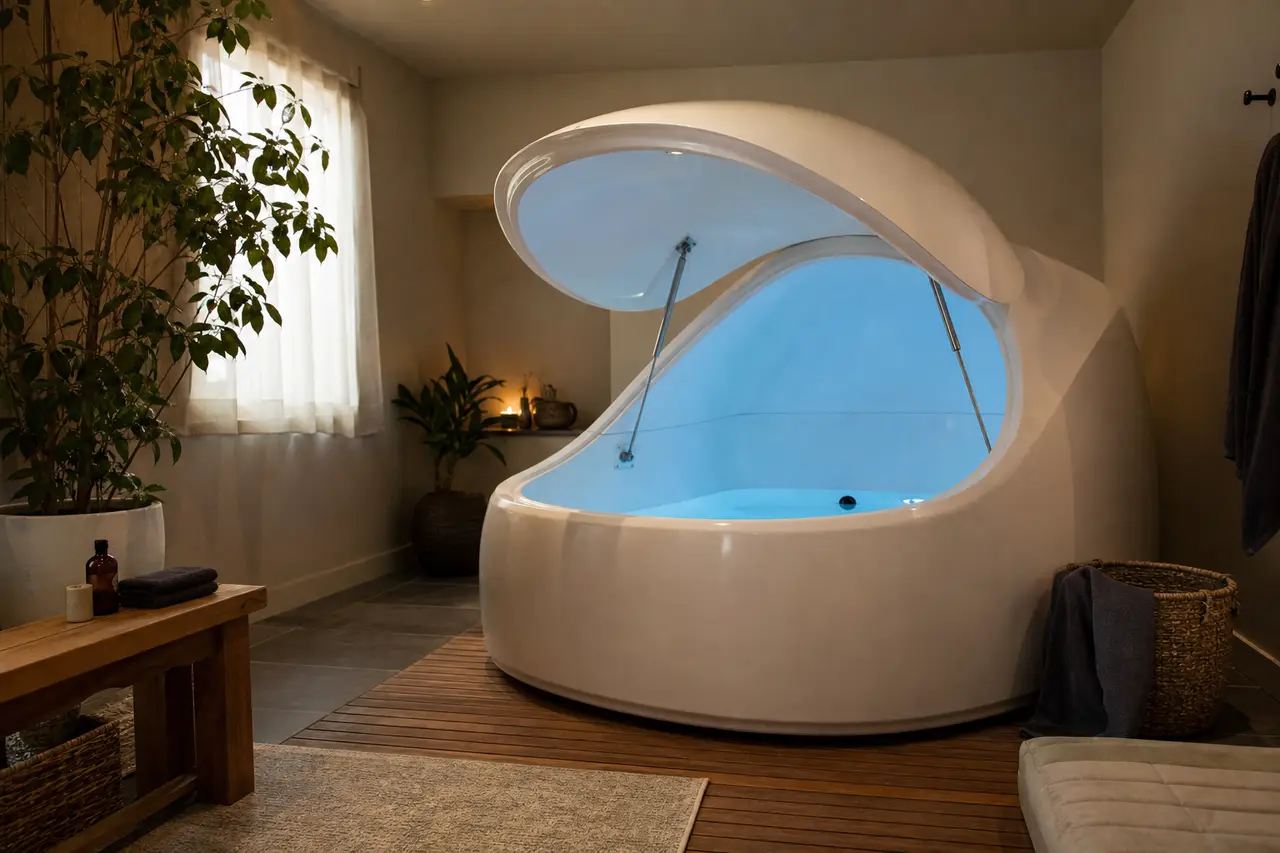
Short answer: Rarely. Entry-level pods run $2,500 to $5,000 and the tank is about half the real cost once you add several hundred pounds of salt, heating and filtration. You also need a permanently dedicated room and a floor that can carry 1,500 to 2,500 pounds. Break-even takes years unless you float weekly.
A home float tank, sensory deprivation tank and isolation tank are three names for the same thing: a light-proof, sound-proof enclosure holding shallow water so heavily saturated with Epsom salt that you float without effort, warmed to skin temperature so you gradually stop noticing where your body ends. The benefit people actually report is the one worth buying for, deep relaxation and a quiet head, and our float tank guide covers what the evidence does and does not support before you spend anything.
Home setups are one of the fastest-growing corners of home wellness, and the search interest runs well ahead of the honest information available. Most of what you find is written by people selling tanks.
The purchase price is the easiest number to find and the least useful. What actually determines whether this works is space, floor loading, and whether you will keep up a maintenance routine that has no equivalent in a home sauna or a cold plunge.
Here is what it costs, what it needs, and the arithmetic against simply going to a centre. We don’t take placement fees, so nothing here points you at a brand.
What does it actually cost?
The tank is roughly half the real number.
Entry-level home pods start around $2,500 to $5,000. Mid-range units with better filtration and heating land in the $5,000 to $10,000 range. Commercial-grade tanks, which is what float centres run, start around $10,000 and go well past $25,000.
Then the costs nobody quotes at the top. Epsom salt for the initial fill is substantial, since a tank holds roughly 500 to 1,000 pounds of magnesium sulphate, and food-grade or USP salt in that quantity typically runs several hundred to over a thousand dollars. You top it up as salt leaves with you.
Running costs are heating and filtration, since the water is held at skin temperature continuously, plus periodic salt replacement, filter cartridges, and hydrogen peroxide or UV consumables. Budget a few hundred dollars a year at minimum, more if you run it warm year-round in a cold room.
What does it need from your house?
A dedicated room, and a floor that can take the load.
This is the part that stops most projects. A filled tank plus water plus salt commonly weighs somewhere around 1,500 to 2,500 pounds concentrated in a small footprint. On a ground floor slab that is fine. On a suspended timber floor upstairs it is a structural question, and the honest answer is that you should ask someone qualified rather than guess.
You also need the room permanently. A float tank is not something you fold away, and the water stays in it between uses. Most people convert a spare room, a basement, or a garage.
The room itself matters more than people expect: high humidity from a large warm water surface needs ventilation or you will get condensation and mould, salt is corrosive to fixtures and anything metal nearby, and you want a floor surface that tolerates repeated salt water drips. A drain in the room, or at least easy access to one, makes water changes far less miserable.
Home float tanks at a glance
| Home float tank | |
|---|---|
| Tank cost | $2,500 to $5,000 entry, $10,000+ commercial |
| Initial salt | Several hundred to $1,000+ |
| Running cost | Heating, filtration, consumables; a few hundred a year up |
| Weight when filled | Roughly 1,500 to 2,500 lb in a small footprint |
| Space | A permanently dedicated room |
| Ventilation | Required; large warm water surface |
| Maintenance | Filtration every session, chemistry checks, periodic salt top-up |
| Realistic break-even | Years, at typical centre pricing |
| Best case for buying | Frequent user, ground floor, spare room, enjoys upkeep |
How much maintenance is it really?
More than a hot tub, and unlike a sauna it never stops.
Water chemistry is the ongoing job. The solution is close to saturated salt, which is naturally inhospitable to most organisms but not sterile, so you still run filtration between every use and manage sanitiser, usually hydrogen peroxide with UV.
You check specific gravity, since salt leaves the tank on your skin and towels, and top it up to keep the buoyancy right. You check and adjust pH. You replace filter cartridges. You wipe salt creep off surfaces before it corrodes them.
None of it is difficult. All of it is regular, and it is the reason home tanks end up drained and unused more often than home saunas do. Be honest with yourself about whether you are a person who maintains a pool well, because this is that job in a smaller and saltier form.
What does a home tank actually do for you?
The same thing a float centre does, with one addition and one subtraction.
The evidence for floating itself is reasonable on a few specific things: lower anxiety and stress after a session, temporary relief from muscle tension and some chronic pain, and better sleep on the night you float, particularly if your baseline stress is high. It is weaker on durable effects that outlast the session, and there is no credible support for detox or cellular-reset claims. Our float tank guide sets out what the research does and does not show in full.
What owning one adds is frequency. The benefits above are dose-dependent in practice, and the main reason people stop floating is friction: booking, driving, and the ninety minutes around the session. A tank at home removes all of that, which is the honest case for buying one.
What it subtracts is the environment. A commercial float room is built to be dark, silent and thermally stable, and the water is filtered between every session by equipment you are not going to install at home. A spare bedroom with a pump running down the hall is a different experience, and if your setup is even slightly noisy, bright or too cool, you lose a meaningful part of what makes a float work.
So the benefit question and the purchase question are not the same question. If you want to know whether floating helps, float at a centre several times first. If you already know it helps and you are only limited by how often you go, that is when the tank starts to make sense.
When does the maths work?
Only if you float often, for years.
Run the arithmetic against your actual usage rather than your intended usage. At typical float centre pricing, a mid-range home setup takes a large number of sessions to break even before you count salt, power, and your time.
Most people float far less often than they plan to. The honest comparison for an occasional user is not close, and a membership or a ten-pack at a centre wins comfortably.
Where it does work: you float weekly or more, you have a ground-floor room you can give up permanently, and you would genuinely rather maintain equipment than book appointments. That is a real profile, it is just narrower than the marketing suggests. Our guide on whether wellness studio memberships are worth it covers the same maths for studio use.
What are the alternatives?
Float centres, and a cheaper home experiment.
A float centre gives you a commercial tank, professional water management, a soundproofed room, and no upkeep. For almost everyone that is the better product. Our guides to float tanks and what a session is like and what to expect at your first float cover the experience, and finding a good studio in a new city covers vetting one.
If the appeal is deep rest rather than buoyancy specifically, there are far cheaper routes to a similar state. Our guides on yoga nidra and float tank vs sound bath cover them.
And if you are building a home wellness setup generally, a sauna or cold plunge is a much easier first purchase: lower maintenance, no water chemistry, and simpler installation. Our guides on home cold plunge and sauna costs and starting a home cold plunge safely cover that route.
What should you check before buying?
Five things, in this order.
Floor loading, if it is going anywhere but a ground-floor slab or basement. Get a professional opinion; this is not a guess-and-see item.
Room dimensions including door access, because tanks are large and some do not fit through a standard doorway assembled.
Ceiling height, if you want a pod you can sit up in or a cabin you can stand in.
Ventilation and drainage in the room you have in mind.
Filtration spec and support, since the cheap end of the market varies a lot in pump quality, heater reliability, and whether anyone will help you when something fails. Ask what the warranty covers and how consumables are sourced.
FAQ: home float tanks
How often do you change the water? With good filtration and chemistry, the solution is maintained rather than fully replaced, often for a year or more. You top up salt and water continuously and do a full change occasionally.
Can I float in a bathtub instead? Not really. A standard tub is too shallow for the buoyancy to work properly and holds nowhere near enough salt volume. This is a genuine difference from cold plunging, which does work in a bathtub.
Is the salt the same as Epsom salt from a pharmacy? Chemically yes, magnesium sulphate, but you need food-grade or USP quality in bulk, which is sourced differently and priced by the pallet.
Does a float tank need its own electrical circuit? Often, for the heater and pump. Check the spec before you assume an existing outlet will do.
The bottom line on home float tanks
Entry-level pods start around $2,500 and commercial units run past $10,000, but the purchase price is roughly half the real cost once you add several hundred pounds of salt, heating, filtration, and consumables.
The deciding factors are a permanently dedicated room, a floor that can carry well over a tonne concentrated in a small area, and a water-chemistry routine that never stops. If you float weekly and have the space, it can make sense. For everyone else, a centre is the better buy and the maths is not close.