Wellness with lymphedema: heat, massage, exercise and what the spa version gets wrong
Spas sell lymphatic drainage as a slimming treatment. People with lymphedema need the clinical version from a certified therapist, cautious heat, no deep pressure on the limb, and, against every instinct, supervised strength training.
Short answer: Spa lymphatic drainage is not the treatment for lymphedema. What helps is decongestive therapy from a certified therapist, compression, skin care, and supervised progressive strength training, which a landmark trial found safe and protective. Heat is short-and-cooler, deep pressure on the limb is out, and broken skin risks cellulitis.
Lymphedema is chronic swelling caused by a lymph system that no longer drains properly, most often an arm or leg after cancer treatment, and the spa treatment sold under the same name is not the treatment for it. What helps is the clinical version, delivered by a certified lymphedema therapist alongside compression and skin care, and, against every protective instinct, supervised strength training, which a landmark trial found safe and protective.
Around that, the wellness menu needs reading with the limb in mind. Heat is the standard caution, deep pressure on the affected limb is the thing to refuse, scrubs and anything that breaks the skin raise the infection risk that matters most, and swimming is close to ideal. Massage elsewhere on the body is fine.
This is general information, not medical advice. Lymphedema is managed by a lymphedema therapist and your medical team, and what follows is how to enjoy the rest of the menu without undoing their work.
What lymphedema actually is
A drainage problem, not water retention, and it is chronic.
The lymph system collects fluid and protein from the tissues and returns it to the bloodstream through a network of vessels and nodes. When nodes are removed or damaged, most commonly by cancer surgery and radiation, fluid backs up in the limb or region they served, and the swelling that results is lymphedema. It can appear months or years after treatment, it is chronic, and it is managed rather than cured. Primary forms exist that are not caused by treatment.
The International Society of Lymphology consensus document in Lymphology in 2020 sets out the standard of care: complete decongestive therapy, which combines manual lymphatic drainage, compression, exercise and skin care, delivered by trained therapists. That combination is the treatment, and every item on the spa menu below is measured against it.
The spa version and the clinical version
Same name, different thing, different person doing it.
Manual lymphatic drainage is a specific, light, rhythmic technique, and in a clinical setting it is one part of decongestive therapy for someone with a diagnosed condition. Ezzo and colleagues in the Cochrane Database of Systematic Reviews in 2015 reviewed it for lymphedema after breast cancer treatment and found it adds a modest benefit to compression, on limited evidence. That is the honest size of the effect, and it is real.
The spa version borrows the name for a slimming, detox or contouring treatment on people with a working lymph system. Our lymphatic drainage explainer covers how thin that side is. For someone with lymphedema the distinction is practical: you want a therapist certified in lymphedema care, working within your treatment plan, not a spa menu item performed by someone trained in a weekend. Ask about certification directly, and use our credential-checking guide for the rest.
Heat, saunas and hot tubs
The standard caution, and why it is a caution rather than a ban.
Heat dilates blood vessels and increases the fluid arriving in the tissues, and a limb that cannot drain properly may swell more after a sauna, a hot tub or a long hot bath. That is the reasoning behind the standard advice to be careful with heat, and the evidence behind it is mostly experience rather than trials. Many people with lymphedema use saunas at lower temperatures and shorter sessions without trouble; some find any heat brings the swelling up.
The practical version is a short, cooler session, the affected limb elevated where possible, compression back on afterwards as your therapist advises, and honest attention to what the limb does the next day. Hot stones, heat packs and heated wraps placed directly on the affected limb are the version to decline outright. Our guide to hot springs and our read on whether a sauna is good for your heart cover the general physiology, and neither is written for a limb that cannot drain.
Massage, pressure and the affected limb
Everywhere else, fine. On the limb, only the trained kind.
A general massage is welcome, with one rule: no deep or vigorous work on the affected limb or the region it drains into, including the trunk on that side after breast surgery. Deep pressure and vigorous stroking there can increase fluid load, and the light drainage technique that helps is not something a Swedish or deep tissue therapist improvises. Tell the therapist which limb, ask them to work around it, and keep compression on if that is your routine.
Our guide to massage during and after cancer treatment covers the broader picture for anyone in or after treatment, and our guide to the types of massage covers which styles rely on the deep, sustained pressure to avoid here.
Exercise, and the trial that changed the advice
Strength training is protective, supervised, and the opposite of the old rule.
For years people with lymphedema were told not to lift anything heavy with the affected arm. Schmitz and colleagues in the New England Journal of Medicine in 2009 tested that in women with breast-cancer-related lymphedema and found that a supervised, slowly progressive weight-lifting program did not worsen the swelling and reduced the flare-ups that needed treatment. The program was gradual, supervised and done in compression, and those conditions are the point: it is not a licence to start heavy lifting alone.
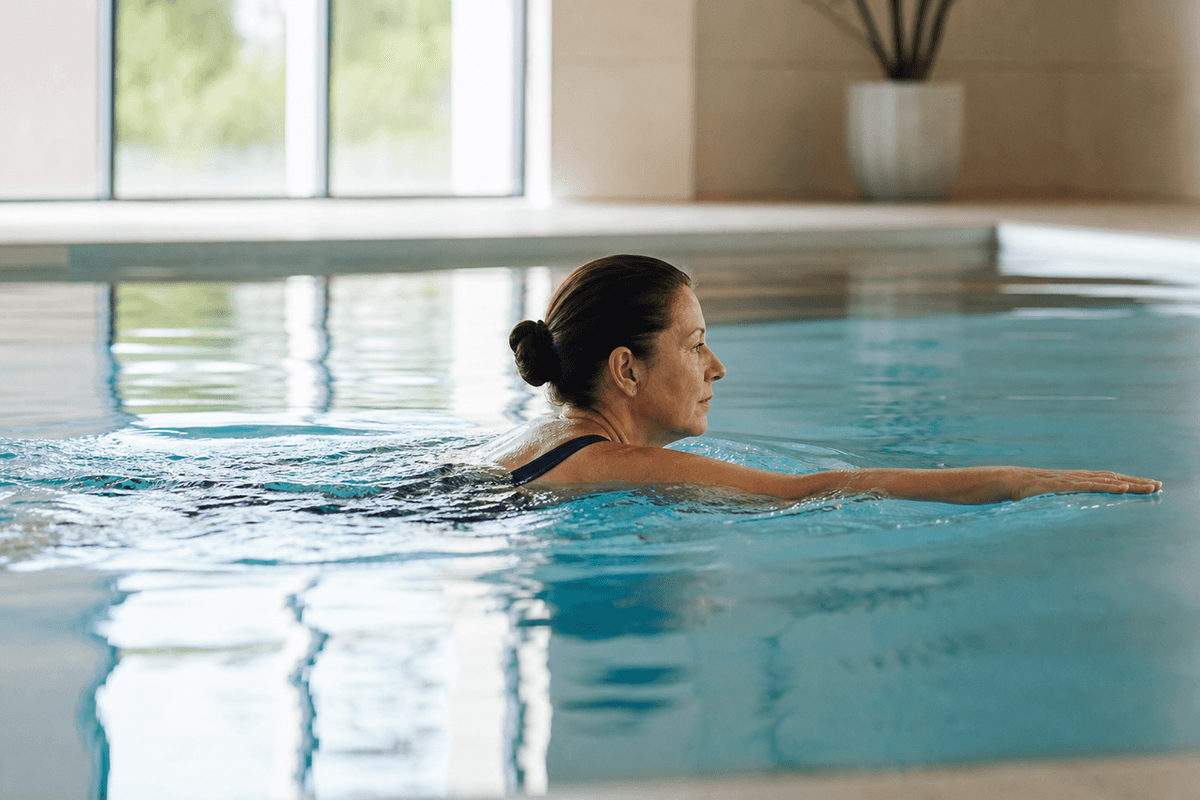
Swimming and water-based movement are close to ideal, because the water’s pressure supports drainage while the limb moves, and the pool is cool. Walking, cycling and yoga with the limb in mind are all reasonable. Our comparison of massage and physical therapy covers why the exercise side belongs with someone who can program it, and a lymphedema therapist or a physiotherapist who knows the condition is that person.
Skin, scrubs, floats and the infection risk
Cellulitis is the emergency, and broken skin is how it starts.
A limb with lymphedema is prone to cellulitis, a spreading skin infection that needs prompt antibiotics, and any break in the skin can start it: a scratch, a cut, a burn, an insect bite, a blister. That reframes a good part of the spa menu. A hammam scrub or a body scrub on the affected limb, cupping or gua sha there, a pedicure with aggressive cuticle work on an affected leg, and dry brushing over the limb all belong in the avoid column. Our read on dry brushing already separates the brush from the drainage it claims to perform.
Keep the skin moisturised, protect it from the sun, and treat any redness, warmth, pain or fever in the limb as urgent. A float tank on intact skin is generally fine and the salt water is not the problem; get out and rinse if there is any cut, and skip it during any skin trouble. Our float tank guide covers the rest of the session.
Compression boots, flights and altitude
A clinician’s device, a standard travel rule, and a question to ask before booking a mountain retreat.
Pneumatic compression devices, the boots and sleeves sold for recovery, are a medical tool in lymphedema care under a therapist’s direction and a very different proposition as a wellness purchase. Our read on whether compression boots work covers the recovery-gadget version. With lymphedema, the settings, the fit and whether to use one at all belong with your therapist, and a studio’s boots are not a substitute.
Flying is a known trigger for many people, and wearing a compression garment for the flight is standard advice from lymphedema clinics. A retreat at altitude is worth a conversation with your therapist for the same reason, and our guide to wellness on a business trip covers the travel logistics that apply to everyone.
Lymphedema and wellness at a glance
| Practice | Fine as is | Needs adjusting | Avoid |
|---|---|---|---|
| Massage, unaffected areas | Yes | Tell them which limb | Deep or vigorous work on the limb or its drainage region |
| Lymphatic drainage | From a certified lymphedema therapist | Within your treatment plan | Spa “drainage” as a substitute |
| Sauna, hot tub, hot bath | Short and cooler, if the limb tolerates it | Raise the limb, compression after, watch the next day | Long hot sessions, heat directly on the limb |
| Hot stones, heat packs | Elsewhere on the body | Nothing specific | On the affected limb |
| Strength training | Supervised, gradual, in compression | Programmed by someone who knows the condition | Heavy lifting alone as a first step |
| Swimming, water movement | Close to ideal | Rinse and moisturise after | Nothing specific |
| Scrubs, brushing, cupping, gua sha | On unaffected skin | Nothing specific | On the affected limb |
| Pedicures, waxing on the limb | Nothing specific | Gentle, no cuticle cutting, no nicks | Anything that breaks the skin |
| Float tanks | Intact skin | Rinse well after | Any cut or skin trouble on the limb |
| Compression boots | As your therapist directs | Their settings, their fit | A studio’s boots as treatment |
| Flights, altitude retreats | With compression, as advised | Ask the therapist first | Long flights without a garment |
What is oversold
Drainage for slimming, brushes for lymph, and cures.
The spa “lymphatic drainage” pitch, with its promises of detox and contouring, is the loudest, and it sells the name of a real treatment to people who do not have the condition while offering nothing extra to people who do. Dry brushes, “lymph-boosting” oils and supplements sold to move fluid sit behind it. Nothing sold as a cure is one: lymphedema is managed, and management works. Our guide to spotting a nonsense wellness claim is the filter.
What belongs to your care team
The therapist, the garments, the program and the infection.
Diagnosis and staging, the compression garments and how to wear them, the decongestive therapy itself, the exercise program and any device belong with a certified lymphedema therapist and your medical team. Ask them specifically about heat, flights and strength training before you book anything that involves them.
Contact them urgently for redness, warmth, pain or a sudden increase in swelling in the limb, and for fever or chills alongside any of those, because cellulitis moves fast and responds to early treatment. We only recommend what we would send a friend to, and here that means a therapist who asks which limb before they touch you, and a spa that does not put its own drainage treatment above your clinic’s.
FAQ
Can I use a sauna with lymphedema? Many people can, short and cooler, with the limb elevated where possible and compression back on afterwards, watching what the limb does the next day. Long hot sessions and heat placed directly on the affected limb are the things to avoid.
Is spa lymphatic drainage the same as lymphedema treatment? No. The clinical version is one part of decongestive therapy from a certified lymphedema therapist, and the spa version is a slimming or detox treatment that borrows the name. With lymphedema, ask about certification and stay within your treatment plan.
Can I lift weights with lymphedema? A landmark trial found that supervised, slowly progressive weight lifting in compression did not worsen breast-cancer-related lymphedema and reduced flare-ups. The conditions matter: supervised, gradual, programmed by someone who knows the condition.
Can I get a massage with lymphedema? Yes, everywhere except the affected limb and the region it drains into, where only the light clinical technique belongs. Tell the therapist which limb and ask them to work around it.
The bottom line on lymphedema
Lymphedema is chronic swelling from a lymph system that no longer drains, managed with decongestive therapy from certified therapists, compression, skin care and exercise. The spa treatment that shares its name is not the treatment, and a limb that cannot drain needs cautious heat, no deep pressure, unbroken skin and, with supervision, the strength training the old advice forbade.
Swimming is close to ideal, massage elsewhere is fine, saunas are a short-and-cooler question, and scrubs, hot stones and studio compression boots on the limb are the things to decline.
The garments, the program, the flights and any redness, warmth, fever or sudden swelling belong with your care team, and cellulitis is the one to treat as an emergency.