Your first hyperbaric oxygen session: what to expect
You lie in a sealed chamber for an hour while the pressure rises. The medical version treats serious conditions. The wellness version is a much gentler thing wearing the same name.
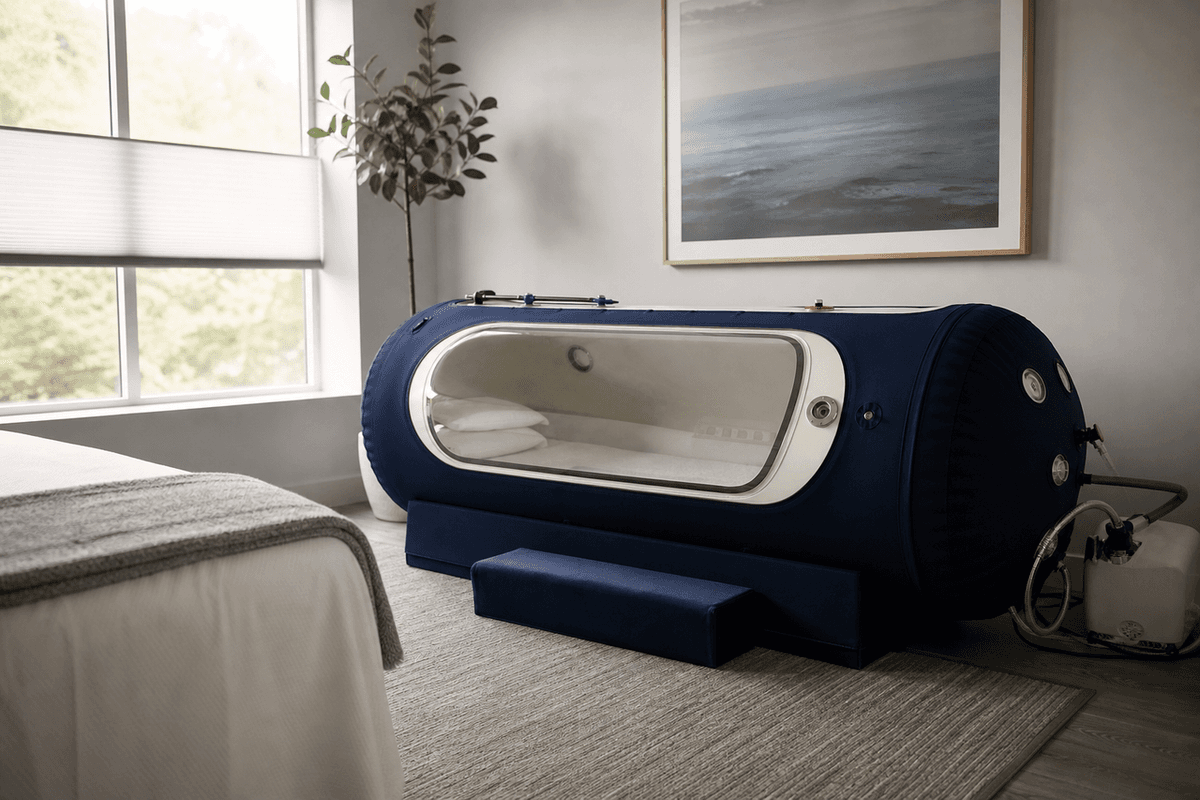
Short answer: You lie in a sealed chamber for 60 to 90 minutes, feel your ears pop during a 10 to 15 minute compression, then get out feeling much the same. Wellness clinics run about 1.3 atmospheres, well below the 2.0 to 2.8 of medical protocols, so skip it with a cold or congestion.
Expect to lie in a sealed chamber for 60 to 90 minutes while the pressure slowly rises, feel your ears pop like a plane coming in to land, and then get out feeling essentially the same as when you went in.
The single most important thing to understand before you book: the hyperbaric oxygen therapy that treats serious medical conditions and the “mild HBOT” sold in a wellness studio are not the same intervention. They share a name and a chamber shape and very little else.
It is a low-drama, generally low-risk hour. Just go in knowing what it is.
What actually happens in a hyperbaric session?
You get in, it seals, the pressure rises, you wait.
You will be shown to either a hard-shell chamber or, at most wellness clinics, a soft-sided inflatable one that looks a bit like a large sleeping pod. You lie down. Depending on the setup you may wear a mask or hood delivering oxygen, or the whole chamber may be pressurised.
Then the compression phase begins, usually 10 to 15 minutes. This is the part you actually feel: pressure building in your ears. You equalise the way you would on a plane, by swallowing, yawning, or pinching your nose and gently blowing.
Once you are at pressure, you just lie there for the bulk of the hour. Most people listen to something, nap, or watch a screen. Then a slow decompression, and you are done.
Why do your ears matter so much?
Because ear barotrauma is by far the most common thing that goes wrong.
The pressure change is real, and if you cannot equalise, the pressure differential can hurt your eardrum. This is not exotic; it is the same physics as a plane or a dive, and it is the most frequently reported side effect of hyperbaric therapy by a wide margin.
The practical rules: tell them immediately if your ears are not clearing, and they will slow or pause the compression. Never push through sharp ear pain. And do not go if you have a cold, congestion, or a sinus infection, because you will not be able to equalise and you can genuinely injure yourself.
If nobody explains equalising to you before your first session, that tells you something about the clinic. Our studio checklist covers the general questions worth asking.
What is “mild HBOT” and why does it matter?
It is the wellness version, run at a fraction of the medical pressure.
Medical hyperbaric protocols, the ones approved for decompression sickness, carbon monoxide poisoning, non-healing diabetic wounds, and radiation tissue injury, typically run at around 2.0 to 2.8 atmospheres in a hard chamber under clinical supervision.
The soft chambers in wellness studios usually run around 1.3 atmospheres. That is a genuine pressure increase, but it is far below what the medical evidence was built on.
So when a studio cites hyperbaric research, ask which pressure the studies used. Almost always it is the clinical protocol, not theirs. Our hyperbaric oxygen guide separates the approved uses from the wellness hype in detail.
Is it claustrophobic?
For some people, yes, and it is fine to find out that you are one of them.
You are zipped into a sealed tube for an hour and you cannot simply stand up and walk out mid-session; decompression takes several minutes. If enclosed spaces bother you, that is worth taking seriously rather than testing on a whim.
Ask for a clear chamber if they have one, ask how you signal to be let out, and confirm someone is present the entire time. A good operator will let you sit in an unpressurised chamber for a minute first.
Most people are fine and describe it as boring rather than frightening. Boring is the correct outcome.
What should you honestly expect from it?
Very little, immediately, and modest amounts at best over time.
You will not walk out transformed. There is no post-session glow the way there is after a sauna. Most people report feeling normal, occasionally slightly tired, occasionally slightly clear-headed, which is difficult to separate from having lain still and quiet for an hour.
The wellness claims, around energy, recovery, cognition, anti-ageing, and inflammation, are considerably ahead of the evidence at these pressures. The approved medical uses are well established and specific, and they are not what you are buying at a recovery studio.
At typical prices, often $100 to $250 a session with protocols suggesting many sessions, this is one of the most expensive things in the recovery world. Our session cost guide covers the wider pricing picture.
Who should not do this?
More people than for most wellness services.
Skip it entirely if you have a cold, congestion, or sinus problems. Do not go if you have an untreated pneumothorax, which is a genuine contraindication. Certain lung conditions, recent ear surgery, and some chemotherapy drugs also matter, and pregnancy warrants medical advice.
This is a case where “ask your doctor” is not a liability disclaimer, it is the actual right step, because the contraindications are specific and physical rather than vague.
The bottom line on hyperbaric oxygen
An hour lying in a sealed chamber, ears popping on the way in, nothing dramatic in the middle, and no obvious effect at the end. Wellness clinics run about 1.3 atmospheres, well below the medical protocols their marketing borrows evidence from.
Low risk if your ears and lungs are clear, expensive, and honestly quite dull. Go in with those expectations and you will not feel misled.
To find recovery studios near you, start with our city wellness maps.