Your first red light therapy session: what to expect
It is the least dramatic thing you will ever pay for. You stand in front of a bright panel in your underwear for ten minutes and feel almost nothing. Here is what is actually going on.
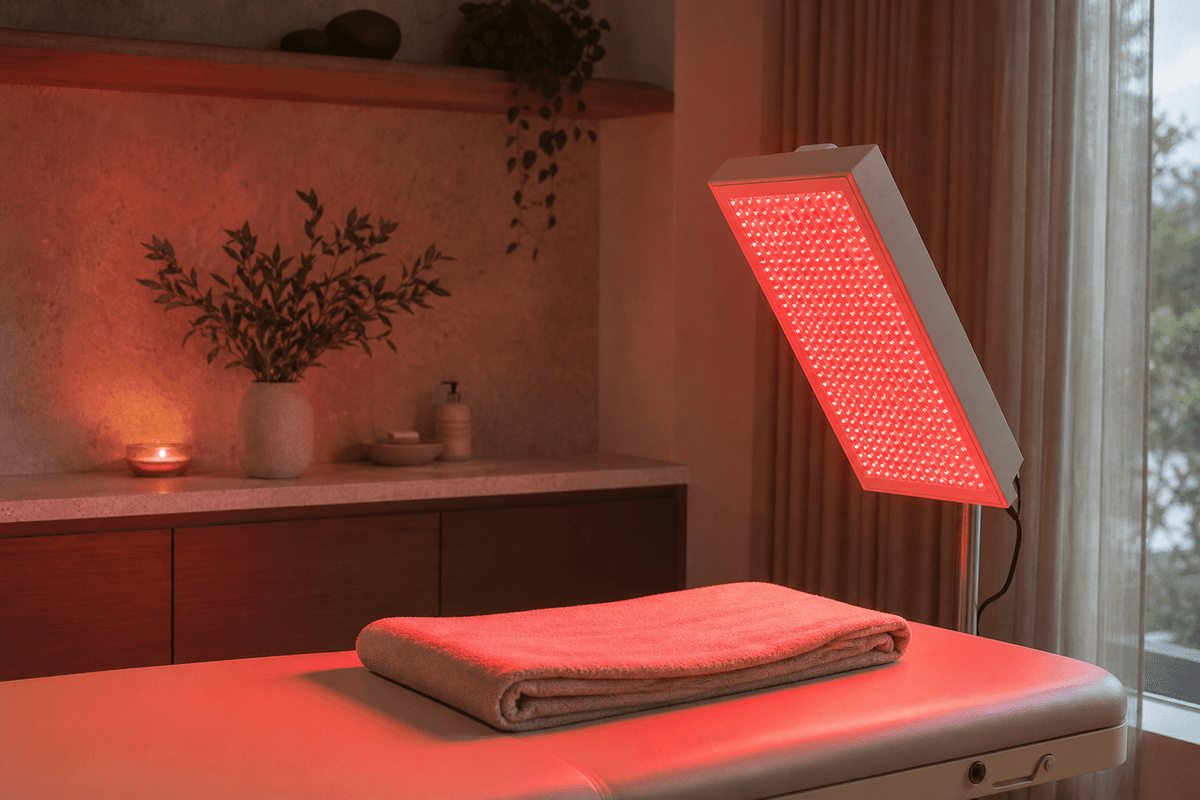
Short answer: Ten to twenty minutes standing or lying in front of a bright panel in a private room, bare skin where you want the effect, goggles on, and almost no sensation beyond mild warmth. Light does not pass through clothing. The evidence is modest, mostly skin and muscle recovery, and it needs repeat sessions.
Expect a bright red panel or a bed of lights, ten to twenty minutes, bare skin on whatever you want treated, eye protection, and almost no sensation beyond mild warmth.
It is genuinely the least eventful thing in a wellness studio. There is no heat to endure, no cold to survive, nothing to breathe through. You stand or lie there, and then you are done.
That undramatic quality is worth knowing in advance, because people expect a sauna and get a lamp.
What actually happens in a red light session?
You undress to the area being treated, put on goggles, and wait.
At a studio, you will usually be shown to a private room with either a large upright panel or a bed with lights above and below. The staff will set a timer, hand you eye protection, and leave.
You position yourself close to the panel, typically somewhere around six to twelve inches away depending on the device, with skin bare where you want the light to land. Light does not meaningfully pass through clothing, so a covered area is an untreated area.
Then you stand or lie there for the duration. The light is very bright and slightly warm. That is the entire experience. Our red light and infrared therapy guide covers what the science actually supports.
Do you need to be naked, and who sees you?
Bare where it matters, and nobody.
Sessions are almost always private, in a room with a door you close yourself. Most people strip to underwear for a full-body panel or bed, and simply expose the relevant area if they are targeting a knee, shoulder, or face.
There is no therapist in the room and no hands-on component. If a studio does have staff present, they should ask first and explain why.
Bring or borrow a towel if you want one. Most studios provide them and wipe the surfaces between clients.
Why is the eye protection non-negotiable?
Because the light is genuinely very bright, and staring into it is a bad idea.
Red and near-infrared LEDs at treatment intensity are not a laser and will not blind you in an instant, but they are far brighter than normal room light, and there is no reason to take the risk with your retinas. Every reputable studio hands you goggles.
Wear them, and do not treat this as optional because you feel fine without them. If a place shrugs about eyewear, that tells you how carefully they run everything else. Our studio checklist covers the other questions worth asking.
If you are treating your face, ask specifically what they recommend, since some protocols and devices differ.
What does it feel like, during and after?
Almost nothing, and that is normal.
You will feel mild warmth on your skin, similar to standing near a sunny window. You should not feel burning heat. If you do, you are too close or the device is wrong, and you should say so.
Afterwards, most people feel exactly the same as before. There is no flush, no drowsiness, no soreness. Occasionally people report feeling slightly relaxed, which is at least partly just having stood still in a quiet room for fifteen minutes.
If you were hoping for the wrung-out feeling of a sauna, you have the wrong tool. Our infrared sauna versus red light guide covers why they are constantly confused and genuinely different.
How often would you have to go?
Often, which is the honest catch.
The protocols in the research generally involve repeated sessions, several times a week, over weeks or months. This is not a one-off treatment where you walk out changed. Whatever effects exist are cumulative and modest.
That has a practical consequence: at typical drop-in prices, a real course of red light gets expensive quickly, and the cost is a genuine part of the decision rather than a footnote. Our session cost guide covers the wider pricing picture and where memberships break even.
Be honest with yourself about whether you will actually go three times a week in month three.
What should you honestly expect it to do?
Modest things, mostly for skin and possibly muscle recovery.
The better-supported uses are dermatological, around skin appearance and wound healing, with some evidence for muscle recovery and soreness. The evidence is real but generally comes from small studies with varied devices, doses, and protocols, which is why confident claims should make you suspicious.
Claims about fat loss, detoxification, or broad systemic health are far ahead of the data. Our red light and infrared therapy guide separates what holds up from what does not.
Go in expecting a small, slow, possible effect on specific things, and you will not be disappointed.
The bottom line on red light therapy
Ten to twenty minutes, bare skin, goggles on, mild warmth, no drama. Private room, no therapist, no sensation worth reporting.
It is a low-risk thing to try, with modest and specific evidence behind it, and it demands consistency to mean anything at all.
To find a red light or recovery studio near you, start with our city wellness maps.