Types of sauna explained: Finnish, bio, infrared and smoke
Studios use 'sauna' for rooms that run anywhere from 45°C to 110°C at wildly different humidities. Those are not variations on one experience, and the label on the door tells you less than the thermometer and the hygrometer do.
Short answer: Two numbers define any heat room: air temperature and relative humidity. A Finnish sauna runs 80 to 100°C at 10 to 20 percent humidity, a sanarium or bio sauna 45 to 60°C at 40 to 55 percent, an infrared cabin 45 to 60°C heating you directly rather than the air, and a steam room is not a sauna at all.
Walk into three venues advertising a sauna and you can get three genuinely different rooms: one at 90°C and bone dry, one at 60°C and pleasantly humid, and one at 50°C where the air feels cool but your skin is hot.
They are all called saunas. Only one of them is a Finnish sauna in the traditional sense, and the differences matter for how long you can stay, how it feels, and what the evidence actually applies to.
Two numbers define any heat room: air temperature and relative humidity. Once you have those, the marketing name is mostly decoration.
The Finnish sauna
Hot, dry air, with steam on demand.
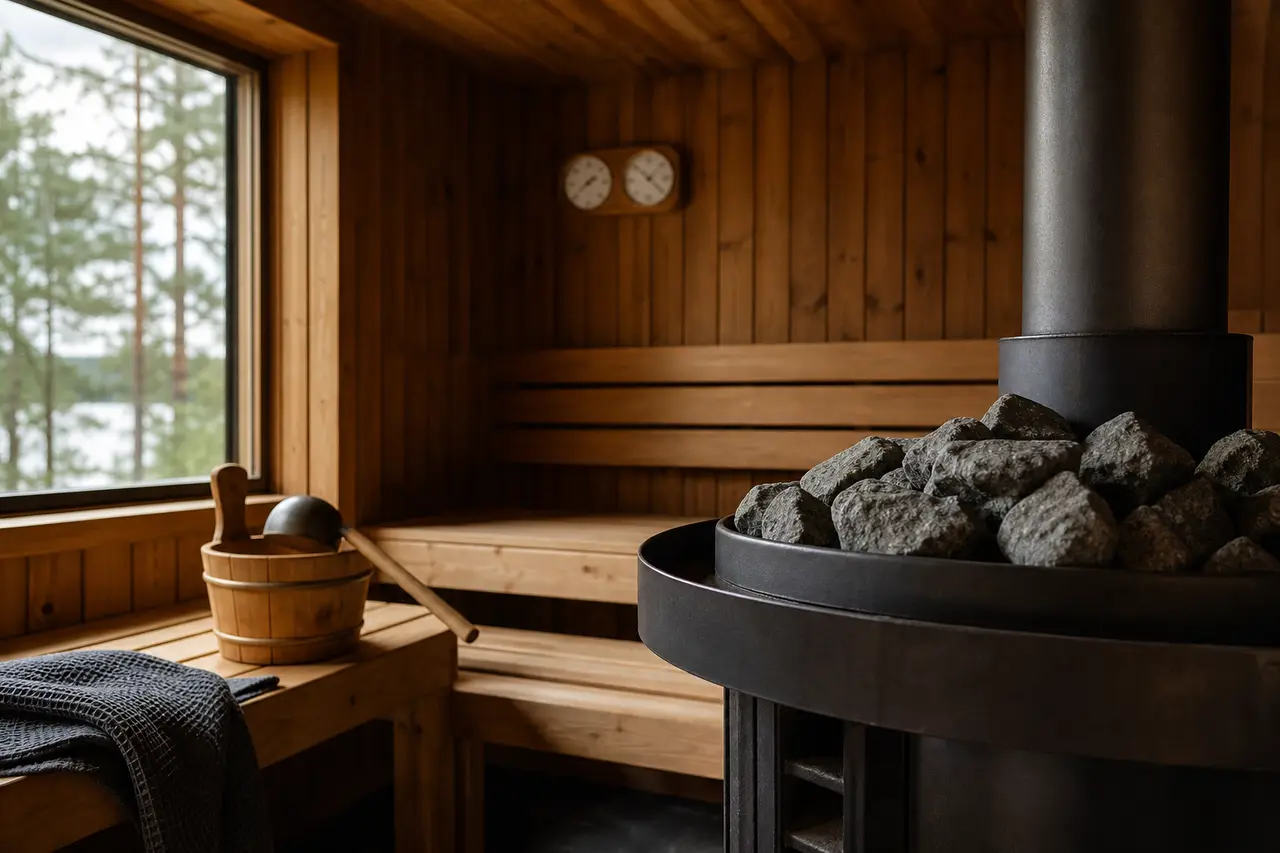
The traditional Finnish sauna runs roughly 80 to 100°C with low humidity, typically 10 to 20 percent. A stove heats a pile of stones, and you ladle water onto them to produce a burst of steam called löyly, which briefly spikes humidity and makes the heat feel far more intense.
This is the format almost all the sauna research was done in. When you read about the Finnish cohort studies associating frequent sauna use with lower cardiovascular mortality, this is the room they mean, at these temperatures, for roughly 15 minutes a session. Our guides on what the sauna evidence supports and how long and how hot cover the dosing.
Practical note: heat stratifies strongly, so the top bench can be 30°C hotter than the bottom one. The bench you choose changes the experience more than most people realise.
Sauna types at a glance
| Type | Air temp | Humidity | Feels like |
|---|---|---|---|
| Finnish sauna | 80 to 100°C | 10 to 20%, spikes with löyly | Sharp, dry, intense; short sessions |
| Sanarium / bio sauna | 45 to 60°C | 40 to 55% | Mild and enveloping; long sessions |
| Infrared cabin | 45 to 60°C | Ambient | Air feels cool, skin feels hot |
| Smoke sauna | 70 to 90°C | Low, soft | Gentle, heavy, smells of woodsmoke |
| Steam room / hammam | 40 to 48°C | Near 100% | Wet, heavy, hard to breathe deeply |
| Banya | 70 to 90°C | High | Hot and wet; venik treatment |
The sanarium, or bio sauna
The mild middle ground, and the one nobody explains.
A sanarium, sometimes labelled bio sauna or soft sauna, runs much cooler at roughly 45 to 60°C with moderate humidity around 40 to 55 percent, often with coloured light and sometimes with herbal infusions.
The point is tolerance. At those numbers you can comfortably sit for 20 to 30 minutes rather than 10 to 15, which suits people who find a Finnish sauna harsh, older users, and anyone easing back after illness or a break.
The trade-off is that it is a considerably milder thermal load, so you should not assume the cardiovascular research from Finnish saunas transfers to it. It is a pleasant, gentle heat room rather than a lower-effort route to the same effects. Our guide on what to do if you feel faint in a sauna covers why a milder room is a reasonable starting point.
The infrared cabin
Not a sauna in the traditional sense at all.
An infrared cabin heats your body directly with radiant panels rather than heating the air. Air temperature sits around 45 to 60°C, which is why the room feels mild while your skin feels hot and you still sweat heavily.
That makes it comfortable for long sessions and much easier to install at home, which is why the home market is dominated by infrared. It also means the physiological stimulus is different and milder than a hot Finnish room, and the evidence base is thinner.
It is a legitimate option, particularly if high heat is unpleasant or unsafe for you. It is just a different thing wearing the same word. Our comparisons of infrared vs traditional sauna and infrared sauna vs red light therapy cover the distinctions, including the common confusion with red light panels.
The smoke sauna
The original, and the best one if you find it.
A smoke sauna has no chimney. A large stone mass is heated by a wood fire for hours, the smoke fills the room, then the fire is left to die, the room is ventilated, and the soot-covered stones radiate a soft, heavy heat for hours afterwards.
People who have used one tend to describe it as gentler and more enveloping than a conventional Finnish sauna at the same temperature, with a distinctive woodsmoke smell.
They are rare outside Finland and Estonia and increasingly rare there too, since they take most of a day to prepare. If you encounter one, it is worth the visit. Our guides to sauna vs banya vs hammam vs Korean spa and what Aufguss involves cover the wider European heat traditions.
What about steam rooms and hammams?
Different category, despite the shared shelf.
A steam room runs much cooler at roughly 40 to 48°C but at near-total humidity, which is why it feels every bit as strong. Because the air is saturated, your sweat cannot evaporate, and evaporation is your main cooling route, so the perceived intensity is high at a low thermometer reading.
That also makes it a genuinely different experience for your airways, which is why people with sinus congestion often prefer it and why strong eucalyptus additives matter if you have asthma. Our guides on sauna vs steam room and sauna, steam and asthma cover both.
A hammam is a structured wet-heat tradition built around being washed and scrubbed rather than sitting, and a banya is hot and wet with the venik treatment as its centrepiece. Our entry guides to your first hammam and your first banya cover them.
Which sauna type should you choose?
Start mild, then follow what you actually enjoy.
If you are new, start with a sanarium or the lowest bench of a Finnish sauna, and keep the first session short. If a hot dry room feels harsh on your throat, try a steam room or a sanarium before deciding heat is not for you.
If you want the format with the strongest research behind it, that is the traditional Finnish sauna at 80 to 100°C for roughly 15 minutes, several times a week. If you want the easiest thing to install at home, that is infrared. Our guide on home cold plunge and sauna costs covers the home options.
And whichever you pick, the two questions worth asking a venue are the temperature and whether the room is dry, humid, or infrared. Our guide on choosing a studio covers what else to check, and you can browse day experiences by city to see which formats exist near you.
FAQ: sauna types
Is a sanarium worth it if I like a hot sauna? Probably as a longer, gentler round rather than a replacement. Many venues have both and alternating works well.
Does infrared make you sweat more? Many people sweat heavily in infrared despite the low air temperature, because the radiant energy heats you directly. Sweating volume is not a measure of benefit either way.
Which is best for sore muscles? Any of them will feel good; none is clearly better on the evidence. Our guide on which recovery tool for which problem covers what actually ranks.
Is a hotter sauna better? Not automatically. The research dose is around 80 to 100°C for roughly 15 minutes, not the hottest bench you can survive.
The bottom line on sauna types
Temperature and humidity define a heat room; the name on the door does not. A Finnish sauna is 80 to 100°C and dry, a sanarium is 45 to 60°C and moderately humid, an infrared cabin heats you rather than the air, and a steam room is near-total humidity at a much lower temperature.
The cardiovascular research applies to the traditional Finnish format at traditional doses, so do not assume it transfers to a mild cabin. Start with the milder rooms, ask any venue for the temperature and the humidity, and pick by what you will actually keep doing.
One comparison that comes up constantly and fits none of the categories above: sauna vs hot tub, which are different tools that get treated as rivals.
And for the ceremonial end of heat culture, our explainer on temazcal and sweat lodges covers the traditions the spa versions borrow from.