What is a snow room? Ice rooms and cold caves, explained
A refrigerated room that makes real snow, installed next to a sauna, so you can rub yourself with it. It sounds like a gimmick and it is the gentlest cooling option in the building, which is exactly why it exists.
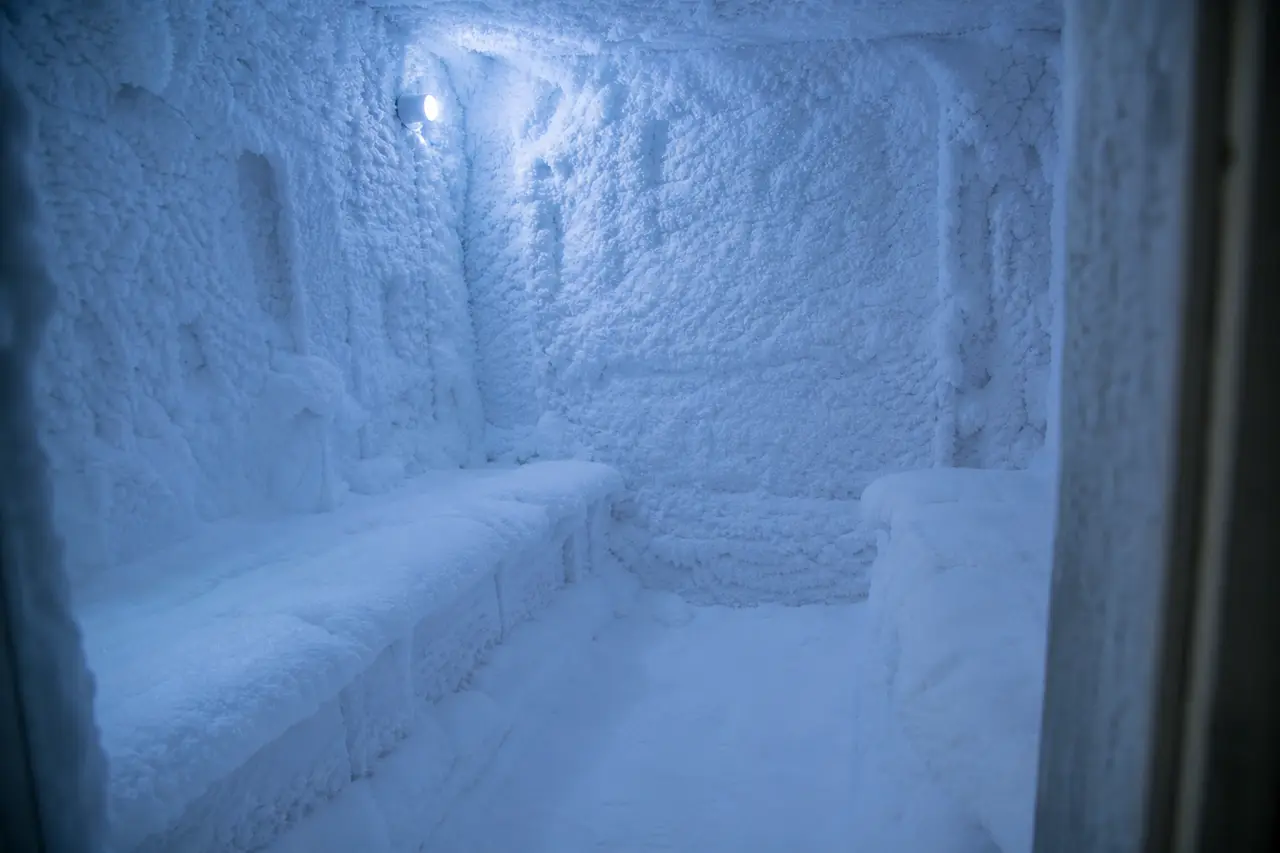
Short answer: A snow room is a refrigerated cabin at around minus 5 to minus 10°C where real snow falls or sits banked on the benches, used to cool for a minute or two between sauna rounds. Because water strips heat roughly 25 times faster than air, it is far gentler than a plunge and produces no cold-shock gasp.
In a growing number of Nordic-style spas and larger bathhouses there is a small refrigerated room, usually around minus 5 to minus 10°C, where real snow falls from the ceiling or sits banked along the benches. You step in after a sauna round, spend a minute or two, and rub snow on your arms and legs.
It reads as a novelty, and the physics say otherwise. A snow room is one of the mildest cooling options available, considerably gentler than a cold plunge despite the far lower number on the wall.
That gap between the temperature and the actual intensity is the interesting part, and it makes snow rooms genuinely useful for people who find plunging too much.
Why is a room at minus 10°C gentler than water at 5°C?
Because water strips heat far faster than air.
Water conducts heat away from your body roughly 25 times more efficiently than air does. That single fact explains why standing in a snow room at minus 10°C is comfortable for a minute or two while sitting in water at 5°C produces an involuntary gasp and a racing heart.
It is also why the cold shock response, the sharp inhalation and rapid breathing that makes cold immersion the risky part of a bathhouse visit, largely does not occur in a snow room. You are cooling gradually rather than being overwhelmed.
Practically: a snow room lowers your skin temperature pleasantly without the cardiovascular jolt. Our guides on how to breathe during a cold plunge and cold plunge safety cover the response that this format mostly avoids.
Snow room, plunge and cryotherapy at a glance
| Snow room | Cold plunge | Cryotherapy chamber | |
|---|---|---|---|
| Temperature | Around -5 to -10°C | 3 to 12°C water | -110 to -140°C |
| Medium | Air and snow | Water | Air (nitrogen or electric) |
| Typical duration | 1 to 3 minutes | 30 sec to 3 min | 2 to 3 minutes |
| Cold shock response | Minimal | Strong | Minimal |
| Perceived intensity | Mild | High | Moderate |
| You control the exit | Yes, walk out | Yes | Timed, attendant present |
| Included in a day pass | Usually | Usually | Usually charged separately |
| Good for nervous beginners | Yes | Less so | Less so |
How do you actually use one?
Short, deliberate, and with the snow.
Come in from a sauna round, warm and sweating. Step in, and take a minute or two rather than testing your endurance; nothing is gained by staying longer and it is easy to get genuinely cold.
Use the snow rather than just standing there. Rubbing it on your arms, legs, and the back of your neck is the point, and it cools your skin far more effectively than the air alone. In traditional practice this is the same instinct as a Finnish snow roll or a plunge in a lake.
Then go back to the warm room, or to the cool lounge to rest. As with any contrast practice, the resting between rounds is doing as much work as the heat or the cold. Our guides on the right order for contrast therapy and planning a wellness day cover the sequencing.
Is there evidence for it specifically?
No, and the honest answer is that it is a cooling method.
There is no research on snow rooms as such. What exists is the broader literature on cold exposure and on contrast bathing, and a snow room is a mild delivery mechanism for the cold half.
That means you should not expect it to reproduce whatever a cold plunge is claimed to do, since it is a substantially smaller stimulus. If you are chasing the large adrenaline response, this is not that.
What it does reliably is cool you down pleasantly between sauna rounds without the shock, which is a real and sufficient reason for it to exist. Our guides on what the cold plunge evidence shows and contrast therapy cover the wider claims.
How does it compare to cryotherapy?
Colder on paper, milder in practice, and a different product.
A whole-body cryotherapy chamber runs at minus 110°C or lower, dramatically colder than a snow room, and yet also works through air rather than water. The exposure is very short and attendant-operated on a fixed cycle.
The practical differences that matter: cryotherapy is timed and you cannot simply walk out, it is almost always charged separately, and it is a considerably larger cold stimulus. A snow room is self-paced, usually included, and mild. Our guides on cryotherapy and cold plunge vs cryotherapy cover that comparison.
For anyone who finds enclosed timed spaces difficult, the walk-out-whenever quality of a snow room is a meaningful advantage. Our guide on anxiety and claustrophobia in wellness spaces covers sorting formats by how easily you can leave.
Who should be careful with a snow room?
The standard cold cautions, at a lower intensity.
Because the shock response is minimal, a snow room is gentler on the cardiovascular system than immersion. The general cautions still apply: cardiac conditions, uncontrolled blood pressure, and pregnancy are all reasons to check with a doctor before adding any cold exposure.
Raynaud’s is worth a specific mention, since cold air on hands is a common trigger, and rubbing snow directly on your skin is exactly the exposure to avoid.
Reduced sensation in the feet, from diabetic neuropathy or otherwise, means you may not accurately feel how cold you are getting, so use a clock rather than a feeling and check your skin afterwards. Our guides on sauna, cold and massage with diabetes and what to do if you feel faint in a sauna cover both.
Where do you find one?
Larger Nordic-style spas and destination bathhouses.
Snow rooms need refrigeration plant and dedicated space, so they appear at larger venues rather than at single-cabin studios. Nordic-style spas, big destination bathhouses, and some hotel spas have them, usually included in a day pass rather than charged separately.
Related formats you may see: an ice fountain, a bowl of crushed ice you scoop and rub on yourself, which does much the same job in less space; and a cold or arctic room without actual snow, which is simply a chilled room.
Our guides on private vs communal sauna and finding a good sauna in a new city cover choosing a venue, and you can browse day experiences by city to see which places are full bathhouse format.
FAQ: snow rooms
Is the snow real? Yes, produced by refrigeration equipment inside the room. It is not decorative plastic.
Do I go in wet from the sauna? Usually yes, straight from a round, and the moisture on your skin makes the cooling more effective. Some venues ask you to rinse first.
Is a snow room better than a cold shower? Different rather than better. A cold shower is water and therefore a stronger stimulus; a snow room is milder and more pleasant.
How cold do I let myself get? Stop while it is still enjoyable. A minute or two is normal, and shivering means you overshot.
The bottom line on snow rooms
A snow room is a refrigerated cabin producing real snow, used to cool between sauna rounds. Because air conducts heat about 25 times less efficiently than water, a room at minus 10°C is dramatically gentler than water at 5°C, and the cold shock response largely does not occur.
That makes it the best entry point in a bathhouse for anyone who finds plunging too intense, and a pleasant alternative to a tub for everyone else. Use the snow rather than just standing there, keep it to a minute or two, and rest properly before the next round.