Foam roller vs massage gun: which is worth buying?
One costs the price of a coffee and never breaks. The other is quicker and reaches the awkward spots. They do broadly the same modest job, so the honest question is which one you will actually use.
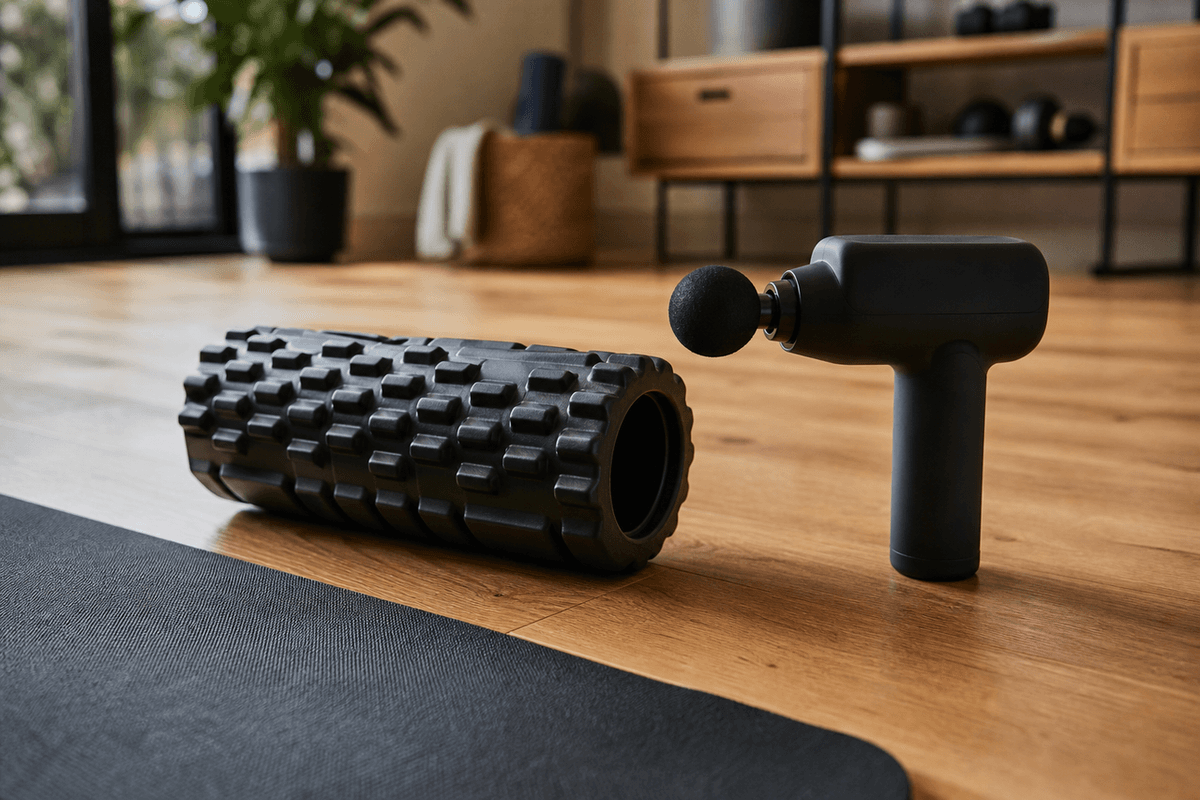
Short answer: Both do broadly the same modest job on a similarly thin evidence base: a small short-term drop in perceived soreness and a brief improvement in range of motion. A foam roller costs under $50, never breaks and is better across large muscle groups; a massage gun costs $150 to $300 for a decent one, is faster, and is better at pinpointing one knot.
Both do broadly the same modest job: reduce muscle soreness a little and briefly improve range of motion, with similar, fairly thin evidence behind them. A foam roller is cheap, durable, and good for big muscle groups. A massage gun is faster, more portable, and better at pinpointing a specific knot.
Neither is a serious treatment, and neither will transform your recovery. They are useful, pleasant self-care tools for soreness and warm-up.
So the honest deciding factor is not which is superior, it is which one you will actually pick up, plus your budget.
Foam roller vs massage gun at a glance
| Foam roller | Massage gun | |
|---|---|---|
| Typical price | $15 to $50 | $40 to $120 budget, $150 to $300 mid, $350 to $600 premium |
| Time per muscle | 30 to 60 seconds, repeated | 1 to 2 minutes |
| Best on | Quads, hamstrings, calves, glutes, upper back | Traps, calves, forearms, one specific knot |
| Effort required | Real, it is bodyweight work on the floor | Almost none, hold it against the muscle |
| Can break | No | Motor and battery, yes |
| Needs a floor | Yes | No |
| Travels | Awkwardly | Easily, though check airline battery rules |
| Specs that matter | Density and length | Amplitude and stall force |
How long should you actually spend on each muscle?
This is the question nobody answers at the point of sale, and both tools get used for far too long.
Foam rolling is usually done in 30 to 60 second passes per area, repeated once or twice, slowing down where it is tender rather than grinding at it. Ten minutes covers a whole lower body. Rolling one spot for five minutes because it hurts is not a more thorough version of the same thing.
A massage gun is typically used for one to two minutes per muscle group, moving it slowly rather than holding it still on one point. Manufacturers generally cap their own recommendations around two minutes per area, which is worth following simply because there is no evidence that more does more.
Both effects are short-lived either way. The range-of-motion improvement fades within the hour, which is fine if you are using it as a warm-up and slightly beside the point if you are using it as a treatment.
Do they work, and how differently?
Similar modest effects, through slightly different means.
Foam rolling and percussion massage both fall under self-myofascial release, applying pressure to muscle to reduce the feeling of tightness and soreness. The research on both is limited but broadly agrees: they can produce short-term reductions in perceived soreness and small, temporary improvements in range of motion, without harming performance the way a long static stretch can.
A foam roller uses your bodyweight pressing the muscle against a firm cylinder as you roll. A massage gun applies rapid percussion to a targeted spot. The mechanisms differ slightly but the practical outcome, feeling looser and less sore, is much the same. Our massage gun versus professional massage guide covers the percussion evidence in more depth.
Worth knowing where both sit in the wider ranking: a 2018 meta-analysis of post-exercise recovery techniques put hands-on massage ahead of cold water, compression and stretching for soreness and perceived fatigue. Our which recovery tool for which problem guide covers that comparison, and neither of these tools is the top of it.
What neither does is break down scar tissue, flush toxins, or meaningfully speed tissue repair. Those are marketing claims. Our massage recovery guide and our piece on the lactic acid myth cover why the flushing story persists.
Which one for which problem?
Sore quads or hamstrings after a long run. Foam roller. Large muscles, broad pressure, and your bodyweight does the work. Our recovery for runners guide covers the rest of the routine.
A knot in one trap or between the shoulder blades. Massage gun, or a lacrosse ball against a wall. A roller cannot get useful pressure into a small spot on the upper back.
Tight calves and Achilles. Either, and the gun is easier because the calf is awkward to roll well. Our guide on shin splints, IT band and Achilles problems covers what tightness there usually means.
Plantar fascia. Neither, really. A ball or a frozen bottle underfoot is the usual tool, and our plantar fasciitis guide covers what has actual support.
A stiff, achy lower back. Be careful with both. Rolling directly on the lumbar spine is unpleasant and unhelpful, and percussion over the spine is on every manufacturer’s do-not list. Work the glutes and hips instead, and read our lower back pain guide before treating it as a tightness problem.
Warming up before lifting. Foam roller, briefly, alongside actual movement. Our guide on whether to stretch before a workout covers the sequence.
Where should you not use either?
The same short list applies to both, and it matters more with the gun because it is easy to press too hard without noticing.
Keep off bone and directly over joints, off the front and sides of the neck, off the kidneys and the abdomen, and off any area that is bruised, swollen, numb, recently injured, or under investigation. Do not use either over varicose veins, a fresh surgical site, or any implanted device.
If you are on blood thinners, percussion deserves a conversation with your doctor first, and our guide on wellness on blood thinners covers why bruising risk changes the calculation for deep pressure.
Pain that is sharp, persistent, or comes with numbness or weakness is not a tightness problem and will not be solved by a gadget. Our guides on checking a practitioner’s credentials and massage versus physical therapy cover who to see instead.
What do they cost, and which specs matter?
A foam roller costs $15 to $50 and the only real choices are density and length. A longer roller, around 36 inches, is more stable and lets you roll across your back; a shorter one travels better. Firmer and heavily textured rollers are not more effective, they are just more uncomfortable, which some people mistake for the same thing.
Massage guns are where the money gets wasted. Two specifications decide whether one is any good, and percussions per minute, the number on the box, is not one of them. Amplitude, how far the head actually travels, runs about 8 to 10 mm on budget devices and up to around 16 mm at the top. Stall force, how hard you can press before the motor gives up, is what separates a device that reaches muscle from one that buzzes on skin. Our massage guns compared guide covers the tiers, and the honest landing spot is the $150 to $300 middle, because above that you are mostly buying quietness and finish.
For context on the alternative: a 60-minute massage runs about $70 to $130 at an independent practice before tip, per our massage cost guide. A mid-tier gun costs about two massages and lasts years, which is a reasonable argument for owning one, and not an argument that it replaces the therapist.
So which should you buy?
Buy a foam roller if you want the cheapest, most durable option, you mainly work large muscle groups, and you will use it for warm-ups and general mobility. It is the higher-value purchase and enough for most people.
Buy a massage gun if convenience is what determines whether you actually do it, you want to target specific spots, you dislike getting on the floor, and the higher cost is fine. Our weekly recovery routine guide covers making recovery low-friction, which is the whole argument for the gun.
Honestly, many people end up with both, and they are cheap enough relative to a single massage that owning both is reasonable. If you buy one, choose by whether cost or convenience matters more to you.
And neither comes close to sleep, easy movement, and sensible training load for actual recovery. Treat both as pleasant finishing touches, not the main event.
FAQ
How long should you foam roll? Thirty to sixty seconds per area, repeated once or twice. Ten minutes covers a full lower body, and longer does not appear to do more.
How long should you use a massage gun on one muscle? One to two minutes, moving it slowly rather than holding it on one point. Most manufacturers cap their own guidance around two minutes per area.
Is a massage gun better than a foam roller? Not better, different. The gun is faster and better at pinpoint spots; the roller is cheaper and better across large muscles. The evidence for both is similarly modest.
Do foam rollers or massage guns break up scar tissue? No. Neither changes tissue structure. What they change is how sore and tight the muscle feels, for a while.
Should you use them before or after a workout? Either. Before, as a brief part of a warm-up alongside movement; after, for comfort. Neither replaces the warm-up itself.
Is an expensive massage gun worth it? Up to the $150 to $300 range, usually, because that is where amplitude and stall force become adequate. Above it you are buying quietness, battery life and build.
Can you use a massage gun every day? Most people do without trouble, within the limits above. Daily use on an area that stays sore is a reason to get it looked at, not to press harder.
The bottom line on foam roller vs massage gun
Foam rollers and massage guns do similar, modest jobs: less soreness, briefly better range of motion. The roller is cheaper, tougher, and better for big muscles; the gun is faster, more portable, and better for pinpoint spots.
Thirty to sixty seconds per area with the roller, one to two minutes with the gun, and stop expecting either to fix anything structural. Buy the one you will actually use.
To find studios and recovery services near you, start with our city wellness maps.