What is a recovery lounge? The multi-modality studio, explained
One room, a timed circuit, and six machines: compression boots, a red light panel, an infrared cabin, a cold tub, a massage gun station and a percussion chair. It is the fastest-growing venue format in US wellness, and the evidence is uneven by station.
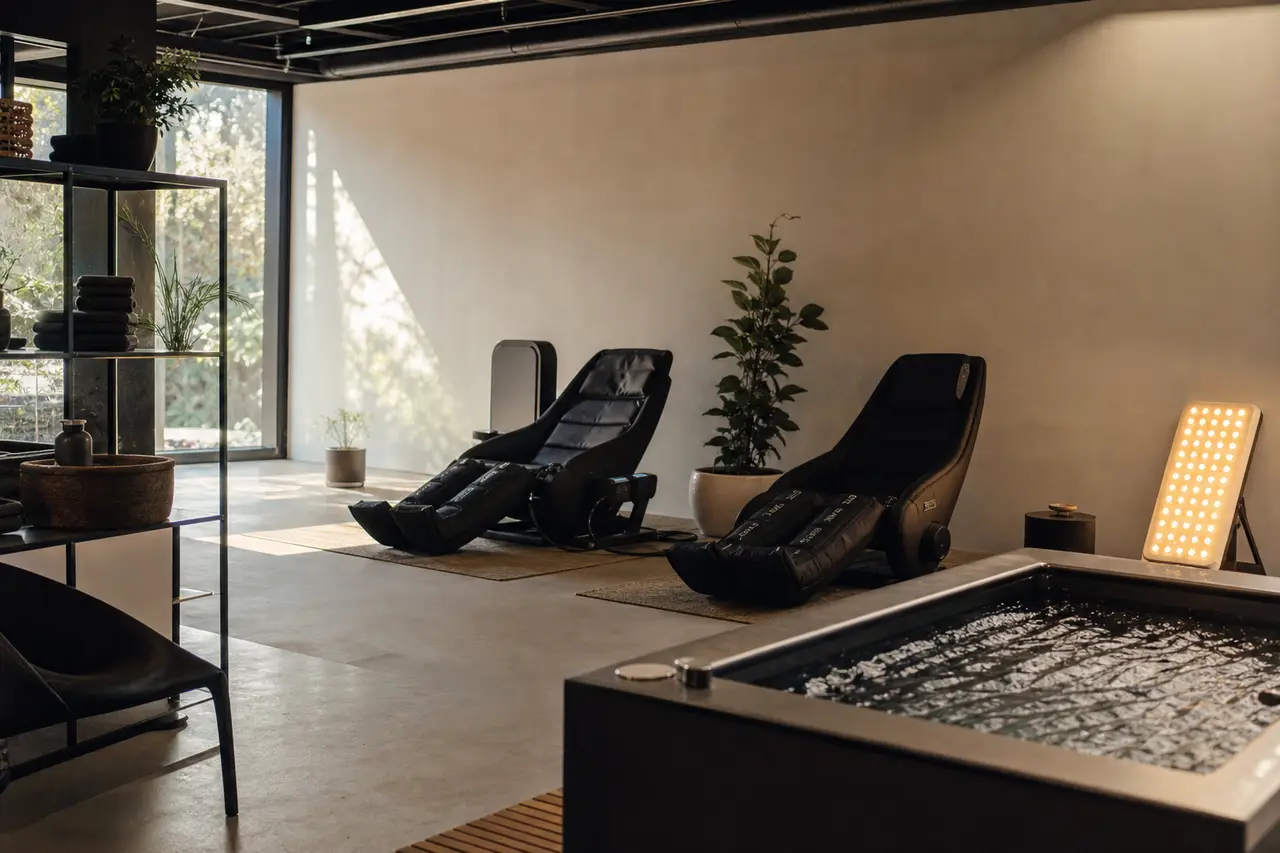
Short answer: A recovery lounge is a timed, self-directed circuit, usually 50 to 90 minutes for $40 to $80, through stations like compression boots, red light, an infrared cabin, a cold tub and a percussion chair, with no practitioner. Compression, heat and cold earn their minutes; the rest is decorative. Use it as a menu, not a lap.
The recovery lounge is the format that has spread fastest in US wellness over the last few years, and it is genuinely different from both a spa and a gym. You book a slot, usually 50 to 90 minutes, and move through a circuit of stations: compression boots, red light, an infrared cabin, a cold tub, a percussion or vibration chair, sometimes a sauna and a stretch area.
The appeal is obvious. Everything in one place, no appointment with a person, no undressing beyond shorts, and you are out on schedule.
The catch is that the stations are not equal, and the circuit format quietly encourages you to spend equal time on all of them. Here is what each one is worth.
How does the format actually work?
A timed circuit, self-directed, no therapist.
You arrive, get shown the stations, and are given a running order or left to your own. Sessions are typically 50 to 90 minutes and priced $40 to $80, often with a membership pushing that down. Staff are present but not treating you.
That is the core difference from a spa: there is no practitioner, which is why it costs less and why the experience is more like a gym than a treatment.
It is also a different product from a bathhouse, where the value is unhurried hours and a hot-cold rhythm. A lounge is efficient and scheduled. Our comparison of private vs communal sauna covers that trade-off, and where to find a cold plunge covers how lounges compare to gyms and spas.
Recovery lounge at a glance
| Station | What the evidence supports | Worth your minutes? |
|---|---|---|
| Compression boots | Modest benefit for perceived fatigue and soreness | Yes, and they are pleasant |
| Infrared cabin | Milder heat, thinner evidence than a hot sauna | Yes if you like heat |
| Traditional sauna | The best-evidenced heat option | Yes, if they have one |
| Cold tub | Good for soreness; blunts strength adaptation | Depends on your training day |
| Percussion / massage gun | Short-term range and soreness | Marginal; you can own one |
| Vibration plate | Weak for the marketed claims | Skip, mostly |
| Red light panel | Real in specific uses; consumer doses differ | Low expectations |
| Normatec-style arms | Same logic as boots, less studied | Optional |
| Stretch area | Fine; not a recovery intervention | Use as warm-up |
Which stations actually earn their time?
Compression, heat, and cold, roughly in that order.
Compression boots have the most consistent support of the machine-based stations for perceived fatigue and soreness. They are also the most pleasant thing in the room, which is not nothing. Our guide on whether compression boots actually work covers the evidence.
Heat is well supported, though the lounge version is usually an infrared cabin rather than a properly hot sauna, which is a milder stimulus with a thinner evidence base. Our comparison of infrared vs traditional sauna covers the difference, and types of sauna explained covers what to ask a venue.
Cold is genuinely useful for soreness and genuinely counterproductive in one specific window: the hours after resistance training, where it blunts the adaptation you trained for. Our guides on whether a cold plunge after your workout blunts gains and cold plunge safety cover it.
The rest are somewhere between marginal and decorative. Our guide on which recovery tool for which problem ranks them against each other, and the summary is that hands-on massage still beats all of them for soreness.
The mistake the format encourages
Treating the circuit as a lap.
Because the stations are laid out in sequence and the session is timed, people do a bit of everything: ten minutes here, ten there, tick the room. That spreads your hour across the weakest stations as evenly as the strongest.
Use it as a menu instead. Pick the two or three that match what you actually came for and spend real time on them. Twenty minutes of compression and a proper heat round beats six stations at eight minutes each.
If you came for a specific thing, say sore legs after a long run, the answer is compression and heat, not the full tour. Our guide on recovery for runners covers that case.
Is it worth the price?
Depends what you are comparing it to.
Against a massage, a lounge session is cheaper and does less for soreness, which is the honest trade. Against a gym sauna, it is more expensive and better equipped. Against buying the gear, a mid-range compression system costs roughly ten to twenty sessions.
The membership maths is the usual trap: worth it above roughly weekly attendance, expensive credit-accumulation below that. Our guides on whether memberships are worth it and what a session costs cover the numbers, and what to do if your studio closes covers the prepayment risk in a fast-growing category with thin margins.
Where lounges are genuinely good value: you want heat and cold in one place, on a schedule, without booking a person.
Who suits this format?
People who want efficiency, not an experience.
It suits training people fitting recovery around a schedule, people who dislike being touched by a stranger, and anyone who wants heat and cold without a bathhouse’s time commitment.
It suits less well if you want the unhurried rhythm of a bathhouse, if you want an actual treatment, or if the appeal of wellness for you is the atmosphere. Lounges are bright, functional and a bit clinical, which is a feature for some and the whole problem for others.
Worth checking before booking: is the cold tub actually cold, and how is the water treated. Our guides on where to find a cold plunge and choosing a studio cover the two questions that separate a good venue from a bad one.
FAQ: recovery lounge
Do I need to be an athlete? No, and the marketing implies otherwise. The stations work the same on a desk worker with a sore neck.
Is there anyone to tell me what to do? Usually staff will orient you and nothing more. If you want assessment or treatment, this is the wrong format. Our comparison of massage vs physical therapy covers when you need that instead.
Can I skip stations? Yes, and you should. Nobody is checking, and the circuit is a layout rather than a protocol.
What should I wear? Shorts and a t-shirt for most stations; swimwear if there is a plunge. Bring both.
The bottom line on recovery lounge
A recovery lounge is a timed self-directed circuit through several machines, cheaper than a spa because there is no practitioner and better equipped than a gym. Compression, heat and cold earn their minutes; vibration plates and most of the rest are filling a slot.
Use it as a menu rather than a lap: two or three stations properly beats six briefly. And keep cold away from the hours after heavy lifting if strength is what you are training for.