Massage gun vs a professional massage: which is worth your money?
A massage gun costs about as much as two studio sessions and lives in a drawer. It also cannot do the main thing a good therapist does. Which is fine, because you probably want different things from each.
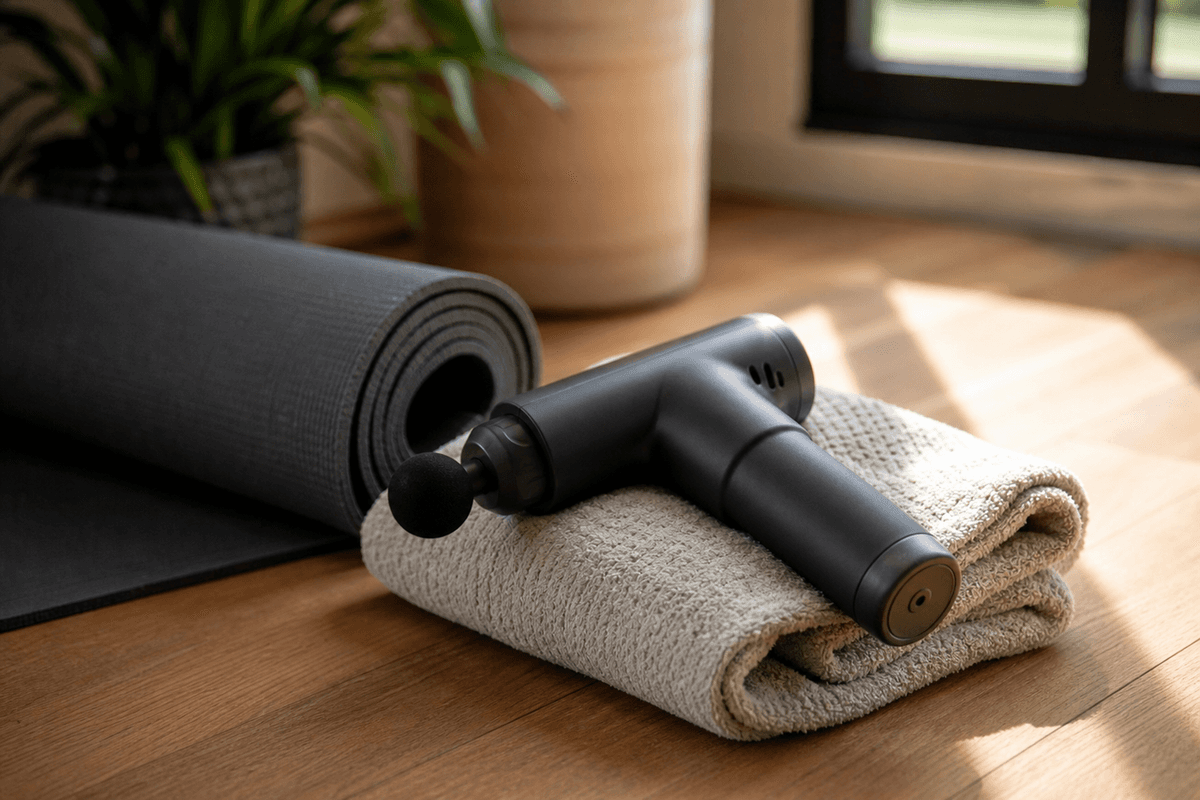
Short answer: They answer different questions. A gun costs $100 to $300 once against $80 to $150 a session, and the evidence supports modest short-term relief of soreness and a brief gain in range of motion. A therapist assesses, adjusts, reaches your own back, and delivers the hour of calm.
Buy a massage gun for cheap, on-demand relief of muscle soreness and a quick pre-workout warm-up. Book a professional massage for full-body relaxation, skilled assessment, and the work you cannot do to your own back.
They are not really competing. The gun is a targeted self-care tool with modest evidence behind it. A therapist is a person who can feel what is wrong and respond, which no device does.
The honest catch is that both are sold as more than they are, and the gun in particular is marketed well past what the research supports.
What does a massage gun actually do?
It vibrates a small area hard and fast, and that has a couple of real, limited effects.
Percussion devices deliver rapid pulses into muscle. The evidence, which is still fairly thin, suggests two modest benefits: a short-term reduction in muscle soreness, and a brief increase in range of motion without the strength loss that static stretching can cause.
A review by Konrad and colleagues (2020) found percussion treatment improved range of motion in the short term. Other small studies point to reduced delayed onset muscle soreness. These are real but modest, short-lived effects, closer to a useful warm-up tool than a treatment.
What it does not do is meaningfully break down scar tissue, release fascia in any structural sense, or flush out toxins. Those are marketing claims, not findings. Our massage recovery evidence guide covers why the flushing story is folk physiology.
Where does the gun genuinely win?
Cost, convenience, and hitting one sore spot the moment it bothers you.
A decent massage gun is a one-off cost, often somewhere in the $100 to $300 range, and then it is free forever. A single professional massage often costs $80 to $150. So the gun pays for itself in one or two sessions if it replaces them. Our session cost guide covers the wider pricing picture.
It is also there at 10pm when your calf is tight, before a run when you want to prime a muscle, or between meetings. No booking, no travel, no appointment.
For a specific, reachable, sore muscle, it is genuinely handy. That is its lane, and in that lane it is good value.
Where does the professional win?
Everything that requires a brain and a second pair of hands.
A skilled therapist assesses. They feel where you are actually tight, notice the thing you did not mention, adjust pressure in real time, and work areas you physically cannot reach well on yourself, your own back and shoulders being the obvious ones.
They also deliver the full-body relaxation and nervous-system downshift that people actually book massage for, which a loud device buzzing against one muscle does not replicate. The value there is as much the hour of calm as the mechanical work. Our first massage guide covers what that session is like.
And for anything that might be a real problem, a person can tell you to go see someone else. A gun cannot. Our massage versus chiropractic guide covers where that line sits.
Can a massage gun replace a therapist?
For relaxation and assessment, no. For quick soreness relief, largely yes.
If what you want is to feel less sore after training and to warm up a muscle, the gun does most of that job at a fraction of the cost. Regular massage is a luxury for that specific goal, not a necessity.
If what you want is to properly unwind, to have someone find and work the thing that is actually wrong, or to reach your own upper back, the gun cannot replace that. Buzzing your own shoulders while tense is not the same experience.
Most people who use both end up using the gun often and the therapist occasionally, which is a sensible split.
Who should be careful with a massage gun?
More people than the marketing suggests.
Do not use it directly over bone, joints, the front of the neck, the spine itself, or an acute injury, and keep it off areas with nerve symptoms like numbness or tingling. If you have a clotting disorder, are on blood thinners (our blood thinners guide explains why percussion is the wrong tool there), are pregnant, or have a condition affecting your circulation or sensation, check with a doctor first.
The percussion is stronger than it looks, and people bruise themselves chasing a “no pain no gain” idea that does not apply. A few minutes on a muscle is plenty. Our practitioner credentials guide is a reminder that for real pain, a qualified person beats a gadget.
The bottom line on massage gun vs professional massage
A massage gun is a cheap, convenient tool with modest, real evidence for soreness and range of motion, and a lot of overblown claims attached. A professional massage offers assessment, relaxation, and reach that no device matches.
Buy the gun for the sore-calf-at-10pm problem. Book the therapist for the unwind-and-assess problem. They are answers to different questions.
To find a massage therapist near you, start with our city wellness maps.