Sauna blanket vs a real sauna: is it worth it?
A sauna blanket costs about as much as a year of drop-ins and lives under your bed. It also is not really a sauna. Whether that matters depends entirely on what you want from the heat.
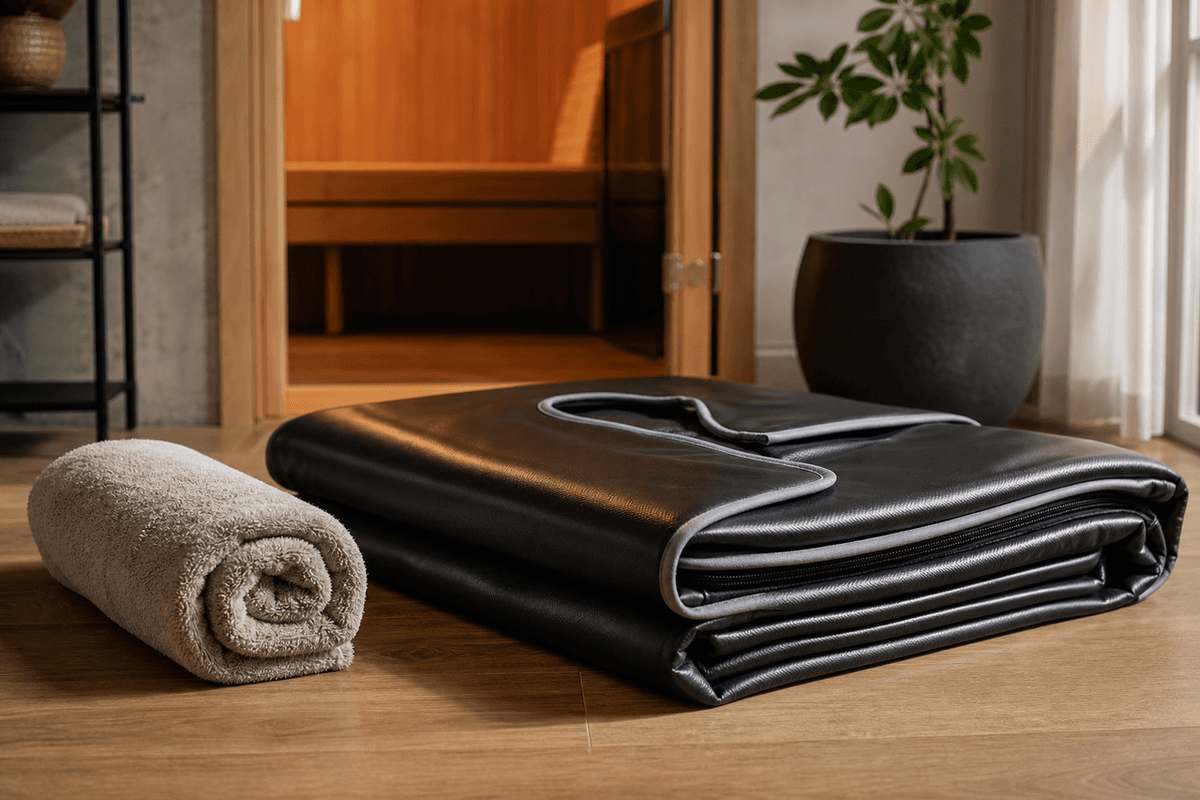
Short answer: Buy a sauna blanket if your barrier is logistics and you would otherwise not go. It makes you warm, sweaty and relaxed at home, and at $400 to $600 it pays for itself against a twice-weekly studio habit within a year. The Finnish cardiovascular evidence does not transfer to it.
Buy a sauna blanket if you want the warm, sweaty, switched-off feeling at home without booking anything, and you know you will not otherwise go. It genuinely delivers that, for a one-off cost that a regular studio habit passes within a year.
Do not buy it expecting the health outcomes from the sauna research. Those come from properly hot traditional saunas, and a blanket cannot reproduce that environment.
It is a convenience product with a real use case. It is just not a sauna in the sense the studies mean.
What is a sauna blanket actually doing?
Heating your skin directly, inside a zipped bag.
A sauna blanket is an insulated sleeping-bag-like wrap with infrared heating elements. You lie inside it, usually with your head out and long sleeves or a layer on to protect your skin from the elements, and it heats you for 30 to 45 minutes. You sweat, a lot.
The key difference from a traditional sauna is that it is not heating a room of air to a high temperature. It is warming you by contact and radiant heat inside an enclosed space. Your skin gets hot and you sweat heavily, but the ambient conditions are nothing like a 180 F cabin.
Sweating a lot feels like the point. It is worth noting that sweat volume is not a measure of benefit. Our sauna detox guide covers why.
Does the health evidence transfer?
This is the crux, and honestly, not really.
The reason anyone takes saunas seriously as health infrastructure is the Finnish cohort research, which links frequent traditional sauna use to lower cardiovascular and all-cause mortality in a dose-dependent way. That data comes from hot Finnish saunas used several times a week over decades. Our sauna and heart guide covers what it does and does not prove.
Those benefits are thought to run largely through genuine cardiovascular load: your heart rate climbing toward exercise-like zones, vessels dilating, real heat stress. A blanket produces a milder version of that at best, and nobody has run the outcome studies on blankets. It would be a leap to assume the effect carries over.
The same caveat already applies, more mildly, to infrared cabins. Our infrared versus traditional guide covers that gap. A blanket sits further along the same spectrum.
What does the maths look like?
Roughly a year of a modest habit.
A decent sauna blanket typically runs a few hundred dollars, often in the $400 to $600 range, once. Studio sauna drop-ins commonly land around $25 to $45, and memberships often sit somewhere in the $100 to $200 a month bracket. Our session cost guide has the fuller picture.
So if you would otherwise go twice a week to a studio, a blanket pays for itself inside a year. If you would otherwise go roughly never, then the blanket’s real competition is your sofa, and it wins easily.
If you were considering building a real setup at home instead, that is a different order of spending. Our home sauna and cold plunge cost guide covers it.
What is the blanket genuinely better at?
Removing every excuse.
There is no drive, no booking, no changing room, no membership you feel guilty about. You can do it while watching something, on a Tuesday night, in the two hours you actually have. For people whose barrier is logistics rather than motivation, that is decisive.
It also solves the self-consciousness problem entirely, which is a real barrier for more people than admit it.
And it is private, quiet, and repeatable. Consistency is where most of the benefit in this field actually comes from. Our habit guide covers making either version stick.
What is the real sauna better at?
Everything about the experience, and the evidence.
A proper sauna gives you the full heat, the ritual, the enforced disconnection, the social or solitary space, and the actual environment the research was done in. You cannot check your phone meaningfully at 180 F. You can, and will, inside a blanket.
There is also the practical annoyance nobody mentions: you sweat heavily into a bag you then have to wipe out, air, and store, every single time. Plenty of blankets end up under the bed by month four for exactly this reason.
And a blanket cannot give you the cold plunge next to it. Contrast is a large part of why people fall for this whole thing. Our contrast therapy guide covers it.
So which should you buy?
Answer one question honestly: what is stopping you now?
If the honest answer is logistics, cost per visit, or self-consciousness, the blanket is a good purchase and will get used. If the honest answer is that you just do not much like being hot, the blanket will join the exercise bike.
And if you have a studio you like within a reasonable distance and you actually go, the blanket adds convenience but subtracts the thing that makes it work.
The bottom line on sauna blanket vs real sauna
A sauna blanket is a legitimate convenience product that makes you warm, sweaty, and relaxed at home, and pays for itself against a real habit within about a year.
It is not the thing the cardiovascular research studied, so buy it for the feeling and the frequency, not for the Finnish mortality curves.
If the blanket proves the habit and you want to upgrade, our home infrared sauna comparison covers the formats, the specs that matter and the EMF marketing, and our red light therapy vs infrared sauna comparison covers the other device these get confused with.
To see the saunas near you before you spend anything, start with our city wellness maps.