US hot springs: what to know before you go
Natural hot springs are the one wellness experience America has more of than almost anywhere, and the one most likely to go wrong for boring reasons: water hotter than any sauna, no attendant, and a two-hour drive back.
Short answer: Decide first between a developed resort and a primitive pool, because only the resort controls temperature and has staff. Source water can exceed 60°C, so test with a hand every time, soak 10 to 20 minutes, never submerge your head in untreated water, skip it with broken skin, and avoid alcohol.
The US has an unusual abundance of geothermal water, concentrated along the volcanic and fault systems of the West, and soaking in it is the closest thing the country has to a native bathhouse tradition.
It also differs from every other wellness experience in one important way: much of it is unsupervised. There is no attendant, no thermostat, no posted temperature and often no phone signal.
That is most of the appeal and all of the risk. Here is what to sort out before you drive somewhere remote to sit in hot water.
Developed or primitive: the decision that matters
They are different activities.
Developed springs are resorts and bathhouses built on a geothermal source: piped pools at controlled temperatures, changing rooms, staff, and usually a treatment menu. Think Calistoga, Glenwood, Ojai, Ten Thousand Waves. You are buying a spa that happens to use natural water.
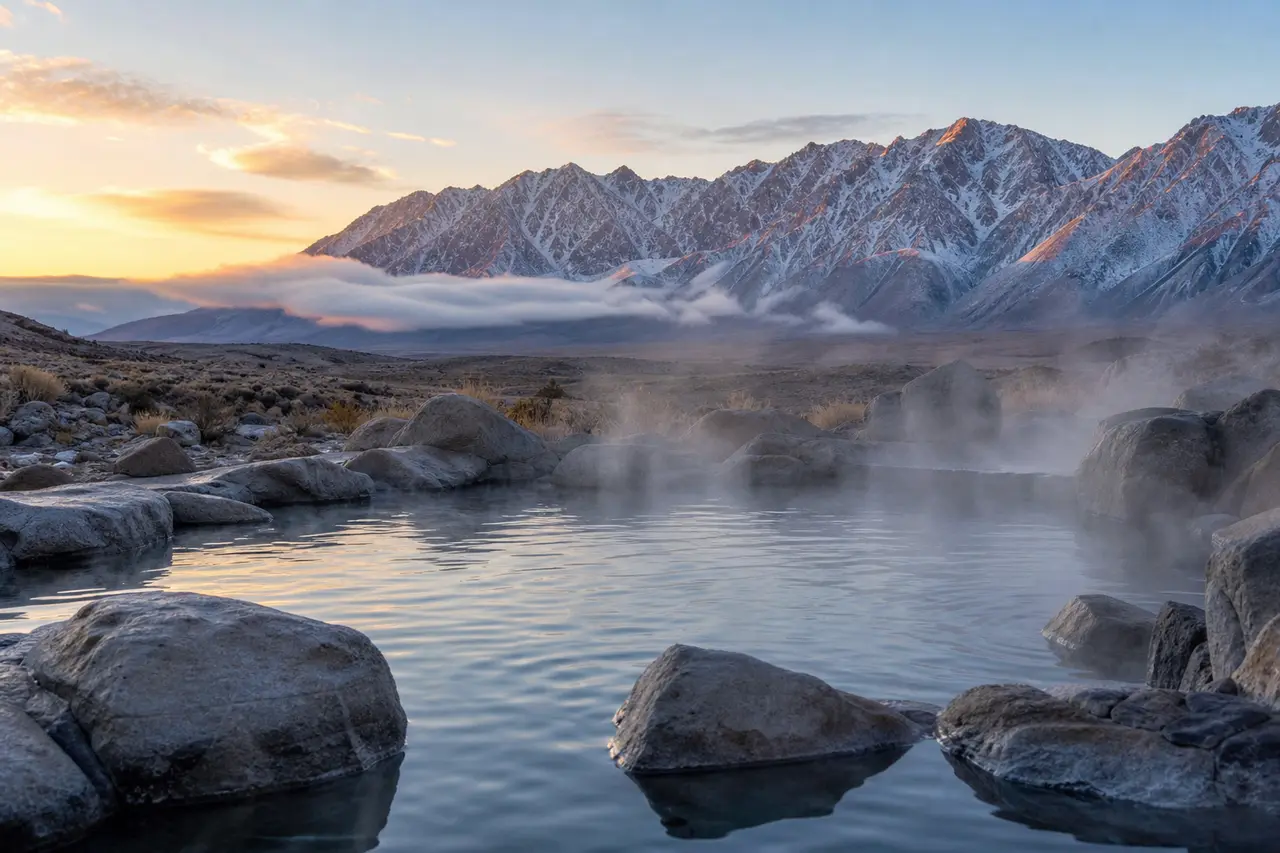
Primitive springs are pools in the ground, sometimes with a rock surround someone built, reached by a trail. No staff, no temperature control, no facilities, and frequently on public land.
Almost everything below applies mainly to the second category. If you want the experience without the variables, book a developed resort, and our guide on hot springs and thermal soaking covers what the soaking itself does.
US hot springs at a glance
| Developed resort | Primitive spring | |
|---|---|---|
| Temperature | Controlled and posted | Whatever the source is doing today |
| Staff present | Yes | No |
| Cost | $30 to $80 day use | Free, sometimes a small fee |
| Changing, toilets | Yes | Usually not |
| Water treatment | Often filtered or flow-through | Untreated |
| Crowds | Managed | Unpredictable; popular ones are busy |
| Main risk | Standard heat cautions | Overheating, no help, the drive back |
| Nudity | Usually swimwear | Varies; often clothing-optional in practice |
The temperature point nobody posts
Source water is frequently hotter than any sauna you have used.
Geothermal sources commonly emerge well above 40°C and can exceed 60°C, which is scalding. Developed pools blend and cool it; primitive pools depend on how far the water has travelled and what the weather has done.
Two consequences. Test with a hand before any part of you goes in, every time, including at a spring you have visited before, because output and mixing change. And expect the upper pool in a chain to be hotter than the lower ones, since each cools as it flows.
Soak times should be shorter than you expect: 10 to 20 minutes, then out and cool down. The heat cautions are the same as a sauna’s and the exit is slower. Our guide on what to do if you feel faint in a sauna covers the warning signs, and they matter more when there is nobody to notice.
That slower exit is the whole difference between hot water and hot air, and our sauna vs hot tub comparison covers why people routinely stay in water far longer than they meant to.
The safety points that are specific to springs
Four, and none of them appear on a trailhead sign.
Never submerge your head. Untreated warm water can carry Naegleria fowleri, a rare but usually fatal amoeba that enters through the nose. The CDC counts 167 US cases from 1962 to 2024 and says to always keep your head above water in hot springs. Keep your face out, do not dive, and do not use nasal rinses with spring water. This is the single most important line in this article, and our guide to hot springs and the brain-eating amoeba covers it in full. If you are pregnant, see our guide to hot springs while pregnant.
Do not drink it. Mineral content varies enormously and some springs carry arsenic.
No open wounds, no recent surgery, no fresh tattoo. Untreated water plus broken skin is an infection route. Our guide on wellness after surgery covers the healing timeline.
Alcohol is the usual factor in incidents. Hot water, dehydration, remote location and a drive home is a bad combination, and it is the pattern behind most hot spring emergencies. Our guide on alcohol and sauna covers the physiology, which is identical here.
Where they actually are
Concentrated in the West, with a few outliers.
Colorado has the densest developed scene, with a well-known corridor of resort towns and a mix of large family pools and small adults-only properties. California spans everything from Napa-adjacent mud-and-mineral houses to remote Eastern Sierra pools. New Mexico combines springs with a strong bathhouse culture. Oregon, Idaho, Montana and Wyoming hold most of the primitive inventory, much of it on public land.
Arkansas is the notable non-Western entry, with a bathhouse row built around a protected thermal source.
Our regional retreat guides cover the wider wellness scene in several of these areas: Colorado Rockies, Santa Fe and New Mexico, Sedona, and the Pacific Northwest.
Practical planning
The trip is the hard part, not the soak.
Check access seasonally. Many primitive springs are behind roads that close in winter or wash out in spring, and the agency managing the land is the authority rather than a blog post.
Go early. Popular accessible springs are busy from mid-morning, and the experience at dawn is a different one entirely.
Bring more than you think: water, a towel you do not mind ruining, sandals for hot or sharp ground, a headlamp, and a bag for everything wet. Mineral water stains and smells.
Plan the drive back. A long hot soak leaves you drowsy and slightly dehydrated, which is a poor state for a mountain road at dusk. Build in a cool-down and a proper drink before you leave.
Leave it as you found it. Primitive springs stay open because users keep them clean; several have closed over litter and behaviour.
Etiquette
Quieter and more variable than a bathhouse.
Many primitive springs are clothing-optional in practice regardless of posted rules, and the norm at any given pool is set by whoever is there. Ask or observe rather than assume in either direction. Our guide on bathhouses abroad covers the same reasoning applied to venue culture generally.
Rinse before getting in if there is any way to do so. Keep voices low; sound carries and most people are there for quiet. Do not bring glass. Do not use soap or shampoo in the pools, including biodegradable, which is still soap.
If a pool is small and occupied, ask before joining. Our guide on choosing a studio covers vetting developed venues, and you can browse day experiences by city for the urban equivalents.
FAQ: US hot springs
Are the minerals absorbed through my skin? Mostly no. Dissolved salts stay on the outside, because skin is a barrier and that is the point of skin. Some dissolved gases such as carbon dioxide and hydrogen sulfide do cross skin in measurable amounts and can dilate blood vessels, which is the basis of some European balneotherapy. Even so, the heat, the buoyancy and the setting are doing most of the work. Our guide on mud baths and clay treatments covers the same claim in the adjacent tradition.
Is a developed resort worth the money? If you want controlled temperature, changing rooms and no navigation, yes. It is a spa with better water rather than a wilderness experience.
Can I go in winter? Snow-country springs in winter are the best version of this, and the access is the problem rather than the water. Check road status with the managing agency.
How long should I stay in? Shorter than feels necessary. 10 to 20 minutes, out, cool down, repeat if you want. Treat it as sauna dosing.
The bottom line on US hot springs
Decide first whether you want a developed resort or a primitive pool, because they are different activities with different risks. The resort controls temperature and has staff; the pool in the ground controls neither.
Test the water with a hand every time, keep your head out of untreated water without exception, skip it with broken skin, avoid alcohol entirely, and treat the drive home as part of the plan rather than an afterthought.