Mud baths and clay treatments: what they are and aren't
Sinking into warm volcanic mud is a genuinely strange and pleasant experience, and it is one of the oldest spa traditions in America. The minerals are not absorbing into you, and it is still worth doing.
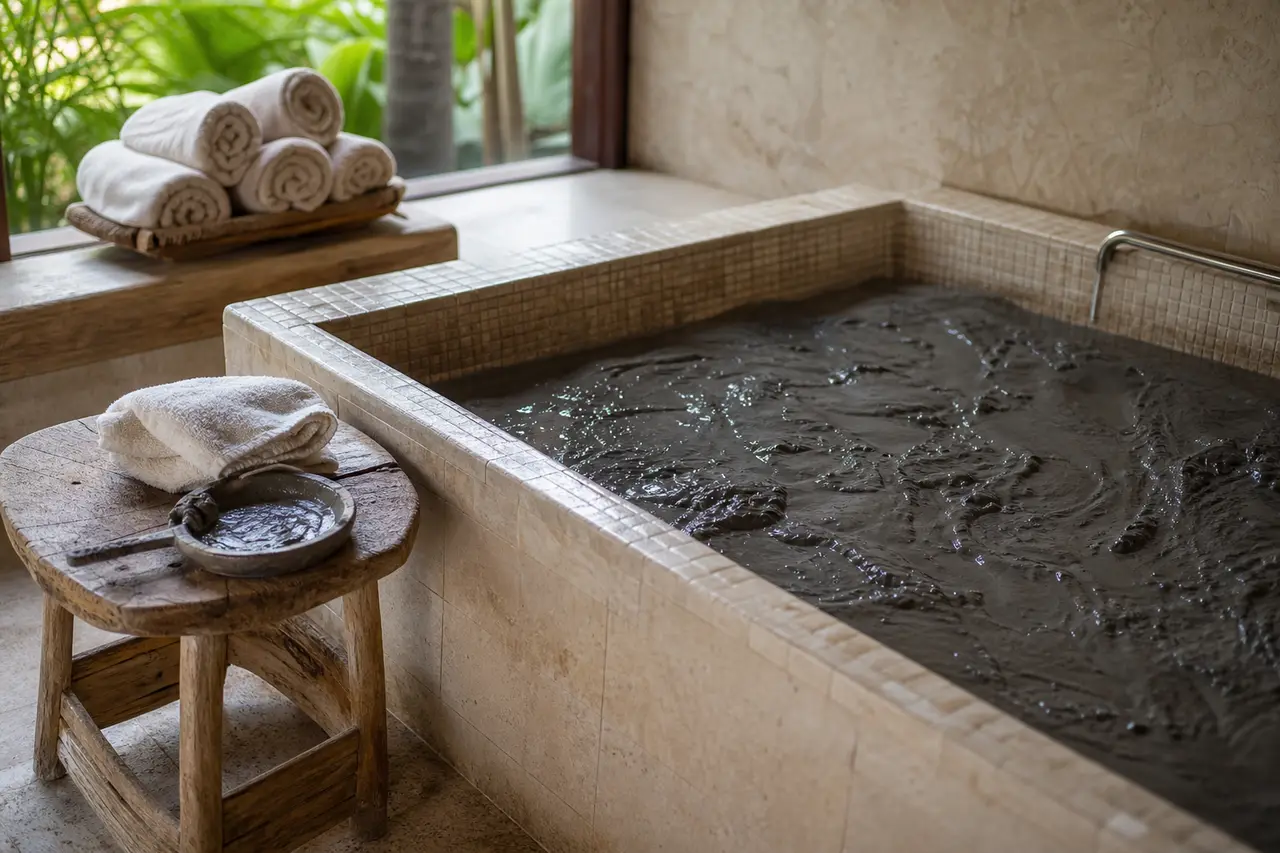
Short answer: A mud bath is a tub of warm volcanic ash, peat and mineral water at around 40°C. You sink in for 10 to 15 minutes, rinse, then move to a mineral bath and a rest, usually 60 to 90 minutes and $100 to $200. The effect is heat, buoyancy and exfoliation, not minerals absorbing through your skin.
A mud bath is exactly what it sounds like: a tub filled with a warm mixture of volcanic ash, peat and mineral water, thick enough that you sink slowly and float oddly. You stay in for 10 to 15 minutes, rinse, and usually move on to a mineral bath and a rest.
It is one of the oldest continuously operating spa traditions in the United States, centred on Calistoga in Napa Valley, where the volcanic ash and geothermal water made it a destination well over a century ago.
The experience is genuinely unusual and worth having. The mechanism sold with it is mostly wrong, and knowing that changes nothing about whether to go.
What actually happens in a mud bath?
A short, hot, heavy soak followed by a cool-down sequence.
You shower first, then step into a tub of warm mud. Getting in is the memorable part: the mixture is dense, you sink slowly, and an attendant usually helps position you. The mud is typically around 40°C, sometimes warmer.
You stay 10 to 15 minutes, which sounds short and is not, because mud holds heat far better than water and you cannot shed it. Attendants check on you and many venues put a cold cloth on your forehead for exactly this reason.
Then you rinse thoroughly, usually move to a mineral or jetted bath, sometimes a steam or a blanket wrap, and finish with a rest. The whole sequence runs 60 to 90 minutes and typically costs $100 to $200. Our guide on hot springs and thermal soaking covers the mineral-water half of the tradition.
Mud baths at a glance
| Mud bath | |
|---|---|
| What is in it | Volcanic ash, peat, mineral water; recipes vary |
| Temperature | Around 40°C, sometimes higher |
| Time in | 10 to 15 minutes, and that is deliberate |
| Full sequence | 60 to 90 minutes with baths and rest |
| Typical cost | $100 to $200 |
| Genuinely delivers | Deep heat, buoyancy, an unusual sensation, exfoliation on rinse |
| Does not deliver | Mineral absorption, detoxification, drawing out toxins |
| Skip if | Pregnant, cardiac conditions, uncontrolled blood pressure, open skin |
Do the minerals absorb into you?
No, and that is your skin working correctly.
The standard claim is that minerals in the mud are absorbed through the skin and that the clay draws toxins out. Skin is a barrier; keeping things out is close to its entire job, and it does not run in reverse on request.
Some substances do cross skin in meaningful amounts, which is how nicotine patches work, but they are specific small molecules in specific vehicles. Bulk minerals sitting in warm mud are not among them.
The “drawing out” framing is the same move as the sauna detox claim and the body wrap claim, applied to a different medium. Our guides on whether sweating detoxes your body, body wraps, and spotting a nonsense wellness claim cover the pattern.
So what does it actually do?
Heat, mostly, plus two real secondary effects.
Heat. The dominant mechanism, and mud is unusually good at holding and transferring it. That produces the same muscle relaxation and pleasant heaviness a hot bath does, more intensely. Our guide on sauna benefits covers what heat exposure is actually supported for, and the mud version shares the general mechanism without any of the cardiovascular research.
Buoyancy and pressure. Being suspended in something denser than water is genuinely unlike anything else, and the even pressure is part of why people describe it as calming. It is a distant cousin of what makes a float tank interesting. Our guide on float tanks covers that.
Exfoliation. Rinsing off a coating of fine ash and clay leaves skin noticeably smooth. That effect is real, mechanical, and temporary.
Those three are a perfectly good reason to book one.
How do clay treatments differ?
Same family, much milder.
Applied clay or mud wraps put a layer on your skin rather than immersing you, usually followed by a wrap or a steam and then a rinse. Common types are bentonite, rhassoul, which appears in Moroccan hammam sequences, and various coloured cosmetic clays.
Because they are topical rather than immersive, the heat load is far lower and the experience is closer to a facial or a scrub than to a bath. Our guide on what to expect at your first hammam covers the rhassoul version inside that tradition.
Clay does have a genuine cosmetic effect on oily skin, since it absorbs surface oil. That is a real, modest, local effect and quite different from the systemic claims.
Who should skip a mud bath?
The heat cautions apply with more force than usual.
Because mud holds heat so effectively and you cannot cool yourself in it, the standard heat exclusions matter more here: pregnancy, cardiac conditions, uncontrolled blood pressure, and anything affecting temperature regulation. Most venues will ask, and reputable ones refuse. Our guides on pregnancy safety and sauna and the heart cover those.
Skip it with open cuts, an eczema or psoriasis flare, a fresh tattoo, or a recent wax. Our guide on using a sauna with a tattoo covers healing skin.
And treat the faint-warning signs as you would in a sauna, because the mechanism is the same and the exit is slower. Our guide on what to do if you feel faint in a sauna is worth reading first; getting out of a mud tub takes longer than getting off a bench.
Is it worth doing?
Yes, once, for the experience.
This is a case where the honest recommendation and the marketing recommendation diverge without the honest one being negative. It is a distinctive, old, genuinely enjoyable thing that most people have never done, and the sequence around it is well designed.
It is not a treatment, it will not detoxify you, and it is not better value than a massage if you want a result rather than an experience. Our guide on which bodywork for which complaint covers the alternatives.
Practical note: wear an old swimsuit or none, since the mud stains, and do not book anything demanding afterwards. Most people come out pleasantly useless.
FAQ: mud baths
Is the mud reused? Practices vary and it is a fair question to ask. Reputable venues drain and sanitise between guests or run continuous treatment; ask how yours handles it.
Does the mud smell? Sulphur is common in geothermal areas and yes, noticeably. Most people stop noticing within a few minutes.
Can I take a mud bath with a partner? Many venues have side-by-side tubs, and it is a common couples booking. Our guide on booking a couples massage covers the format generally.
Do I need to book far ahead? At the well-known Calistoga houses, yes on weekends. Midweek is easier and quieter.
The bottom line on mud baths
A mud bath is 10 to 15 minutes suspended in warm volcanic mud, followed by mineral baths and a rest, and it is one of the oldest spa traditions in the country. The heat, the buoyancy and the exfoliation on rinse are all real.
The minerals are not absorbing into you and nothing is being drawn out, because skin is a barrier and that is the point of skin. Book it for the experience, treat the heat cautions as you would a sauna, and wear a swimsuit you do not care about.