Anxious or claustrophobic? Saunas, float tanks and small rooms
A lot of wellness happens inside small, hot, dark or enclosed spaces, which is a difficult sell if enclosed spaces are exactly your problem. Some of these are much easier to escape than others, and that distinction is what to plan around.
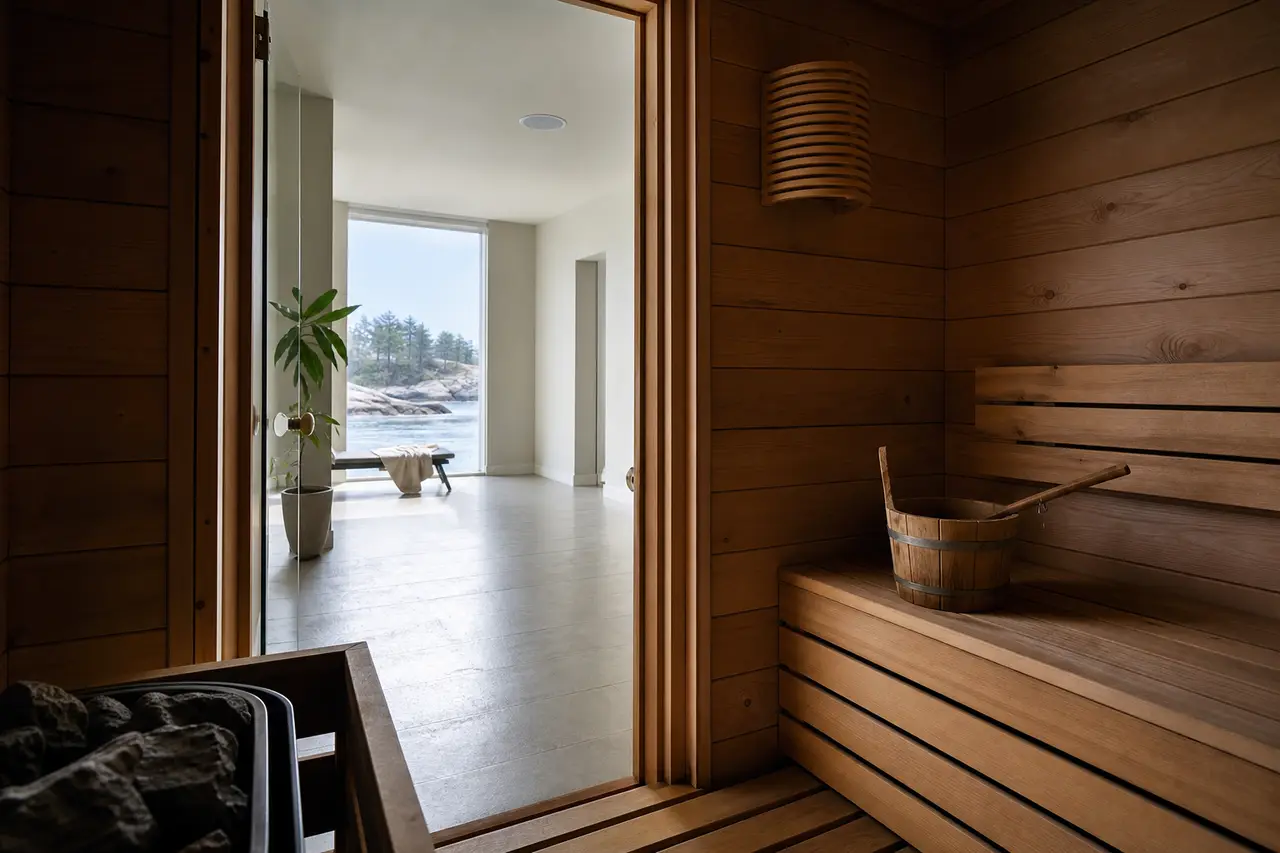
Short answer: Sort these spaces by how easily you can leave alone, not by how enclosed they look. Saunas, steam rooms and float tanks all open from the inside with no attendant; cryo chambers and body wraps need someone else to end the session. Go off-peak, sit by the door, set a short target.
A surprising amount of the wellness menu happens in enclosed spaces: small hot rooms, dark tanks, chambers, and treatments where you are wrapped or immobilised. If enclosed spaces are difficult for you, that rules out less than you would think, provided you sort the options by the right criterion.
The criterion is not size or darkness. It is how easily and quickly you can get out, and whether leaving requires anyone else’s cooperation.
By that measure, some of the most intimidating-sounding options are among the easiest, and one or two of the innocuous-sounding ones are the hardest.
What actually determines whether a space is manageable?
Control over the exit.
A sauna has a door you push open from the inside, no lock, no attendant, and often a bench right beside it. You can leave in two seconds without telling anyone. That is a very different proposition from its reputation.
A float tank has a lid you lift or a door you push, and the light switch is usually inside. Most modern float rooms are cabin-sized rather than coffin-sized, and you can leave whenever you want.
A cryotherapy chamber runs on a fixed cycle with an attendant present. A body wrap involves being wrapped in material you cannot easily remove alone. Those two require somebody else to end the session, and that dependency is what makes them harder if control is the issue. Our guides to float tanks, cryotherapy, and body wraps describe each format.
Enclosed spaces at a glance
| Space | Can you leave alone, instantly? |
|---|---|
| Traditional sauna | Yes, push the door, no lock, no attendant |
| Infrared cabin | Yes, and usually a glass door |
| Steam room | Yes, though visibility is low |
| Float tank or room | Yes, lid or door opens from inside, light switch inside |
| Massage on a table | Yes, though socially harder to interrupt |
| Cryotherapy chamber | Timed cycle, attendant operates it |
| Body wrap | No, you need help to be unwrapped |
| Aufguss ceremony | Physically yes, socially difficult, doors usually closed |
| Hammam or banya treatment | Yes, but you are being worked on by someone |
Why can heat feel like panic?
Because the physical signals overlap almost exactly.
A hot room raises your heart rate, drops your blood pressure, makes you sweat heavily, and can produce lightheadedness. Those are the same sensations a panic response produces, which means a hot room can supply the physical half of a panic attack to someone primed to notice it.
This is worth knowing in advance, because the interpretation matters more than the sensation. Knowing that a raised heart rate in a sauna is ordinary thermoregulation makes it far less likely to escalate.
It also means the standard advice applies with more force: sit low, keep it short, and leave early. Our guide on what to do if you feel faint in a sauna covers the genuine warning signs, which are worth being able to tell apart from ordinary heat sensations.
Breathwork deserves a specific warning here. Hyperventilation-based techniques deliberately produce lightheadedness, tingling, and air hunger, which closely reproduce panic symptoms and can trigger an episode. Our guides on whether breathwork is safe and the Wim Hof Method cover who should avoid those protocols.
How do you plan a first session?
Reduce the unknowns before you reduce the exposure.
Go off-peak, when it is quiet and you are not negotiating a crowded room. Ask to see the space before you book anything; every venue will show you a sauna or a float room, and thirty seconds of looking removes most of the anticipatory anxiety.
Sit nearest the door on your first visit, and use the lowest bench. Set yourself a deliberately short target, three or four minutes, and leave at the target rather than testing your limit. Leaving on your own terms is the point.
Go with someone if that helps, and tell them what you are doing. Tell staff too if you would like them to check in. Our guides on your first sauna session and choosing a studio cover the basics.
Which formats are worth choosing or avoiding?
Private with a glass door, at least at first.
A private cabin removes the social dimension entirely, which for many people is a bigger factor than the enclosure itself. Not having to walk out past strangers makes leaving genuinely free. Our comparison of private vs communal sauna covers the trade-offs.
Infrared cabins often have glass doors and run cooler, which makes them a gentler starting point than a traditional hot room. Our comparison of infrared vs traditional sauna covers the difference.
Worth deferring rather than avoiding forever: Aufguss ceremonies, where the doors close and the duration is fixed by someone else, and cryotherapy, which is timed and attendant-operated. Our guide on what Aufguss involves explains why the fixed duration is the specific issue.
What about float tanks specifically?
Often better than expected, with two easy adjustments.
Float tanks have a reputation problem shaped by old coffin-style pods. Most current facilities use float rooms or cabins you can stand up in, and in every case the interior light is controlled from inside and the door or lid opens with light pressure.
The two adjustments that make it workable: leave the light on, and leave the lid or door partly open. Neither is a compromise on the experience in any way that matters, and both are completely normal requests that staff hear regularly.
The buoyancy also means you are floating rather than lying on a hard surface, which most people find reduces rather than increases the enclosed feeling. Our guides on float tanks and float tank vs sound bath cover the experience.
What should you tell the venue?
Enough to make leaving easy.
You do not need to explain anything. Saying “I would like to sit near the door” or “please leave the light on” is enough, and staff hear both regularly.
If you want more support, saying you are new and would prefer a quiet time, a short first session, and someone to check on you is a normal request. A venue that handles it well is one worth returning to.
And skip anything where you would be alone in a locked or attended-only space if that is the specific fear. There is no version of wellness that requires you to do that. Our guides on accessible wellness and wellness in a larger body cover the same principle of asking about the facility rather than about yourself.
FAQ: enclosed wellness spaces
Can sauna doors lock? Public sauna doors do not lock and open by pushing. Home saunas should never be locked from outside, and you should tell someone you are in there.
Is a steam room worse than a sauna? The low visibility bothers some people more than the enclosure. Try a sauna with a glass door first if that is likely to be an issue.
Will a sauna help my anxiety? Many people find heat and the enforced pause genuinely calming, and there is reasonable mood research on regular sauna use. It is not a treatment for an anxiety disorder. Our guide on whether a sauna helps with depression and mood covers what is supported.
What if I panic mid-session? Leave, get to a cool open space, sit down, and breathe slowly out. Nothing bad has happened and you can try again shorter another day.
The bottom line on saunas and float tanks
Sort these spaces by how easily you can leave them alone, not by how enclosed they look. Saunas, steam rooms, and float tanks all open from the inside with no attendant, which puts them well ahead of cryo chambers and body wraps on that measure.
Go off-peak, look at the space first, sit by the door, set a deliberately short target, and leave when you reach it. Ask for the float tank light to stay on. And know that a racing heart in a hot room is usually just the heat.