Saunas and studios with a visual impairment: what to ask
Wellness venues are deliberately dim, full of wet unmarked level changes, and run on instructions like 'over there' and 'copy me'. Almost every problem has a fix, and none of them appear on a booking page.
Short answer: Ask at booking for an orientation walk described in counted steps and wall-side, a consistent locker, and verbal or hands-on cueing instead of “copy me”. The real hazards are unmarked wet level changes and plunge entries, so get those described. Settle guide dog logistics in writing, since wet heat suits no dog.
Wellness venues are designed around a visual idea of calm: low lighting, minimal signage, matte surfaces that hide edges, and spaces where the layout is meant to be discovered rather than explained. Instruction in classes is largely “watch me” and “over there”.
For anyone with a visual impairment that is a set of solvable problems dressed up as an environment. Almost all of it comes down to one request made in advance and one made on arrival.
Here is what to ask for, where the genuine hazards are, and which formats work with the least negotiation.
The single most useful request
An orientation walk before your first session.
Ask, when booking, whether a staff member can walk you through the space before you start: changing room to shower, shower to sauna, sauna to plunge, and the route to the exit and the toilets. Ten minutes on arrival makes the rest of the visit ordinary.
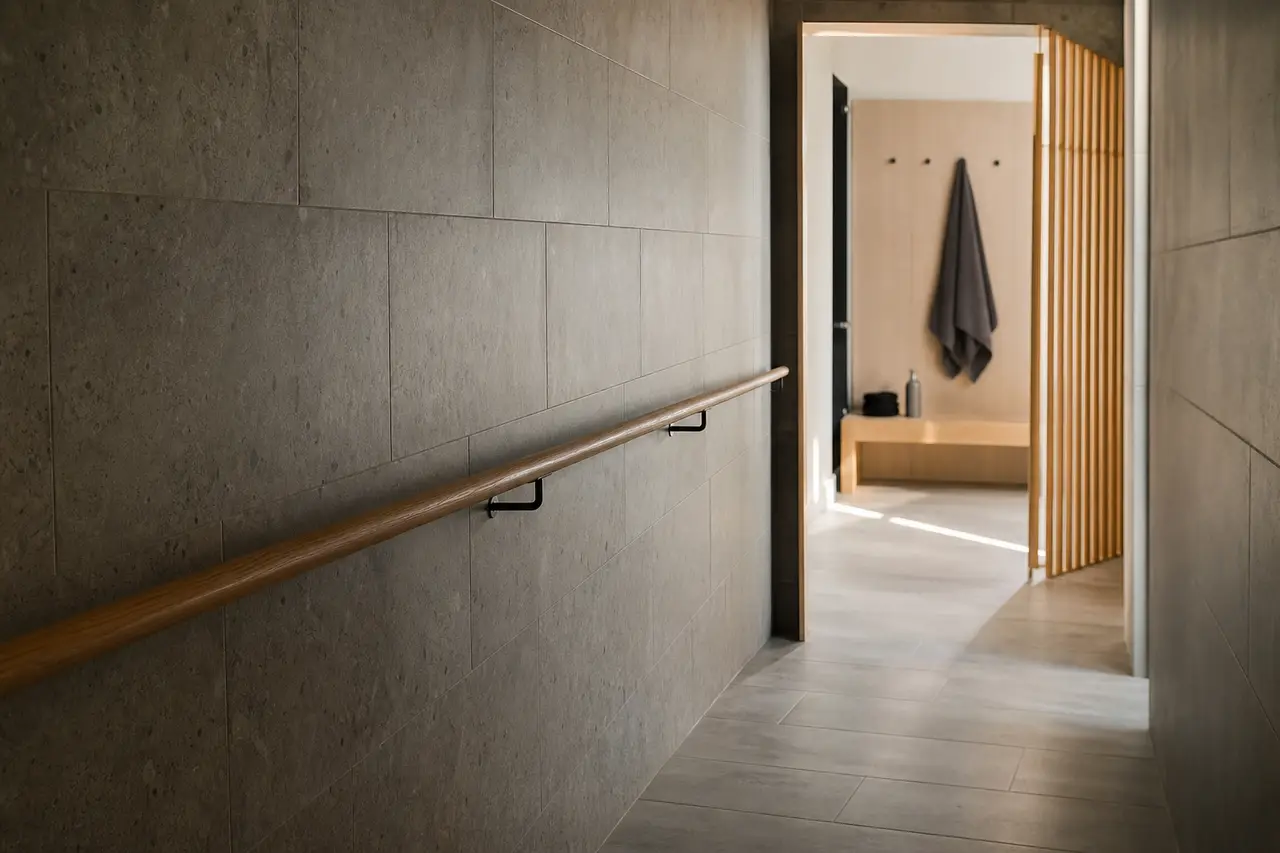
Ask them to describe it in terms you can use afterwards. Counted steps, wall on which side, where the handrails start and stop, where the level changes are, and what the door handles feel like. “It’s just over there” is useless; “twelve steps along the right-hand wall, then a step down” is not.
Almost every venue will do this and almost none will offer it. Booking by email puts it in writing and means you are not negotiating at a busy front desk. Our guide on choosing a studio covers general vetting.
Arrangements at a glance
| What to arrange | Why |
|---|---|
| Orientation walk on arrival | Turns an unknown layout into a known one |
| Same locker each visit | Removes the daily search; most venues will assign one |
| Verbal or hands-on cueing in classes | ”Copy me” is not instruction |
| A consistent instructor | They learn what description works for you |
| Level changes described | Wet steps and pool edges are the real hazard |
| Plunge entry: steps or ladder, and where the rail is | Entry and exit, not the water |
| Guide dog policy, settled in advance | Heat and wet areas are usually not suitable for the dog |
| Staff told you may not see a hand signal | Instructions are often gestured |
Where are the actual hazards?
Wet floors and unmarked level changes.
The genuine risk in a bathhouse is not the heat; it is a wet tiled floor with an unmarked step down into a plunge area, a pool edge with no tactile marking, and a threshold into a steam room you cannot see through.
Ask specifically where every level change is on the route you will use, and whether handrails are continuous or stop partway. Handrails that stop are worse than none, because you have learned to trust them.
For a cold plunge, ask whether entry is by steps or a ladder, where the rail is, and how deep it is. Then never plunge without someone knowing you are in, since the cold shock response is the risky part and it is worse without a clear exit. Our guides on cold plunge safety and where to find a cold plunge cover the formats and their entries.
What about classes?
Ask for cueing that is not visual.
A yoga, Pilates, or barre class is delivered almost entirely by demonstration plus positional language: “over your right knee”, “like this”, “look at the front of the room”. None of that transfers.
Two requests fix most of it. Ask the instructor in advance for descriptive verbal cueing, which means describing the shape rather than pointing at it, and ask whether they are comfortable giving hands-on adjustments so you can feel the position. Both are things good instructors can do and rarely think to offer.
Ask for a consistent spot in the room so the space around you is predictable, and tell them where your mat is so corrections come to you. Arriving a few minutes early to speak to the instructor is the whole difference. Our guides on your first yoga class and group class vs private session cover the formats; a private first session removes almost all of this.
What about a guide dog?
Settle it before you arrive, because the answer is genuinely complicated.
Service animals are generally permitted in public accommodations, and a sauna, steam room, or wet pool deck is usually not a suitable environment for a dog regardless of policy. Heat, humidity, chemicals, and hot surfaces are all bad for them.
So the practical question is not whether the dog may enter the building but where the dog can safely and comfortably wait, and whether a staff member can guide you between spaces in the meantime.
Raise it at booking, in writing, and be specific: where can the dog settle, is it climate controlled, and who will assist with orientation while you are in the wet areas. Venues that have thought about it will answer quickly; venues that have not need the lead time.
Which formats work best?
Private and consistent beats communal and new.
A private sauna cabin or a booked treatment room is a single known space with no navigation and no crowd. That makes it the easiest starting point at any new venue. Our comparison of private vs communal sauna covers the trade-off.
Massage is one of the most straightforward services here: you are shown to a room, you lie down, and nothing depends on sight. Ask the therapist to narrate before contact, which is a good practice for everyone. Our guides on what to expect at your first massage and what trauma-informed actually means cover narration as standard practice.
Mobile massage at home removes the venue entirely, along with the unfamiliar layout and the travel. Our comparison of mobile massage vs going to a studio covers it.
Returning to the same venue repeatedly is worth more here than variety. A known layout stops being an obstacle after two or three visits.
What else is worth telling staff?
That you may not see a signal.
A lot of venue communication is gestural: a wave that a session is ending, a hand signal to move rooms, pointing at a bench. Say plainly that you will not see those and ask them to speak to you.
Also ask how they signal the end of a timed session, particularly in a float tank or a booked cabin, and agree something audible or a knock.
And in an emergency, ask that someone come and get you rather than relying on you following an exit sign. That is one sentence at reception and it covers the situation nobody plans for. Our guides on accessible wellness and saunas as a Deaf or hard of hearing guest cover the same ask-in-advance approach for other access needs.
FAQ: visual impairment at venues
Will venues actually do an orientation walk? Almost always, and almost never unprompted. Ask at booking so someone is rostered for it.
Can I bring my own equipment? Yes. A cane, non-slip footwear, and your own towel are all fine and nobody will comment.
Is a bathhouse harder than a studio? Usually, because there is more to navigate and more wet flooring. It becomes much easier on repeat visits to the same venue.
What if the instructor keeps saying “like this”? Remind them once and ask for a description instead. Most simply forget rather than refuse.
The bottom line on venues with low vision
Ask for an orientation walk before your first session, described in counted steps and wall-side rather than in gestures, and ask for a consistent locker and a consistent spot in class. Those two requests remove most of the friction.
The real hazards are unmarked wet level changes and plunge entries, so get every one described in advance and ask where handrails start and stop. Settle guide dog logistics in writing before you arrive, and tell staff you may not see a gestured signal or an exit sign.