Sensory-friendly wellness: booking a session that works
Spas are designed around an idea of relaxation that includes music you did not choose, scent you cannot escape, dim lighting, and being touched by a stranger who does not narrate what they are doing. Almost all of it is adjustable if you ask in advance.
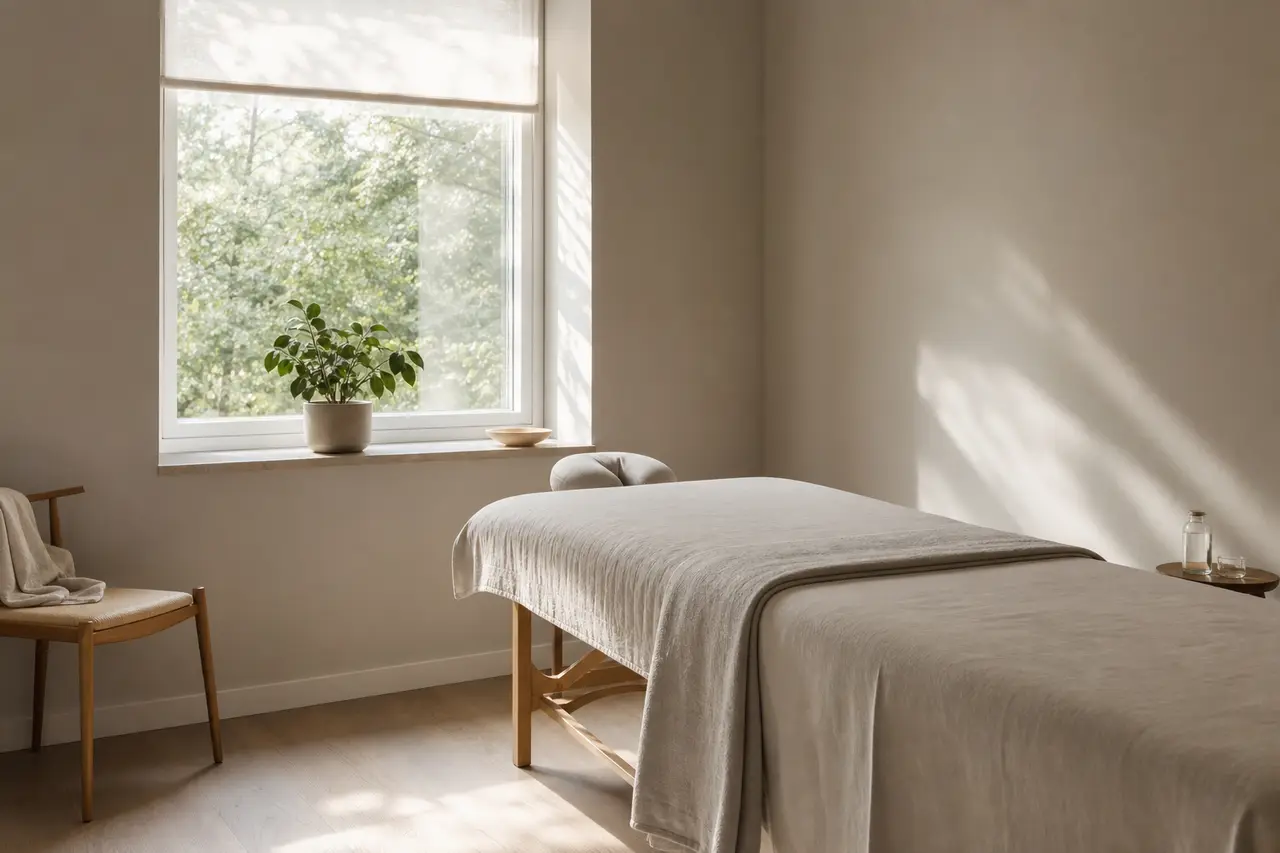
Short answer: Almost every overwhelming element of a spa is a venue preference, not a requirement: music off, unscented oil, lights up, narrated touch and no conversation are routine requests. Work out which one or two sensory channels are the problem, ask by email at booking, and start with a private room rather than a communal one.
The standard spa environment is a specific sensory design: low light, ambient music, heavy scent, unpredictable touch, and a social script where you are expected to be pleasantly passive. For a lot of people that is relaxing. For a lot of autistic and ADHD people, and anyone with sensory processing differences, it is the opposite of relaxing. For the attention side rather than the sensory side, our guide to wellness with ADHD covers which practices fit.
The useful thing is that almost every element is a preference the venue chose, not a requirement. Music can be turned off. Scent can be skipped. Lights can come up. A therapist can tell you what they are about to do before they do it.
None of this is advertised, so it only happens if you ask. Here is what to ask for, and how.
Work out which channel is the problem
The adjustment is different for each.
This sounds obvious and it is the step people skip, because “spas are overwhelming” is usually two or three specific things rather than a general quality.
Sound: ambient music, water features, other guests, the therapist talking. Scent: essential oils, eucalyptus steam, laundry products, massage oil. Touch: unpredictability more than pressure; not knowing where or when. Light: dimness that makes it hard to orient, or harsh changing-room lighting. Interoception: heat and cold sensations being hard to gauge, which matters for safety in a sauna. Predictability: not knowing the sequence, how long things last, or what is expected.
Once you know which two matter most, the requests get short and specific, and short specific requests get accommodated.
Sensory adjustments at a glance
| What to ask for | Normally possible? |
|---|---|
| No music, or music off in the room | Yes, routinely |
| Unscented oil and no aromatherapy | Yes; ask for fragrance-free specifically |
| Lights up, or a specific level | Yes |
| Therapist narrates before each area | Yes; a good therapist offers this anyway |
| No conversation at all | Yes, and common |
| Keep clothing on, or more draping | Yes |
| Same therapist every visit | Usually, if you book ahead |
| See the room before booking | Almost always |
| Quietest time slot | Yes; ask which |
| A private cabin rather than communal | Yes, at most studios |
The wording that works
Ask for the adjustment, not for understanding.
“I am sensitive to scent, so please use unscented oil and skip any aromatherapy” gets a clean yes. “I have sensory issues” invites a sympathetic noise and no change to the session.
For touch, the single most effective request is narration: “please tell me which area you are moving to before you start”. It converts unpredictable contact into predictable contact, which for many people is the whole difference. Therapists do this readily and some do it by default.
For sound: “could we do the session without music?” For light: “could the lights stay up?” For talking: “I would rather not chat during the session, nothing personal.” All are ordinary requests that staff hear regularly. Our guides on what to expect at your first massage and what to do if a treatment goes wrong cover speaking up during a session, which is worth deciding in advance that you will do.
Which formats suit which profile?
Private and predictable beats communal and social.
Private sauna cabins and booked studio slots are the best starting point for most sensory profiles: one room, no strangers, no negotiating a shared space, a known duration. Our comparison of private vs communal sauna covers the trade-off against cost.
Float tanks are a genuinely interesting case. They remove almost all sensory input, which some people find profoundly good and others find intolerable. You control the light and the door from inside, and you can leave the light on and the lid ajar. Our guides on float tanks and anxiety and claustrophobia in wellness spaces cover both directions.
Worth deferring: Aufguss ceremonies, where scent is heavy, the doors close, and the duration is fixed by someone else; and busy communal bathhouses on a weekend evening. Our guide on what Aufguss involves explains the fixed-duration issue.
Mobile massage removes the venue entirely, which solves changing rooms, lighting, other guests, and travel in one step. Our comparison of mobile massage vs going to a studio covers what you give up.
The safety point about heat and cold
Interoception matters more than usual here.
Saunas and cold plunges rely on you noticing internal signals and acting on them. If you have difficulty gauging temperature, thirst, or the early lightheadedness that means leave now, the standard advice to listen to your body is weaker guidance for you than for others.
The workaround is external: use a timer rather than a feeling, take the lowest bench, drink on a schedule rather than when thirsty, and set a shorter limit than you think you need.
Learn the warning signs in advance rather than relying on recognising them in the moment. Our guide on what to do if you feel faint in a sauna is worth reading before a first session, and medications, saunas and cold plunges covers stimulant medication, which is relevant if you take it for ADHD.
How to make a first visit predictable
Remove the unknowns before you go.
Ask to look at the room before booking. Almost every venue will say yes, and seeing the space removes most of the anticipatory load. Ask what the sequence is: where you change, where you wait, who comes to get you, how long each part takes.
Book the quietest slot. Weekday mornings and mid-afternoons are dramatically quieter than evenings and weekends everywhere.
Bring your own things if it helps: your own towel, earplugs for communal areas, sunglasses for a bright changing room, your own unscented oil. No venue will object. Our guides on choosing a studio and finding a good one in a new city cover the general vetting, and accessible wellness covers the physical-access questions that use the same asking-in-advance approach.
FAQ: sensory-friendly booking
Will asking for these adjustments be awkward? Ask by email at booking rather than at the desk, and it is a two-line message. Staff deal with preference requests constantly.
Can I keep my clothes on for a massage? Yes. Many modalities work fully clothed, including Thai massage and shiatsu, and any therapist can work over clothing. Our guides on Thai massage and shiatsu cover the clothed options.
Are earplugs rude in a communal sauna? No. Nobody will comment, and plenty of people wear them.
What if the venue gets the request wrong anyway? Say so during the session if you can, and afterwards if you cannot. A venue that takes the note seriously is worth returning to; one that does not has told you something useful.
The bottom line on sensory-friendly sessions
Almost every overwhelming element of a spa is a choice the venue made, not a fixed feature. Music off, unscented oil, lights up, narrated touch, no conversation, and a quiet time slot are all routine requests that simply have to be made in advance.
Identify which one or two sensory channels are actually the problem and ask for those specific adjustments by email at booking. Start with a private format, and because interoception is the safety mechanism in a hot room, use a timer and a low bench rather than relying on noticing the signal in time.
And if you are the one caring for someone else, our guide on wellness for caregivers is written for a schedule that is not your own.