Wellness with fibromyalgia or chronic widespread pain
The instinct with a painful body is to book the deepest, most thorough treatment available. With centrally sensitised pain that is often the exact wrong move, and the thing with the better evidence is a warm pool.
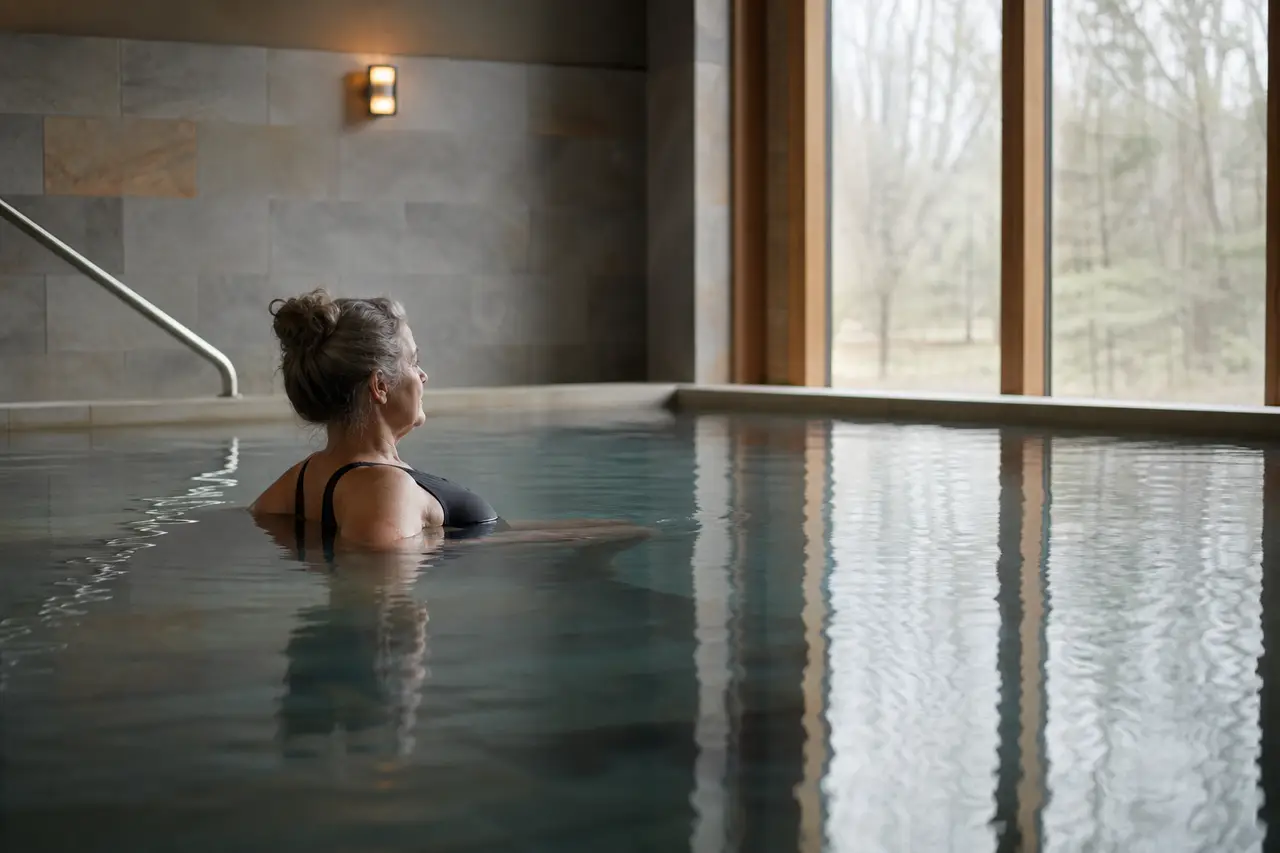
Short answer: Warm water immersion and gentle movement in water have the most consistent evidence, from a meta-analysis of balneotherapy trials in fibromyalgia. Deep pressure frequently provokes rather than relieves, because the problem is signal amplification rather than stubborn tissue. Book gentler and shorter than feels intuitive, and wait 48 hours before judging anything.
If your whole body hurts, the reasonable-sounding plan is to find someone who will really get into it. Deep tissue, firm pressure, an hour and a half, properly worked over.
For centrally sensitised pain, which is what fibromyalgia and most chronic widespread pain involve, that is frequently the treatment most likely to leave you worse for three days. The nervous system is amplifying signals, and a strong input is a strong signal.
The approach with the better evidence behind it is gentler and warmer than the industry’s default, and it is worth knowing before you spend money finding out. Your clinician knows your case and their guidance overrides this.
What does the evidence support?
Warm water, more than hands-on pressure.
The most useful synthesis is Naumann and Sadaghiani in Arthritis Research and Therapy in 2014, a systematic review and meta-analysis of balneotherapy and hydrotherapy in fibromyalgia, which found benefits for pain and quality of life across the pooled randomised trials.
That is a stronger and more consistent signal than most of what a spa menu offers, and it points at something cheap and widely available: warm water immersion, and gentle movement in warm water.
The caveats are the ones that apply to this whole field: modest trial sizes, impossible to blind, and heterogeneous protocols. But warm water is low-risk, inexpensive, and pleasant, which makes the risk-benefit unusually favourable even with imperfect evidence.
Why does deep pressure often backfire?
Because the problem is amplification, not tissue.
In centrally sensitised pain, the nervous system’s processing of signals is turned up. Ordinary pressure can register as painful, and genuinely deep pressure can produce a flare that outlasts the session by days.
That is why “no pain no gain” framing is actively wrong here, and why a therapist who equates firmness with thoroughness is the wrong therapist. Our guide on why you feel sore after a massage explains that post-massage soreness is a mechanical load rather than evidence of a good session, which matters more for you than for most readers.
Massage can still help. The research on massage in fibromyalgia is mixed but not negative, and gentler styles are the ones that show benefit. Ask for Swedish or relaxation-style work, moderate-to-light pressure, and a shorter session than you think you want. Our comparison of Swedish, deep tissue and sports massage covers choosing.
Fibromyalgia approaches at a glance
| Approach | |
|---|---|
| Warm water immersion, gentle pool movement | Best-supported; start here |
| Massage | Yes, gentle and shorter; not deep tissue |
| Sauna | Often tolerated; keep it short and cooler |
| Cold plunge | Highly variable; some flare badly, test tiny |
| Deep tissue, firm sports massage | Usually counterproductive |
| First session length | 30 minutes, not 60 or 90 |
| Judging a session | Wait 48 hours; flares are often delayed |
| Graded movement | Yes, but gently and slowly progressed |
How should you handle heat and cold?
Heat usually easier, cold genuinely unpredictable.
Warm and moderate heat is generally the better-tolerated end. A sauna at a lower bench for a shorter round is often fine, and many people find the warmth eases the background ache. The cautions are the ordinary ones about blood pressure and hydration, and they matter more if you are deconditioned or take medication that affects either. Our guides on what to do if you feel faint in a sauna and medications, saunas and cold plunges cover both.
Cold is the unpredictable one. Some people with chronic pain find brief cold genuinely helpful; others find it triggers a significant flare. There is no way to know except by testing very small, and the honest advice is to start with something far milder than a plunge.
Our guides on Kneipp therapy, which is brief partial cold you can stop by stepping out, and cold plunge safety cover the gentler entry and the exclusions.
How do you test something safely?
One variable, tiny dose, 48-hour wait.
Change one thing at a time. If you try a sauna and a massage on the same day and flare, you have learned nothing about which caused it.
Start at a dose that feels almost pointlessly small: five minutes of warm water, a 30-minute gentle massage, one gentle pool session. The point is to find out whether it is tolerated at all, not to get a result.
Then wait two days before concluding anything, because flares are frequently delayed. If it was fine, increase slowly. If it flared, the next attempt should be meaningfully smaller rather than the same again. Our guide on wellness with chronic fatigue and long COVID covers the same pacing logic for a related population, and note that many people have both.
What should you tell a therapist?
Three specific things, at booking.
Say you have chronic widespread pain, that you need lighter pressure than they would normally use, and that you would like a shorter session. All three are ordinary requests.
Ask them to check in about pressure rather than waiting for you to volunteer it, and to tell you before moving to a new area. Unpredictable contact is harder work for a sensitised nervous system than predictable contact of the same intensity.
Mention any allodynia, where light touch itself is painful, and any areas to avoid entirely. A good therapist will build the session around that; one who insists you need deep work to see results is telling you they do not treat this population. Our guides on checking a practitioner’s credentials and what to expect at your first massage cover finding the right person.
What should you be sceptical of?
Anything promising to resolve it.
Chronic pain attracts a large amount of protocol marketing: IV drips, ozone, hyperbaric oxygen, supplement stacks, elimination diets, and coaching promising that the condition can be reversed by retraining your nervous system.
Some of these are expensive, some invasive, and none has evidence matching its price. Our guides on IV therapy and vitamin drips, hyperbaric oxygen therapy, and whether you need a wellness coach cover what those categories can and cannot do.
The honest framing: warm water, gentle movement, sleep, and paced activity are the boring things with the best support, and comfort is a legitimate goal in its own right without needing to be reframed as a cure.
FAQ: fibromyalgia and chronic pain
Is a hot tub as good as a therapy pool? For warmth and buoyancy, a hot tub gives you much of it. Watch the temperature and duration, since hotter is not better and long soaks can leave you drained.
Can I do gentle exercise in water instead? That is arguably the best version, since it combines the warmth with graded movement. Aquatic classes designed for arthritis or chronic pain are usually well pitched.
What about a float tank? Warm, buoyant, and passive, which fits the profile well. Our float tank guide covers what to expect.
Should I push through a flare? No. A flare means the dose was too high, and the response is to reduce it, not to persist.
The bottom line on chronic widespread pain
Warm water immersion and gentle movement in water have the most consistent evidence in fibromyalgia, and they are cheap and low-risk. Deep pressure frequently provokes rather than relieves, because the problem is signal amplification rather than stubborn tissue.
Book gentler and shorter than feels intuitive, change one variable at a time, and wait 48 hours before judging anything, since flares are usually delayed. Treat comfort as a legitimate goal, and treat anyone promising to reverse the condition as a reason to keep your money.