Which cold format for which goal: plunge, shower, cryo, snow
Five ways to get cold, priced from free to sixty dollars a session, and they are not interchangeable. Water strips heat roughly 25 times faster than air, which is why the coldest-sounding option is often the mildest.
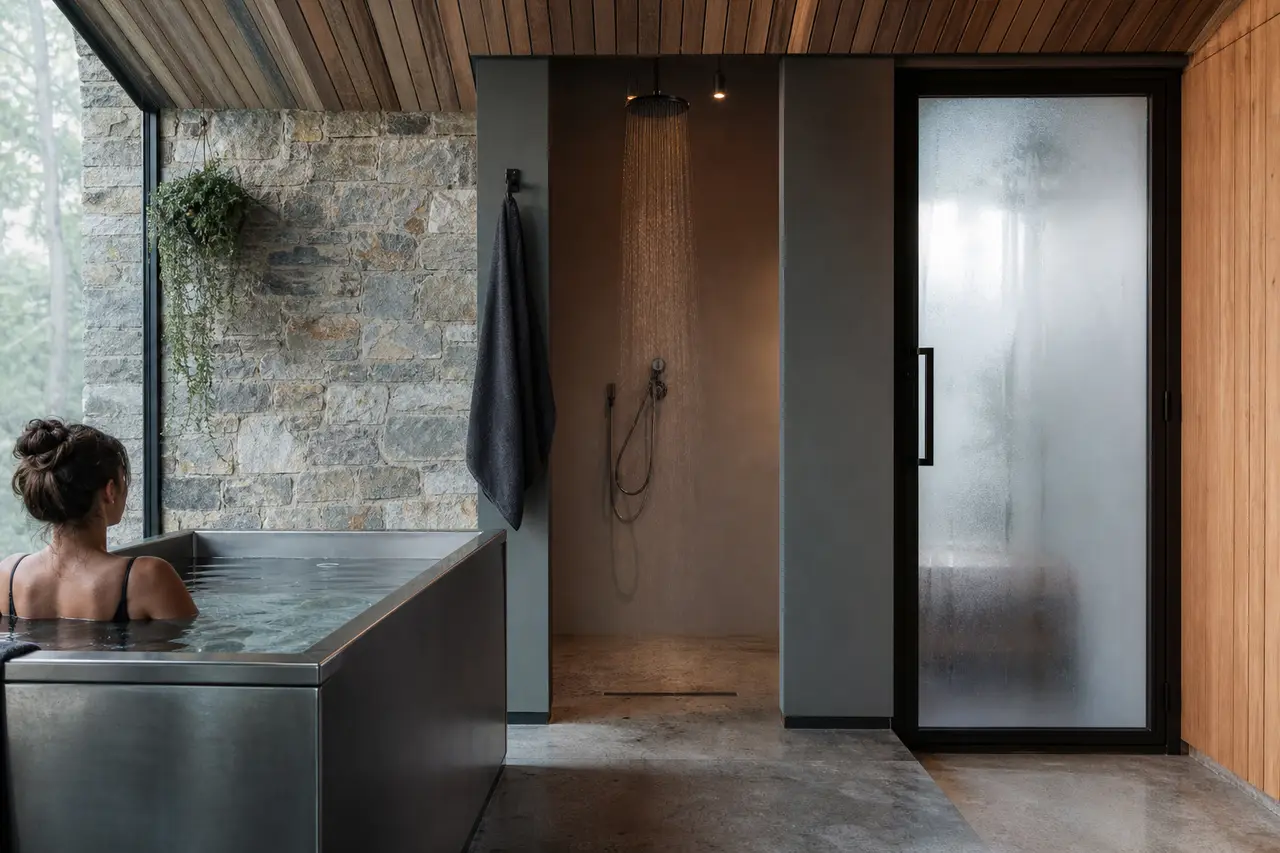
Short answer: Cold water beats cold air: water conducts heat away roughly 25 times faster, so a 5°C plunge is a stronger stimulus than a -110°C cryo chamber. Pick by how much control you want over the exit, not by the number on the wall. And keep cold away from the hours after resistance training.
Cold water beats cold air, because water conducts heat away roughly 25 times faster, so a 5°C plunge is a stronger stimulus than a -110°C cryo chamber. Pick your format by how much control you want over the exit and whether you are training for strength that week, not by the number on the wall. Cold exposure now comes in at least five formats, and studios present them as a ladder of intensity where colder equals stronger. The physics say otherwise.
What actually separates them is the medium, how long you are in it, and whether you can walk out whenever you like.
Here is how they compare, sorted by what you are trying to get.
The physics that makes the numbers misleading
Water conducts heat away roughly 25 times faster than air.
That single fact explains most of the confusion. A cryotherapy chamber at -110°C sounds vastly more extreme than a tub at 5°C, and the tub produces the stronger physiological response, because you are surrounded by a medium that strips heat fast.
It is also why a snow room at -10°C is comfortable for a minute or two while water at the same temperature would be genuinely dangerous.
Practically: if you want the big cold-shock response, you want immersion. If you want cooling without the gasp reflex, you want air. Our guides on what a snow room is and how to breathe during a cold plunge cover both sides of that.
The five cold formats at a glance
| Format | Real intensity | Cost | You control the exit |
|---|---|---|---|
| Cold shower | Moderate | Free | Completely |
| Kneipp water treading | Mild, partial | Free | Completely |
| Snow or ice room | Mild despite the number | Usually included | Walk out any time |
| Cold plunge tub | High | $30 to $60, or included | Yes, but the shock is real |
| Cryotherapy chamber | Moderate | $40 to $80, usually extra | Timed, attendant-operated |
| Natural open water | High and variable | Free | Depends entirely on the exit |
Sorted by what you actually want
Alertness now. Any of them; cold is reliably arousing. A cold shower is free and does most of it. Our comparison of cold plunge vs cold shower covers what immersion adds.
Soreness after endurance work. Immersion has the best evidence, and a plunge or a cold bath is the format studied. Our guide on which recovery tool for which problem ranks it against massage and compression, and massage wins.
Contrast, hot to cold and back. You want a venue with both, which means a bathhouse or a recovery lounge. A snow room is a legitimate and gentler cold half. Our guide on the right order for contrast therapy covers sequencing.
Getting started without the shock. Kneipp treading or a snow room. Neither triggers the gasp reflex, and both stop the moment you step out. Our guide on Kneipp therapy covers the bathtub version.
Nothing. If you are training for strength this week, see below.
The one situation where cold works against you
The hours after resistance training.
Routine cold immersion straight after lifting blunts the long-term muscle and strength adaptations you trained for. The inflammation being suppressed is part of the signal that drives the adaptation.
This is the clearest actionable finding in the whole cold literature, and it is the opposite of how recovery studios position the plunge next to the gym. Our guide on whether a cold plunge after your workout blunts gains covers the evidence.
It is a timing rule rather than a ban: use cold on rest days, after endurance work, or before a session rather than after. Heat does not carry the same problem, which makes a sauna the better post-lifting option.
What about the claims?
Thinner than the marketing, and the honest parts are still worth having.
Cold reliably produces alertness and a large catecholamine response, and reduces soreness. It does not reliably boost immunity, raise testosterone, or lower cortisol, all of which are commonly claimed. Our guides on what the cold plunge evidence shows, whether cold exposure raises testosterone, and whether sauna or cold lowers cortisol cover each.
The mood research is the most interesting open area, and it is genuinely unresolved rather than settled either way. Our guide on whether cold water helps depression and anxiety covers it.
If a venue’s pitch leans on immune boosting or cellular anything, our guide on spotting a nonsense wellness claim covers the tells.
Which is safest?
The ones you can leave instantly.
The genuine risk in cold exposure is the cold shock response on entry to water: an involuntary gasp and rapid breathing, which is dangerous if your face goes under and is a cardiac stress regardless. Air-based formats largely avoid it.
Cryotherapy is timed and attendant-operated, which removes your control over the exit. That is fine for most people and a real consideration if enclosed timed spaces are difficult. Our guides on cryotherapy and anxiety and claustrophobia in wellness spaces cover it.
Open water is the highest-risk option by a distance, because the exit, the depth and the current are all variables. Our guide on wild swimming covers doing it safely, and cold plunge safety covers who should avoid cold entirely.
What should you pay for?
Usually nothing, and then a plunge if you like it.
A cold shower costs nothing and delivers a reasonable share of the effect, which makes it the sensible place to find out whether you actually enjoy this. Plenty of people discover they do not.
If you want immersion regularly, a bathhouse day pass or a studio session is the cheap way to test before buying equipment. Our guides on where to find a cold plunge and home cold plunge and sauna costs cover both routes.
Cryotherapy is the one most often charged separately and the one whose per-session price is hardest to justify against a tub. Our comparison of cold plunge vs cryotherapy covers the trade-off.
FAQ: cold exposure
Is colder better? No. The research clusters around 10 to 15°C for immersion, and colder mostly buys discomfort. Our guide on how cold and for how long covers the dosing.
How long should I stay in? Short. Most protocols are 30 seconds to three minutes, and shivering afterwards means you overshot. Our guide on what to do after a cold plunge covers the afterdrop.
Can I do cold exposure every day? Yes for most people, with the lifting-day caveat. Frequency matters less here than it does for heat.
Is an ice bath at home the same as a studio plunge? Functionally yes if the temperature is the same. Our guide on starting a home cold plunge safely covers the method and the supervision point.
The bottom line on choosing a cold format
Water beats air by roughly 25 times for heat transfer, so a tub at 5°C is a far stronger stimulus than a chamber at -110°C. Choose immersion for the full response, air for cooling without the gasp reflex, and a free cold shower to find out whether you like any of it.
The one rule worth obeying: keep cold away from the hours after resistance training if strength is the goal. Everything else is preference.
If you want to try immersion at a studio rather than at home, our city guides to Washington DC, Dallas-Fort Worth, Los Angeles and Seattle list the venues we would send a friend to.